Theopolis Logo

Writing

Explore our collection of theological essays, biblical studies, and reflections on faith and culture.

See all
denise-jans-dpemksg59la-unsplash
Art

Glorifications Versus Debasement

Because of sin, the arts sometimes do not serve to glorify but to debase. Sinful men make their environments ugly, and create ugly art to “enhance” their ugly words. But since all men are still God’s images, no men are able to live with such ugliness all the time. Thus,…

by James B. JordanMay 25, 1994

jeremy-yap-j39x2xx_8cq-unsplash
Art

Words and Glory

Arts and literature reviews in most evangelical Christian publications generally approach their subjects in terms of ideology. We are told whether or not the film or book is acceptable in terms of morals, sexual graphicness, and theological accuracy. While there is definitely a place for such reviews, I fear that…

by James B. JordanMay 25, 1994

screen-shot-2018-04-12-at-9-48-08-am
Biblical Horizons

Broadening Our View of the Trinity

We speak of God as Father, Son, and Holy Spirit. The early Church tended to speak of Him as Father, Word, and Spirit. In this short essay, I want to suggest some other ways to think of the Trinity, ways that I have found pastorally helpful in my own life…

by James B. JordanMay 5, 1994
Biblical Studies

Thousands of Generations

I, Yahweh your God, am a jealous God, visiting the iniquity of the fathers on the children, on the third and fourth of those who hate Me, but showing lovingkindness to thousands, to those who love Me and guard My commandments (Ex. 20:5-6). The Second Word forbids acts of ceremonial…

by James B. JordanMay 5, 1994
ben-white-w8qqn1pmqh0-unsplash
Biblical Chronology

The Chronology of the Pentateuch (Part 3)

8. The Table of Nations If we assume births every two years, and about 30 years between generations (cp. Gen. 11:12-24), we can come up with an approximate series of dates for the generations recorded in Genesis 10. We shall assume that all three of Noah’s sons had their firstborn…

by James B. JordanMay 5, 1994
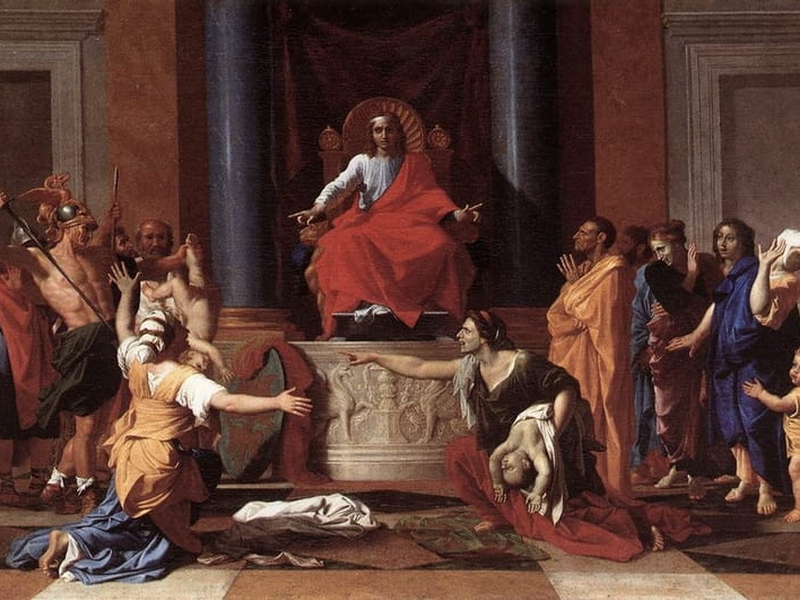
49980-nicolas_poussin_-_the_judgment_of_solomon_-_wga18330-800w-tn
Biblical Studies

The Eighth Month

Zechariah’s first prophecy (Zech. 1:1-6) was delivered in the eighth month of the second year of Darius. The notation of this date serves a number of purposes. Most obviously, it relates Zechariah’s prophecies to those of Haggai. By the time Zechariah delivered his first prophecy, Haggai had already chided the…

by Peter LeithartApril 23, 1994

Showing page 279 of 309

See all

Showing page 6 of 43

See all

Apolitical Liberalism

Judd Owen’s Religion and the Demise of Liberal Rationalism calls on liberals to pay attention to the foundational issues raised by liberalism’s antifoundational critics. Owen recognizes that liberalism does not propose a “neutral” theory of politics. While political regimes do not take sides in religious disputes, and thus exercise a…

February 6, 2018

Symphonic Love

Robert Jenson writes: “our enjoyment of God is that we are taken into the triune singing. Perhaps we may say we are allowed to double the parts. And here too we must insist on concreteness. That the proclamation and prayer of the church regularly bursts into beauty, indeed seems to…

February 6, 2018

Mill at an Impasse

John Gray ( Liberalisms ) argues that the “argument from ignorance” is at the heart of certain liberal theorizing, that it cannot hold up to scrutiny. Human knowledge is limited, and that puts constraints on political certainty. Besides, it is argued that human knowledge advances best when freedom is maximized.…

February 5, 2018
Economics

Un-Tragic Commons?

In his Out of the Wreckage , George Monbiot cites the famous 1968 article of Garrett Hardin on the "Tragedy of the Commons." In Monbiot's summary, Hardin argued that "common property will always be destroyed, because the gain that individuals make by over-exploiting it will outweigh the loss they suffer…

February 2, 2018
Work

God the Laborer

Heiner Ruschaupt writes: “In Greek society labor was viewed as an inescapable fate imposed by the gods. To be like the gods meant to live free from labor. In the world of the ancient Orient, labor was viewed as a burden, as slave labor for the gods, who therefore were…

February 2, 2018

Love Song

Markus Rathey ( Bach's Major Vocal Works ) argues that Bach's Christmas Oratorio is a love song. Several threads of argument support this conclusion. In composing the Oratorio , Bach recycled music from earlier compositions, including the quasi-operatic Lasst uns sorgen , which renders a myth about Hercules in musical…

February 2, 2018

Showing page 98 of 2212

Browse by Category

In Medias Res

Your weekly digest for all things Theopolis.

Donate

Theopolis is nearly 100% donor-supported. Consider joining us on our mission.