Theopolis Logo

Writing

Explore our collection of theological essays, biblical studies, and reflections on faith and culture.

See all
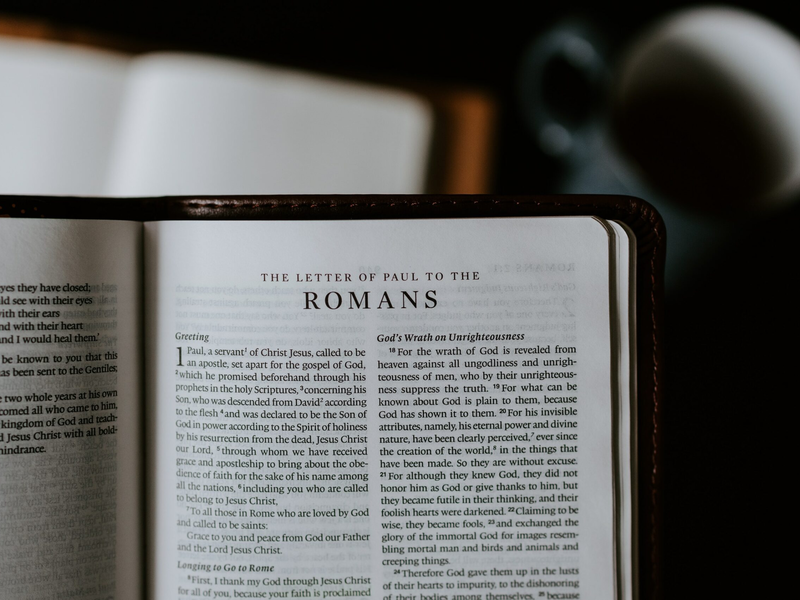
kelly-sikkema-gpoh17dxqdm-unsplash
Romans

A Pathway into Romans, Addendum

An addendum to the earlier post on Romans. In my first essay, I pointed out how the role of the sin of Joseph’s brothers in bringing about Joseph’s exaltation in Egypt, and the resulting salvation of the world from famine, might show us and explanation to some of the distinctive…

by Mark HorneMarch 7, 2013

kelly-sikkema-gpoh17dxqdm-unsplash
Romans

A Pathway into Romans

When Paul wrote to the Romans, he was obviously writing a missionary support letter of a sort. One can read Romans 1.15 and then jump into 15.23 (“[S]ince I no longer have any room. . . .) without losing virtually any coherence. Yet into this letter he “dropped,” as it…

by Mark HorneMarch 5, 2013
preston-goff-xncifslw0jw-unsplash
Biblical Studies

Mapping of Time

The Westminster Confession says that each passage has one meaning , not many, and that gets picked up on by lots of people who are suspicious of and do not like typological readings of Scripture. I will defer to wiser and more learned heads than mine as to exactly what…

by Richard BledsoeMarch 1, 2013
kiwihug-l4gw27xzn1i-unsplash
John

How Jesus Saved the World | (Part 2)

By arresting, torturing, and killing Jesus, the authorities thought that they were securing well being and peace again in their society by means of the tried and true method of a single-victim scapegoat. Everyone’s thirst for violence will be satisfied and we can get on with the business of everyday…

by Jeff MeyersFebruary 28, 2013
lea-v-z2ied5ktd-8-unsplash
Ecclesiology

A Vision of Social Harmony

This is the second in a series of essays on "Continuing the Reformation." In his important though sadly unavailable book, Calvin's Doctrine of the Church (Brill, 1970), Benjamin Charles Milner argues persuasively that in Calvin's view God's perfect order for His creation, an order that was to grow and develop…

by James B. JordanFebruary 25, 2013
markus-winkler-aid-xyrtlec-unsplash
Theopolis News

Jordan Lectures

Trinity House Fellow James Jordan recently gave a series of lectures in London on how to read the Bible. They are available online at NorthLondonChurch.org .

by Peter LeithartFebruary 24, 2013

Showing page 198 of 309

See all

Showing page 7 of 43

See all
Philosophy

Heidegger in his woods

Latour is tired of being accused of having forgotten Being, and offers this clever brush-off of Heidegger: “If, scorning empiricism, you opt out of the exact sciences, then the human sciences,, then traditional philosophy, then the sciences of language, and you hunker down in your forest - then you will…

November 15, 2006
History

Semi-modernism

Postmoderns, Latour suggests, think they are still modern, but in fact they have greatly oversimplified the modern Constitution. Postmoderns might emphasize the separation of subject and world, and stretch that opposition to a breaking point (Latour vividly describes them as doing the splits to keep subject and world apart); but…

November 15, 2006
History

Modern temporality

In his very good section on modern temporality, Latour argues that modernity assumes that everything in the present, modern moment, is purely modern, novel. Anything that appears that is not up-to-date is a “archaism,” and moderns worry constantly that this or that event or trend might “turn back the clock.”…

November 15, 2006
History

Representation

One of the key moves made since the 17th century, Latour argues, is a distinction between modes of “representation.” In the laboratory Boyle is representing things before selected witnesses through scientific experiments, giving mute nature a voice through the scientist, while in politics Hobbes suggests that the Sovereign speaks for…

November 15, 2006
History

We Have Never Been Modern

Bruno Latour’s We Have Never Been Modern (Harvard 1993) is a rich study. He describes modernity in terms of a dual process of “purification” and “hybridization.” Purification involves the clean construction of a nature (and science) separated off from society and the self, while hybridization involves mixtures of nature and…

November 15, 2006

Tears of things

And/Or: Virgil is aware that the furor of civil war can be curbed only by an opposing, and more intense, furor. That, as Milbank says, is the way of paganism - peace established only by superior violence against violence. But in those tears Virgil expresses the the painful recognition -…

November 13, 2006

Showing page 1763 of 2212

Browse by Category

In Medias Res

Your weekly digest for all things Theopolis.

Donate

Theopolis is nearly 100% donor-supported. Consider joining us on our mission.