Theopolis Logo

Writing

Explore our collection of theological essays, biblical studies, and reflections on faith and culture.

See all
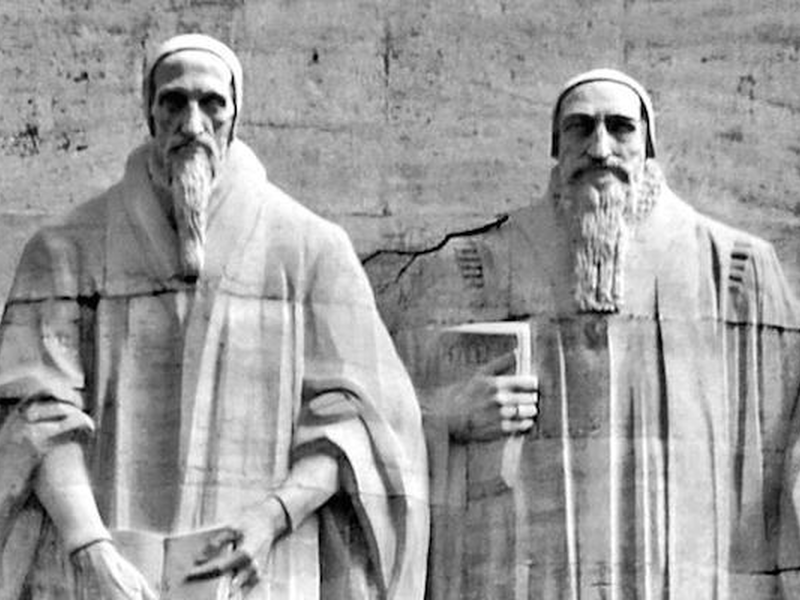
reformation-wall
History

How the Reformation Failed

The Reformers did not start out with a plan to found separated churches. Their goal was to reform the entire Latin church. In this they failed. The paradox is sharp, and we need to feel its point and its edge if we Protestants are to reckon honestly with our history…

by Peter LeithartApril 18, 2017

img_7521
Federal Vision

What is Conversion?

Conversion is a turning from sin to Christ. Now, let's think about that. Does conversion happen only once in a lifetime, or does it happen many times? That is the question, I believe, that needs answering. From my experience, and from my understanding of the Bible and of Christianity, there…

by James B. JordanApril 13, 2017
sky-from-bridge
Biblical Studies

Priests to the Nations

Israel was supposed to be a priest to the nations (Ex. 19:6). Her water would cause their trees to grow. This was signified to all men when Israel came out of Egypt, for "then they came to Elim, where they were twelve springs of water and seventy date palms, and…

by James B. JordanApril 11, 2017
holodomor
Ukraine

Borderland

Rousing Soviet songs surround us as we pass through a gloomy gauntlet of titanic statues on our way to Kyiv’s Museum of the Great Patriotic War. My friends, a Polish and a Ukrainian pastor, remember the songs, which played incessantly on the radio during their childhood. The sculpture complex depicts…

by Peter LeithartApril 6, 2017
img_0166
Eucharist

Worship and Ceremony, Part II: The Lord's Supper

This is the second installment of a two-part article. Click HERE to read Part I. The fourth perspective on ceremony is that of the action of the Lord's Supper. As we noted before, the inauguration of the Lord's Supper preceded its interpretation. Jesus did not at that point give an…

by James B. JordanApril 4, 2017
e99a9380
Course Recap

Architecture Course Recap

The best courses are those that make you see the Bible, the church, or the world differently. The recent Theopolis Architecture Course with Daniel Lee did exactly that. Architect Daniel Lee began the week with architectural theory, continued through the week taking students through a history of architectural practice, and…

by Brian MoatsMarch 31, 2017

Showing page 114 of 309

See all

Showing page 7 of 43

See all
Philosophy

Hermeneutics v. Semiology

According to Michel Foucault, what Marx, Nietzsche, and Freud introduce is an age of interpretation. He develops one of the implications of this by suggesting there is a “fierce war” between semiology and hermeneutics, between treating words as signs and treating them as interpretations. Nietzsche in particular, Foucault claims, develops…

August 26, 2006
Literature

Shakespeare and Bible

Steven Marx’s Shakespeare and the Bible (Oxford, 2000), purports to be the “first book to explore the pattern and significance” of Shakespeare’s biblical allusions. Perhaps. The results are mixed. Each chapter of Marx’s book attempts to show structural, plot, and thematic parallels between a section of Scripture and a play…

August 26, 2006
Literature

Ubiquitous Shakespeare

Exploring Lake Superior in 1840, one Charles W Penny wrote, “We read the Bible I dare say much more than we would have done had we been in Detroit. Shakespeare was duly honoured, as he is every day when we travel. When on the water, some one of the party…

August 26, 2006

Divine Love

The Persons of the Trinity live out an eternal round of self-sacrificing love. If a proof text is needed, John 15 supplies it. 1) Jesus says, “as the Father loved Me, I have also loved you” (v. 9). Jesus’ love for the disciples is modeled on the Father’s for Him.…

August 26, 2006

Queen of the Sciences

John Stuart Mill declared at the beginning of his book on logic that “Logic is the common judge and arbiter of all particulars investigations. It does not undertake to find evidence, but to determine whether it has been found. Logic neither observes, nor invents, nor discovers; it judges.”

August 24, 2006
History

New

Hans Jonas writes in an essay on technological and scientific advance that one of the key cultural shifts in the sixteenth and seventeenth centuries was a, well, new understanding of “new,” and a corresponding revision of traditional ways of thinking about history: “A sign of this spreading mood is the…

August 24, 2006

Showing page 1804 of 2212

Browse by Category

In Medias Res

Your weekly digest for all things Theopolis.

Donate

Theopolis is nearly 100% donor-supported. Consider joining us on our mission.