Theopolis Logo

Writing

Explore our collection of theological essays, biblical studies, and reflections on faith and culture.

See all
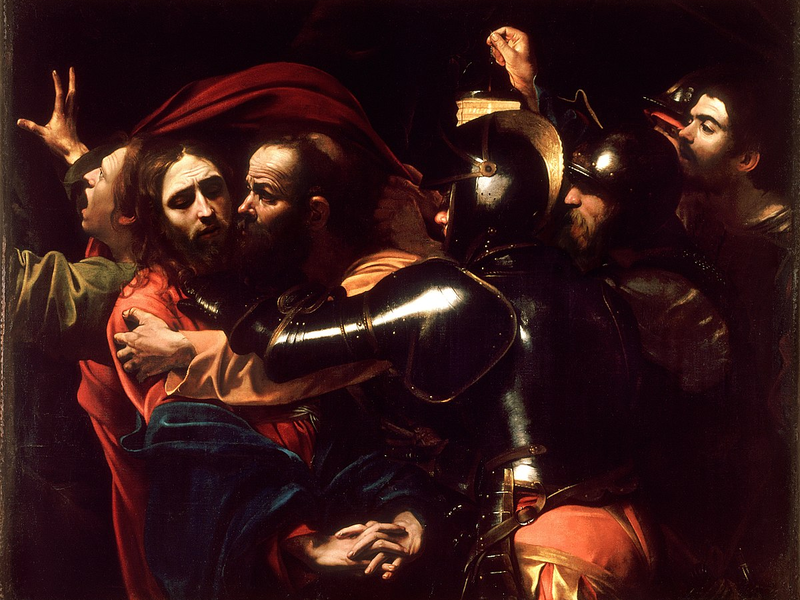
1200px-the_taking_of_christ-caravaggio_c-1602
John

Jesus, David, Adam: A Reading of John 18:1-11

John 18:1-11 appears on the surface to be a straightforward, if somewhat unusual, narrative of Jesus’ arrest by officers of the chief priests and Pharisees accompanied by an apparently large group of Roman soldiers, all of them led by the betrayer, Judas. But there is much more here than what…

by Ralph Allan SmithJuly 3, 2013

taylor-brandon-y8r0rtnriwm-unsplash
American Politics

Not So Special

Why is the US embroiled in the Middle East? There are two primary answers: Oil and Israel. Both are fairly intractable problems, the latter in significant part because of the unique convergence of theology and politics that has forged American policy in the region. Dispensationalists insist that we must bless…

by Peter LeithartJuly 1, 2013
screenshot-2023-09-20-at-11-21-06-am
Hermeneutics

Raven of the Gospel

There’s a common theme that arises in the study of theologians James B. Jordan and Peter Leithart. It is this: Context matters. Details matter. This is God’s Word. The details are not arbitrary “filler” hiding the kernel of truth in the husk of the text. The husk and the kernel…

by Troy GreeneJune 26, 2013
zoriana-stakhniv-puvghybgzn8-unsplash
Anxiety

Marriage and Betrayal

Perhaps the most fearful of all possibilities in the world is the possibility of betrayal on the part of someone who is in a “position of trust.” This, unfortunately, is the first block in what ought to be the foundation of every marriage in the world. Every woman has a…

by Richard BledsoeJune 24, 2013
markus-winkler-aid-xyrtlec-unsplash
Theopolis News

One More Week

Only one more week to register to the Trinity Term class on "How to Read the Bible," taught by James Jordan and Peter Leithart. Sign up today!

by Peter LeithartJune 24, 2013
korney-violin-b6ihcrsxnke-unsplash
Homosexuality

Reorienting our Sex Talk

The way we talk about the world matters. Our doctrine of creation tells us that words do not simply reflect reality. They also shape it and the way we inhabit it. Among the world’s many language groups, the Church is distinct. She is called to name things with Scriptural language,…

by Matthew MasonJune 19, 2013

Showing page 192 of 309

See all

Showing page 7 of 43

See all

Covenant lawsuit

John’s gospel is a contentious courtroom of a gospel. Legal language dominates the whole gospel - witnesses are called, Jesus promises an advocate, the Jews are constantly trying to put Jesus in the dock. But the whole gospel is really the trial of the Jews, just as what appears to…

February 28, 2006

Hidden Hero

Homer’s prologue to the Odyssey delays the identification of the hero until the end of the prologue, a literary sign that this hero comes hidden, disguised, in craft. That, of course, is precisely how Odysseus behaves throughout the epic. John’s gospel begins with similar techniques. We learn about the Word…

February 28, 2006
Literature

Coriolanus and Christ

Shakespeare’s Coriolanus can be read as dramatizing the Augustinian perspective most recently articulated by Oliver O’Donovan, namely, that “within every political society there occurs, implicitly, an act of worship of divine rule.” Through his dramatization of Roman society, Shakespeare points to another act of worship that constitutes a different sort…

February 28, 2006
Philosophy

J. L. Austin, Deconstructionist?

JL Austin famously distinguished between “performative” and “constative” utterances, the former of which perform the action to which they refer and the latter of which make assertions that can be judged as true or false. Modern philosophy has treated the constative as the norm, and performatives, if considered at all,…

February 28, 2006
Philosophy

structuralism, linguistic and other

How did the linguistic theory of Saussure become a model for anthropologists, sociologists, and analysts of pop culture? Jonathan Culler suggests that this move rests on “two fundamental insights: first, that social and cultural phenomena are not simply material objects or events but objects or events iwth meaning, and hence…

February 27, 2006
Philosophy

Anthropologized science

Foucault, in Canguilhem’s summary, argues that an anthropologization of the sciences took place in the late eighteenth and early nineteenth century, when Kantian philosophy combined with biology, economics, and linguistics to raise the question What is Man? Foucault argues: “From the moment when life, work, and language ceased to be…

February 27, 2006

Showing page 1874 of 2212

Browse by Category

In Medias Res

Your weekly digest for all things Theopolis.

Donate

Theopolis is nearly 100% donor-supported. Consider joining us on our mission.