Theopolis Logo

Writing

Explore our collection of theological essays, biblical studies, and reflections on faith and culture.

See all
preston-goff-xncifslw0jw-unsplash
Biblical Theology

The Old Testament Precursor to the Pastor

WHAT IS THE OT PRECURSOR OF THE NT OFFICE OF PASTOR? HOW DOES THE FORMER ILLUMINATE THE LATTER? The first problem to address is: how do we know that there is an office of pastor in the New Testament? 1 Perhaps the way the question is put may permit me…

by Mark HorneJune 5, 1999

nasa-vhsz50aafas-unsplash
Biblical Horizons

The Geocentricity Question

[This essay was originally published in December, 1981, in The Biblical Educator , a publication of the Institute for Christian Economics, and again with slight revisions in Contra Mundum 7 (Spring, 1993). It is reprinted here as a supplement to my book Creation in Six Days .] In 1979, Dr.…

by James B. JordanJune 4, 1999
screen-shot-2022-05-12-at-12-07-23-pm
Biblical Horizons

Call Me Ishmael, Part 2

Anyone seeking to reverse the meaning of this promise needs to come to grips not only with the phrase "God was with the lad" later on, but also with Hagar’s response in 16:13. She worships Yahweh, putting her trust in Him and obeying Him. In fact, Hagar is at the…

by James B. JordanJune 4, 1999
aaron-burden-h8s0pf2rcqs-unsplash
Biblical Horizons

Call Me Ishmael, Part 1

Ishmael is the narrator of Melville’s fantasy-romance Moby Dick. Melville takes up the traditional view of Ishmael as a wayward son of Abraham, driven out solely because of the Divine "caprice" of election, an angry man with his hand raised against all other men. He is a fitting "anti-hero," or…

by James B. JordanMay 4, 1999
aaron-burden-1ebsmyrau-s-unsplash
Isaiah

Five Cities and Isaiah 19

There were five cities at the center of the Canaanite culture in the circle of the Jordan, a place like the Garden of Eden, like the land of Egypt, before it became the Dead Sea at the destruction of the cities (Genesis 13:10). Genesis 14:2 tells us their names: Sodom,…

by James B. JordanApril 4, 1999
phillip-medhurst-abraham-and-lot
Biblical Horizons

Lot

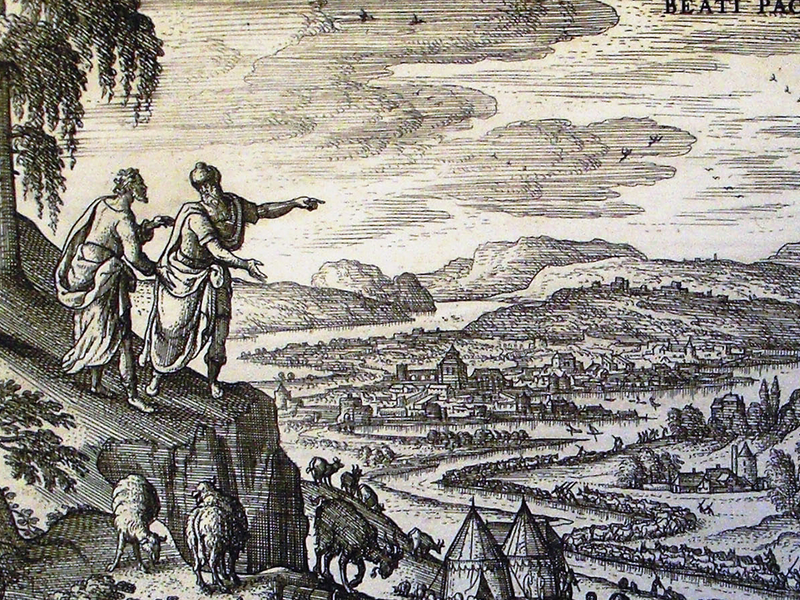
Meditations by James B. Jordan Genesis 19, the destruction of Sodom and the rescue of Lot, is part two of a story that begins in Genesis 18. These two chapters happen in one 24-hour period: noon and evening in Mamre, and midnight and daybreak in Sodom. God and two angels…

by James B. JordanApril 4, 1999

Showing page 244 of 309

See all

Showing page 7 of 43

See all

The argument of Romans

Mark Horne continues his studies in Romans at the Trinity House site.

June 17, 2013
American Religion

Founded on founding

Prior to the founding of America, argues Hannah Arendt in On Revolution , political orders were justified and legitimated by appeal to absolutes: “a divinity, not nature but nature’s God, not reason but a divinely informed reason” gave validity to political order and buttressed political power. Over time, the early…

June 16, 2013
Philosophy

Piety and Nihilism

Theory, Nietzsche argued, arises from the will to “correct existence.” Taking his cues from Nietzsche, Lyotard describes the difference between “pious” and “pagan” theorizing. The former is guilty of Nietzsche’s charge: Since Plato, Lyotard argues, philosophers have attempted to formulate a perfect theory of justice or freedom on the grounds…

June 16, 2013

New Frontiers

In their contribution to American Space/American Place: Geographies of the Contemporary United States , John Agnew and Joanne Sharp describe the context and import of Frederick Jackson Turner’s famed “Frontier Thesis.” Turner wrote in the context of the downturn of the 1890s, and his argument was partly about the future…

June 16, 2013
Economics

Papal economics

Michael Miller’s essay in Christian Theology and Market Economics focuses on “Business as a moral enterprise.” In part, he offers a summary of John Paul II’s teaching on economics and business, especially as expressed in the encyclical Centessimus Annus . As one might expect, John Paul puts business into the…

June 13, 2013

Productive Money

In his contribution to Christian Theology and Market Economics , Stephen Grabill reviews the “pre-Enlightenment” history of economic theory. That is to say, scholastic economics. For many economic historians, the notion of a scholastic economic theory is fallacious, and Exhibit #1 is always the scholastic prohibition of usury, grounded in…

June 13, 2013

Showing page 719 of 2212

Browse by Category

In Medias Res

Your weekly digest for all things Theopolis.

Donate

Theopolis is nearly 100% donor-supported. Consider joining us on our mission.