Theopolis Logo

Writing

Explore our collection of theological essays, biblical studies, and reflections on faith and culture.

See all
dan-meyers-0agtpoaarte-unsplash
Matthew

Fertile Toledots

The Book of Genesis contains eleven distinct markers readily acknowledged as the toledot formula. 1 Commentator Nahum Sarna counts the ’elleh toledot to be “…one of the distinguishing characteristics of the Book of Genesis”. 2 Among translations, the noun is variously translated as “generations” (ESV, KJV), “records of the generations”…

by Ben LoveladyDecember 20, 2022

49980-nicolas_poussin_-_the_judgment_of_solomon_-_wga18330-800w-tn
Romans

Who was Judah's Wickedest King? (Kings & Romans 1:18ff)

The answer that immediately comes to mind to the question in the title is Manasseh, the son of Hezekiah. He was conceived during the extension of life that God granted Hezekiah in response to his ardent prayer on his sick bed (2 Kings 20:1-11, 21:1). His reign is summarized in…

by Mark HorneDecember 13, 2022
carlos-macias-pu0rodvqjl4-unsplash
Ecclesiology

The End of Premium Mediocre Church

Back in 2019, on a whim, I sketched out a setting for a modern fantasy story: a single coffee shop that is simultaneously present in multiple cities throughout the world: “...you know the one. Books by local authors, brochures for a walking tour of the city’s outdoor sculpture, a poetry…

by Tim NicholsDecember 6, 2022
screen-shot-2022-11-29-at-2-01-18-pm
Colossians

Colossians 4:2, “Watch"

Peter O’Brien’s translation of Colossians 4:2 surprised me: “Persevere in prayer as you watch for the Lord’s return, and be thankful.” 1 What is surprising about that? Well, none of my English translations mentioned “the Lord’s return” — nor does the Greek text! Translated literally, the verse just says: “In…

by Ralph Allan SmithNovember 29, 2022
cicero-denounces-catiline-painting-roman-cesare-maccari-1888
Books

The Laws and the Cosmos: A Brief Response to Stephen Wolfe on Cicero

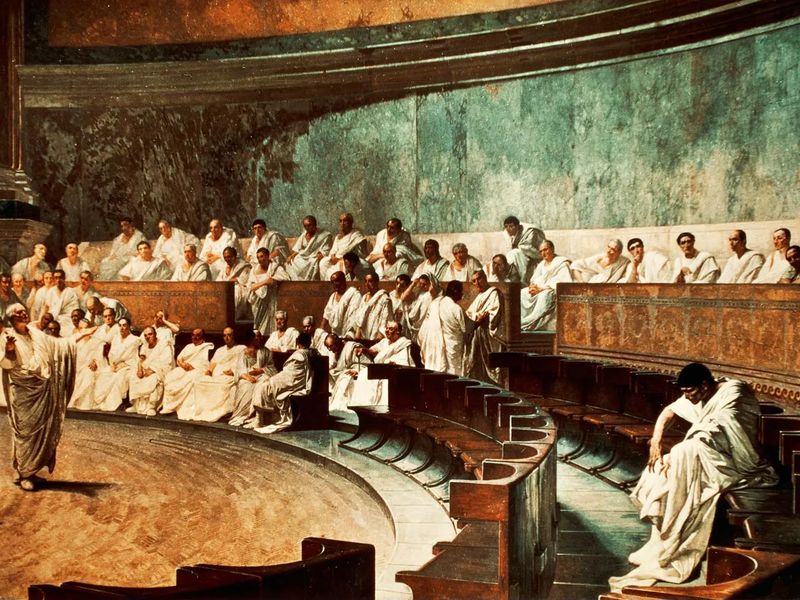
I Natural Law This is a brief (well, briefer than it could be) first attempt at responding to a very small section of Stephen Wolfe’s recent book The Case for Christian Nationalism . It’s partial, deeply incomplete, and does not at all address the book as a whole; it is…

by Susannah Black RobertsNovember 24, 2022
giammarco-zeh-ljawhtg-unsplash
Formation

A Bad Man Speaking Well

The scuttlebutt of the last hundred years would tell us that Albert Einstein was a horrible husband, Winston Churchill was a racist, Mother Theresa was a hypocrite, and Caravaggio a murderer. From Benjamin Britten’s boys to Gandhi’s girls, it can be depressing and confusing to hear about people of great…

by Garrett SoucyNovember 22, 2022

Showing page 37 of 309

See all

Showing page 8 of 43

See all
History

Revolutionary timing

Are we living in a time of world-revolutionary change? Impossible to say, of course, but there might be some hints contained in the developments of the last millennium. Rosenstock-Huessy notes that Western man has been formed by periodic world-historical revolutions since the 11th century: Gregorian (11th), the Reformation (16th), Puritan…

December 29, 2006
History

One world

William Cavanaugh suggests that globalization represents a false catholicity, a unification of the human race organized around consumption and Hollywood blockbusters. That’s certainly one legitimate angle. On the other hand: The wealth of the wicked is stored up for the righteous, and Cain and Nimrod built cities long before David…

December 29, 2006
History

Fallen Soldiers

George L. Mosse’s Fallen Soldiers (Oxford 1990) is a fascinating study of the “Myth of War Experience” that developed between the French Revolution and came to a climax in World War I and its aftermath. Mosse develops a number of intertwined themes: the rise of volunteer armies after the French…

December 29, 2006

Childbirth

Rosenstock-Huessy notes the difference between animal birth and human childbirth, the main difference being that human parents remain with children after the birth: “marriage means to go from the blind act of the moment, through the whole life cycle to its most opposite point the childbirth,” and this shows “that…

December 29, 2006
History

Naming and nationalism

With nationalism at its height in the nineteenth century, the common practice of giving children biblical names was a check on nationalist idolatry, a reminder that the child was part of Christendom, not merely of France, Germany, England, etc. Rosenstock-Huessy puts the point dramatically: “When biblical names disappeared in Europe…

December 29, 2006
Science

Scientific law

In their Science & Grace (Crossway 2006), Tim Morris and Don Petcher helpfully define a law of nature as “God’s sustaining of, or man’s description of, that pattern of regularity that we observe in nature as God works out His purposes towards His own ends in HIs covenant faithfulness, through…

December 28, 2006

Showing page 1746 of 2212

Browse by Category

In Medias Res

Your weekly digest for all things Theopolis.

Donate

Theopolis is nearly 100% donor-supported. Consider joining us on our mission.