Theopolis Logo

Writing

Explore our collection of theological essays, biblical studies, and reflections on faith and culture.

See all
25f3baab-e5a9-42ec-aab6-649e53879085-3
John

Israel Redux: The Image of Christ in the Gospel According to John (Part IV)

John 18, 19: Latter Prophets and the Writings John 18 and 19 record the arrest, trial, torture, and death of Jesus as laid out in detail in Isaiah 53. After the Roman soldier pierces Jesus’ side, John quotes Zechariah: “They shall look at him whom they pierced” (Zech 12:10). In…

by Geert HeetebrijDecember 6, 2018

25f3baab-e5a9-42ec-aab6-649e53879085-3
John

Israel Redux: The Image of Christ in the Gospel According to John (Part III)

John 12.12 – John 17: Latter Prophets In the Hebrew Scriptures, Kings is followed by the Latter Prophets. John 12:15 quotes Zechariah 9:9 as having prophesied Jesus’ triumphal entry: “Do not be afraid, O Daughter of Zion; see, your king is coming, seated on a donkey’s colt.” [1] N.T. Wright…

by Geert HeetebrijDecember 5, 2018
25f3baab-e5a9-42ec-aab6-649e53879085-3
John

Israel Redux: The Image of Christ in the Gospel According to John (Part II)

John 6.16-70: Joshua The book of Joshua documents the nation of Israel entering the Promised Land. Consider the order of events: (1) Israel is still receiving the daily miracle of manna; (2) Israel miraculously crosses the Jordan on dry foot; (3) The day after Passover , Israel eats produce of…

by Geert HeetebrijNovember 29, 2018
25f3baab-e5a9-42ec-aab6-649e53879085-3
John

Israel Redux: The Image of Christ in the Gospel According to John (Part I)

Since my educational and professional training have revolved around story and narrative structure, I approach John’s Gospel from a literary and narrative perspective. In doing so, I have noticed structural story patterns and followed them where they seem to lead: the Gospel of John parallels the ordering of the books…

by Geert HeetebrijNovember 27, 2018
white-hall-hospital
Art

The Clouds of Mt. Sinai

The Mt. Sinai Hospital was neolithic on the black hill of Hollow, New Hampshire. Winter dampened the trees and the wind bit at the sparse branches, the sidewalks and stairs were perilous with soggy leaves, and the dim yellow light cast a pallor upon the milky stone building. Ambling inside…

by Remy WilkinsNovember 22, 2018
sodom-and-gomorrah-58ecfa883df78c5162cb92b5
Revelation

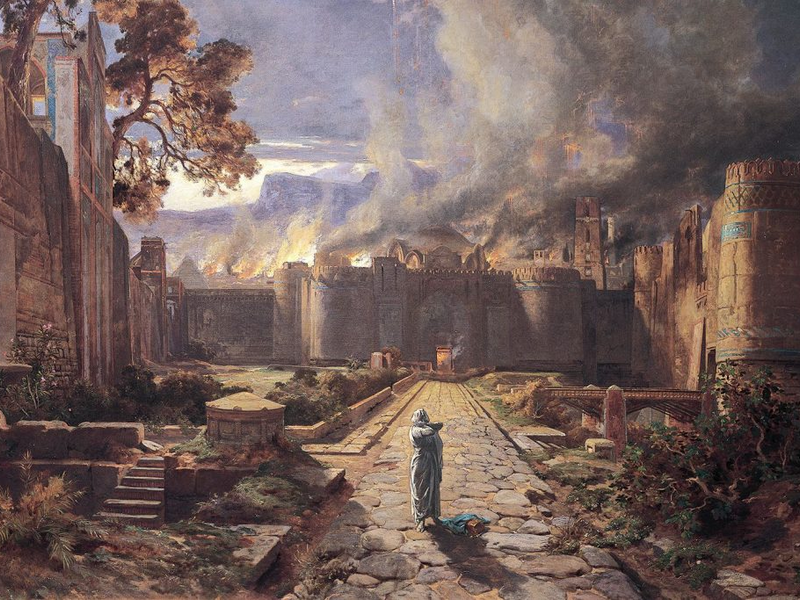
Egypt and Sodom, Where the Lord was Crucified

The Revelation can only be understood in the light of Old Testament symbols and sequences. The same is true of the epistle of Jude, which serves as a blistering hors d’oeuvre to John’s fiery feast. Possibly written by the apostle Judas Thaddaeus (Luke 6:16; Acts 1:13; John 14:22), the epistle…

by Mike BullNovember 20, 2018

Showing page 84 of 309

See all

Showing page 8 of 43

See all

Architecture of Fancy

T he title essay of John Summerson's Heavenly Mansions sets Gothic architecture in a story of the architecture of fancy. He begins with doll houses, and moves to aedicules, originally small buildings holding the image of a god that eventually became purely decorative alcoves. In Gothic, the ornament is turned…

February 17, 2017

Slow Grow

I n his Rise and Fall of American Growth , Robert J. Gordon argues that the growth rates for the American economy have leveled because the rate of innovation has leveled. And the rate of innovation has leveled, in part, because some innovations happen only once: The flood of inventions…

February 17, 2017

Anthropology of Deficiency

A ccording to Ingolf Dalferth ( Creatures of Possibility ), Christianity “contradicts a view that understands human beings in their fundamental dependence, finitude, and passivity, not merely biologically, but anthropologically, as deficient beings , interpreting their absolute dependence as absolute neediness, their finitude as a metaphysical evil, and their experience…

February 17, 2017

Passive Creativity

C hristian theology has long taught that we are “finite copies of the infinite Creator: created creators” (Dalferth, Creatures of Possibility , 198). Christian anthropology is eschatologically oriented: “Who we are is not determined by our origin; it will become evident in our future” (198). This comes to expression in…

February 17, 2017

Slackers

I t’s a challenge to get a clear idea of what slackers are really all about. Tom Lutz isolates the dilemma in his Doing Nothing (18-19): The famous or almost-famous idlers, loafers, loungers, and slackers throughout history had to produce work about not working in order for us to know…

February 17, 2017

Living Sacrifices

J oseph Ratzinger reflects on Romans 12:1-2 in his Theology of the Liturgy (349-51), which is evident in the Roman Canon's prayer that “our sacrifice may be rationabilis .” He writes: It is not enough—indeed, it is quite wrong—to translate this as saying that it should become rational. We are…

February 17, 2017

Showing page 205 of 2212

Browse by Category

In Medias Res

Your weekly digest for all things Theopolis.

Donate

Theopolis is nearly 100% donor-supported. Consider joining us on our mission.