Theopolis Logo

Writing

Explore our collection of theological essays, biblical studies, and reflections on faith and culture.

See all
screen-shot-2022-08-04-at-9-36-57-am
Matthew

Paul Doesn't Care About Universal Individual Sinfulness or General Revelation

One reason readers assume Paul is trying to prove that all human beings are sinful is that they understand him to be arguing that no one can keep the law. That means, they think, his opponents must believe that human nature is potentially sinless. Taking Paul’s statement that, if you…

by Mark HorneJune 17, 2013

karsten-wurth-imegmbunara-unsplash
Mission

Dreams and Visions

[Note: This post was written prior to our name changing to Theopolis Institute.] What is Trinity House for? Three things: We aim to advance the reformation of the church and, through the church, to promote the renewal of culture; in furthering reformation, we aspire to be a site of fraternal,…

by Peter LeithartJune 12, 2013
sixteen-miles-out-al48tflf4e8-unsplash
Deuteronomy

Sons to Yahweh your God!

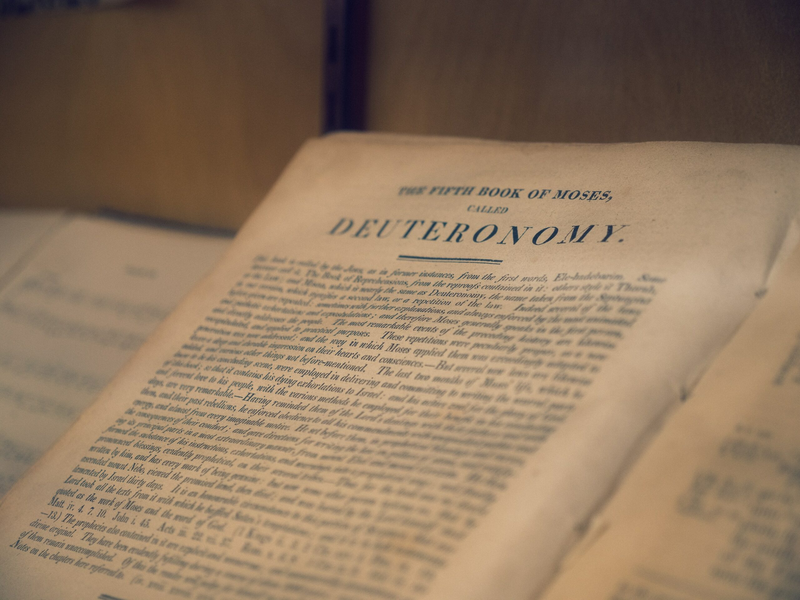
This is the third in a series of studies of the Third Word, and especially of Deuteronomy 14. In 1979 Stephen Kaufman penned a groundbreaking essay on Deuteronomy, arguing that it was a meticulously structured and carefully composed book. In his view, chapters 12 to 26 in particular follow the…

by Ralph Allan SmithJune 10, 2013
kelly-sikkema-gpoh17dxqdm-unsplash
Romans

How is Wrath Revealed?

A large mistake is made in understanding Romans if one assumes that Paul is concerned with proving the fact that no one can ever live without sin—or that all attempts at obeying God’s commands are at least tainted with human sinfulness. The first problem with such an assumption is that…

by Mark HorneJune 5, 2013
chris-bair-ndczc5739ck-unsplash
Deuteronomy

The Third Word

This is the second in a series of studies on the Third Word, and especially on the food laws of Deuteronomy 14. In the second part of this series, I argue that Moses’ reworking of the Ten Words in Deuteronomy 5 includes adding nuance to the Third Word. This prepares…

by Ralph Allan SmithJune 3, 2013
yannis-papanastasopoulos-if_29sed7ta-unsplash
Culture

Turning Babel into a Beast

Recent months have brought a lively discussion of Christian participation in the culture war. On the one hand, the pro-life movement appears to be making some slow progress on the abortion issue. The trial of abortionist and serial murderer Kermit Gosnell has the potential to awaken those who are nominally…

by Joe RigneyMay 29, 2013

Showing page 193 of 309

See all

Showing page 8 of 43

See all

Monster to Music

In Rune 40 of the Finnish epic, Kalevala , the hero, Wainamoinen, is sailing with his friends to Pohjola, where he intends to recover the Sampo, a talisman of good luck and extraordinary, mysterious power. No one today quite knows what the Sampo was, but many of the episodes of…

April 28, 2015

Chaucer and the Greeks

Chaucer, like Shakespeare after him, set some of his poems in ancient Greece. The “Knight's Tale” takes place in Athens, ruled by the same “Duke” Theseus who rules Athens in Midsummer Nights Dream . Troilus and Cresyde is a Trojan love tragedy. Neither of these works, however, shows much deep…

April 28, 2015

Greece in the English Renaissance

According to C. S. Lewis ( English Literature in the Sixteenth Century , 27-28), English humanists were most interested in style, but the style was mostly Latin: “Greek was given abundance of ‘mouth honor,’ but only the minor Greek authors (Plutarch, Heliodrous, Chilles Tatius, the Anthology) were really relished. Greek…

April 28, 2015

Make Love and War: The Knight's Tale

Emily, the lady-love of Chaucer's “Knight's Tale,” the first of the Canterbury Tales, appears in a garden, and the poet describes her as if where were part of the garden. She is Eve in Eden. But this is no Edenic world. The men who see her are locked out of…

April 28, 2015

Universal Tragedy

Tragic stories are fall stories. Whether through moral wrong or through some inadvertent hamartia , the tragic hero falls from a high place. Others are engulfed in the tragedy to one extent or another, but not everyone. Those who watch can experience the catharsis of pity and fear by watching…

April 28, 2015

Invention of Allegory

C S. Lewis describes the formation of medieval allegorism in his classic Allegory of Love . He begins by distinguishing between an allegorical and a sacramental or symbolic turn of mind. Allegory begins, he says, with “an immaterial fact, such as the passions which you actually experience” and finds ways…

April 27, 2015

Showing page 434 of 2212

Browse by Category

In Medias Res

Your weekly digest for all things Theopolis.

Donate

Theopolis is nearly 100% donor-supported. Consider joining us on our mission.