Theopolis Logo

Writing

Explore our collection of theological essays, biblical studies, and reflections on faith and culture.

See all
johann-siemens-epy0gbjzzzu-unsplash
Apologetics

A Sabbath Conversation: How Old is the Earth?

As Adam and Eve walked to the center of the Garden of Eden to meet with the LORD on their first Sabbath they conversed about the origin and age of the earth. Adam: You know, honey, we spent a lot of time yesterday making preparations for our house, and we…

by Jeff MeyersOctober 3, 1997

img_1043
Biblical Horizons

Psalms for Exile: The Narrative Progression in the Fifth Book of the Psalter

Some of our forefathers believed in reading/singing the psalms in order. Today, when the psalms are even used at all, they tend to be used randomly, though sometimes tied to a church calendar or to the pastor’s sermon. The Bible does not bind us to any particular practice, but there…

by James B. JordanSeptember 4, 1997
jordan-wozniak-xp_agmeea6s-unsplash-2
Biblical Chronology

The Anthropomorphic Days of C. John Collins, Part 2

Dr. Collins begins his essay with a brief statement of the Day Age view and then a brief statement of the Six Day view, focussing on the challenge to that view posed by modern "science." He ends this discussion by writing: "Two crucial points are at stake here: first, the…

by James B. JordanSeptember 4, 1997
john-salzarulo-wtjrpjzabcq-unsplash
Biblical Horizons

Paperweights and the Puzzles of Secularism

In his The Construction of Social Reality , Berkeley philosopher John Searle puzzles over the ontology of the products of human construction. Certain things – granite, platypi, weeping willows – occur naturally; while other realities – stone walls, zoos and parks, Chase Manhattan Bank – exist only as products of…

by Peter LeithartAugust 27, 1997
ales-krivec-4mibe6zg5r0-unsplash
Biblical Chronology

The Anthropomorphic Days of C. John Collins, Part 1

In the journal Presbyterion 20 (1994):109-130, published by Covenant Theological Seminary, Dr. C. John Collins sets forth a revision of the Day Age approach in his essay, "How Old Is the Earth? Anthropomorphic Days in Genesis 1:1–2:3." Dr. Collins’s essay has been widely accepted in evangelical Presbyterian circles as an…

by James B. JordanAugust 4, 1997
screenshot-2023-09-04-at-10-37-01-am
Biblical Horizons

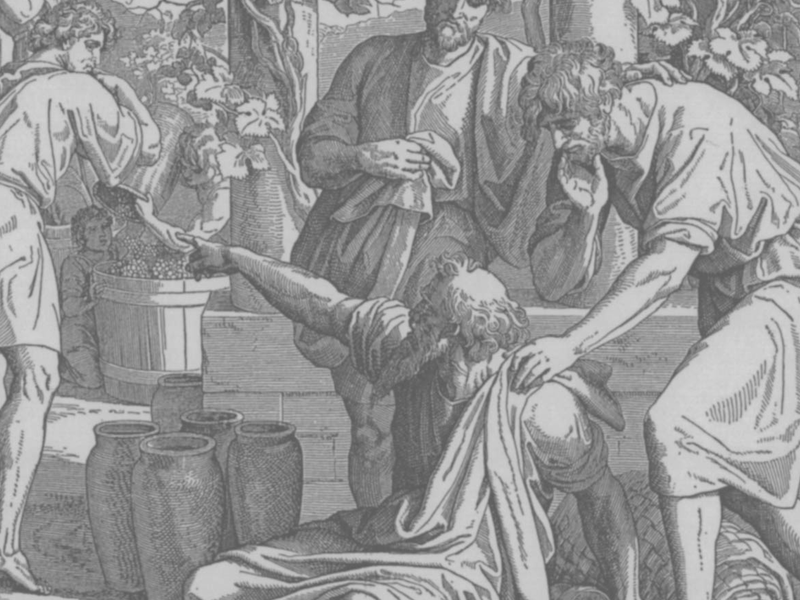
The Sin of Ham and the Curse of Canaan, Part 3 (An Exposition of Genesis 9:20-27)

The Righteousness of Shem and Japheth As noted above, the action of Shem and Japheth was purely symbolic. They did not need to cover Noah with a garment, for he was already covered by the tent. Their action was a symbolic affirmation of Noah’s authority, a symbolic rejection of Ham’s…

by James B. JordanAugust 4, 1997

Showing page 254 of 309

See all

Showing page 8 of 43

See all

The Body Assumed

The Servant comes, and the arm of the Lord is revealed (Isaiah 53:1). The Servant’s face and form are marred, stricken, pierced, crushed, chastened, scourged. It looks like the body that’s already there, the body of Israel: “Where will you be stricken again, as you continue in rebellion? The whole…

March 21, 2013

No form, no face

According to the NASB, Isaiah 53 says that the Servant has “no stately form ( to’ad ) or majesty ( hadar ) that we should look upon Him, nor appearance ( mar’eh ) that we should desire ( chamad ) Him” (v. 2). Two of those three terms appeared at…

March 21, 2013

Desolated

Yahweh’s Servant prospers (or “deals prudently”), and so is raised, lifted, exalted greatly (Isaiah 52:13). But that exaltation is paradoxical, surprising, since the Servant that is lifted up is mangled and marred more than any of the sons of Adam (v. 14). The word translated as “astonished” ( shamem )…

March 21, 2013
Biblical Studies

Judgment according to works

The New Testament says several times that there is a day of accounting coming when all will be judged according to their deeds (Matthew 16:27; Romans 2:6; 2 Corinthians 5:10). In Romans 2 especially, this is an individual accounting: God “will render to every man according to his deeds” (Paul…

March 21, 2013

Egoism and evil

Self-obsessed egoism is not, Zizek argues ( Violence: Six Sideways Reflections ), the essence of evil, and the “true opposite of egotist self-love is not altruism, a concern for the common good, but envy, ressentiment , which makes me act against my own interest.” The true evil is (citing Freud)…

March 20, 2013
Politics

No Higher Cause

We are often told that we live in a “post-political” era or an era of “bio-politics.” Slavoj Zizek ( Violence: Six Sideways Reflections , 40-2) defines the post-political as “a politics which claims to leave behind old ideological struggles and instead focus on expert management and administration” and “bio-politics” as…

March 20, 2013

Showing page 770 of 2212

Browse by Category

In Medias Res

Your weekly digest for all things Theopolis.

Donate

Theopolis is nearly 100% donor-supported. Consider joining us on our mission.