Theopolis Logo

Writing

Explore our collection of theological essays, biblical studies, and reflections on faith and culture.

See all
kristina-flour-bcjdbykwquw-unsplash
Culture

On Foul Language

The Stranger: Do you have to use so many cuss words? The Dude: What the f*ck you talking about? - The Big Lebowski There was a man I knew, an elder at his church, who, whenever he was called upon to announce a pregnancy, preferred the euphemism “with child” because…

by Remy WilkinsJanuary 12, 2016

organ-pipes
How to Worship

Pipes Worth Playing

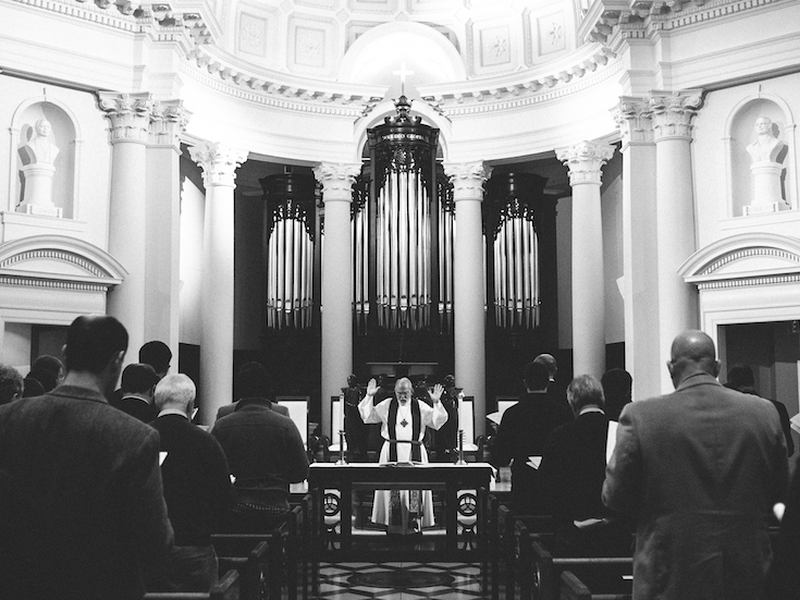
I know what you’re thinking. Organ: funeral, ball game, grand dusty cathedral. Why should modern Christians of such a technological age revisit a thousand year-old instrument? Don’t worry, I will not be trying to punch another hole in my Weird Music Preferences and Opinions card here. The truth is, our…

by Jarrod RicheyJanuary 7, 2016
tree-2
James

Do Things Have Natures?

Do things have natures? As I am posing the question, it is not simply a question of whether there are particular kinds of things in the world that have characteristic features, patterns of behavior, trajectories of growth and development. If that is what the word means, then the answer is…

by Peter LeithartJanuary 5, 2016
jim-leading-worship
Theopolis News

2016 Nevin Lectures with Father John Behr

We are excited to announce our 2016 Nevin Lectures featuring Father John Behr. Fr. John is the Dean of St. Vladimir's Seminary and Professor of Patristics, as well as the author of multiple works. He will be delivering three lectures over the course of two days dealing with "What Protestants…

by Brian MoatsJanuary 4, 2016
times-square
Creation

Time, Curse or Gift?

New Year's Day makes one reflective, at least about the past year, perhaps about life, perhaps, more broadly, about time itself. Many view time as a curse. Some see it as a curse because of missed chances. As one day or year moves on to the next, all we can…

by Peter LeithartDecember 31, 2015
nativity-2
Advent

The Manger

It seems a truism to say that we live in the world: that the world is outside of us. In reality the world is very much inside of us too. In fact the world passes through us as much as we pass through it. We breathe in its air, using…

by Arthur KayDecember 29, 2015

Showing page 138 of 309

See all

Showing page 8 of 43

See all

Chaucerian apocalypse

In their The Apocalyptic Imagination in Medieval Literature , Richard Emmerson and Ronald Herzman find apocalypse in unexpected places. Like Chaucer. For the medieval mind, any pilgrimage evoked the pilgrimage of the soul toward heaven, and The Canterbury Tales is no different: “For the individual pilgrims, the pilgrimage suggests the…

March 19, 2013
Uncategorized

Stephen’s Sermon in Luke-Acts

Someone recently referred me to Delbert L. Wiens’s Stephen’s Sermon and the Structure of Luke-Acts . It looks wonderful. He has a triple thesis: First, that Stephen’s speech is “a politike in the broadest sense, a sociological and political account of the levels and developmental stages of the Kingdom of…

March 19, 2013

It’s Coming

In his wonderful Jesus and the Victory of God , NT Wright compiles all the passages where Jesus warns of an impending catastrophe, within “this generation.” It’s a long list. Someone needs to do the same with the rest of the New Testament. (Andrew Perriman’s The Future of the People…

March 19, 2013

Prodigals and older brothers

Matthew doesn’t tell the parable of the Prodigal Son, but he might has well have. He records the parable of the laborers in the vineyard, which has the same structure and point. Some laborers work through the heat of the day, some come at the 11th hour and work only…

March 19, 2013

Cup-bearer

Jeremiah tells the exiles that they will be conquered by Yahweh’s “servant” Nebuchadnezzar and will be under Babylon for 70 years (Jeremiah 25:8-11). When the time’s up, Yahweh will punish Babylon and recompense them for their deeds (vv. 12-14). In preparation for this eventual judgment, Yahweh hands a cup to…

March 19, 2013
Literature

Gogol’s Sobornost

Nicolai Gogol’s mystical, exotic religious views didn’t quite fit any form of orthodox Christianity. Orthodoxy deeply marked him, especially Orthodoxy monasticism. After his first visit to the monastery at Optina, Gogol wrote that he “took a memory away with me that will never fade. Clearly, grace dwells in that place.…

March 18, 2013

Showing page 772 of 2212

Browse by Category

In Medias Res

Your weekly digest for all things Theopolis.

Donate

Theopolis is nearly 100% donor-supported. Consider joining us on our mission.