Theopolis Logo

Writing

Explore our collection of theological essays, biblical studies, and reflections on faith and culture.

See all
lightstock_568139_medium_christ_hold_fast
Biblical Theology

Feasting with Elisha

After Elijah’s battered and depressed howling in the wilderness it must have seemed like the new prophet came eating and drinking. Which is a pattern we see again in the New Testament—John is explicitly identified with Elijah (Luke 1.17, Matthew 11.14), howling the truth in the wilderness that the people…

by Tim SuffieldJuly 19, 2022

marjan-blan-marjanblan-dkjquypc4ps-unsplash
Colossians

Lie Not To One Another

Reading Robert Conquest’s biography of Stalin 1 has opened new lines of meditation on Paul’s command in Colossians 3:9. But before turning to that, let me briefly indicate what Paul is not saying. He is not saying that there is no such thing as righteous deception, such as Jael practiced…

by Ralph Allan SmithJuly 14, 2022
francesco-zxnkxnr32ng-unsplash
Amos

Book of the Lion

You won’t find wild lions today in Israel. But lions used to range much more widely than they do now, and in biblical times they were a menace that shepherds in Israel had to contend with. David did as a shepherd boy, and Amos—who “ was among the sheepbreeders of…

by Daniel HoffmanJuly 12, 2022
adam-and-eve-in-the-garden-of-eden-wenzel-peter
Ezekiel

An Uncool Day

I would like to remedy a flaw for English speakers in the book of Genesis. A flaw that may seem innocuous, but we must remember where the devil lives...in the details. If we are to fear the Lord, it behooves our translation committees to ensure that the fearfulness of God…

by Matthew CoreyJuly 7, 2022
frankie-lopez-mis5ib0ktbc-unsplash-2-2
Literature

You Become What You Behold

While reading at my son’s baseball game this week, a mom from our school approached me and asked if I was reading Dante. I wasn’t, but our sons are both reading Divine Comedy in their sophomore literature class, so it was a reasonable question. What unfolded was a quick conversation…

by Mandi GerthJuly 5, 2022
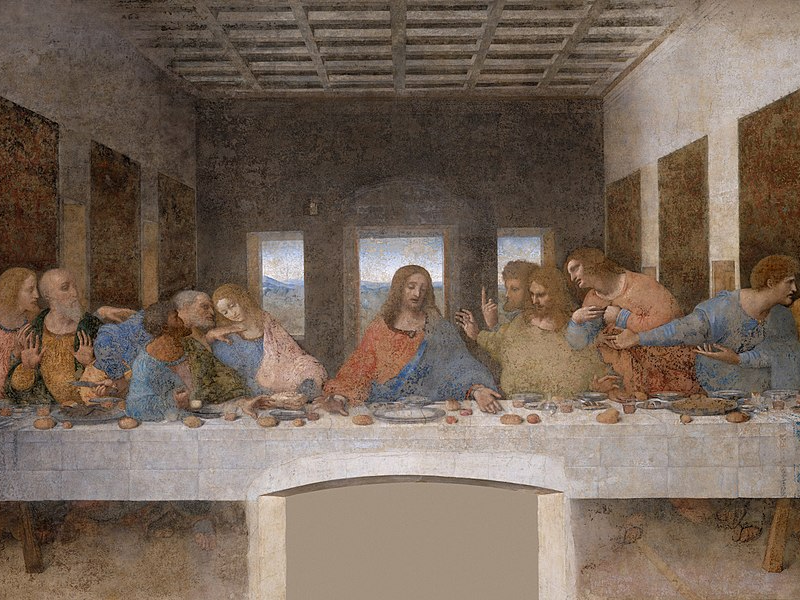
the_last_supper_-_leonardo_da_vinci_-_high_resolution_32x16
Deuteronomy

Torah as Testimony (Part 3)

In the first two essays in this series, I addressed the question of how the nations would learn about Israel’s Torah, in the second essay especially emphasizing the aesthetic aspects of Israel’s testimony. For we naturally wonder: How would people in Mesopotamia or Egypt, not to mention the rest of…

by Ralph Allan SmithJune 28, 2022

Showing page 42 of 309

See all

Showing page 9 of 43

See all

Times

Choon-Leong Seow has some helpful comments about the “time for this, time for that” poem in Ecclesiastes 3. He points out that the thrust of the section is about God’s control of times and portions. As evidence, he notes that the word “season” us normally used “of predetermined or appointed…

January 7, 2006
Philosophy

Objectivity and incarnation

In his early work on Husserl’s treatise on the origins of geometry, Derrida highlights the critical insight that the objectivity and universality of geometric axioms depends, paradoxically, on their embodiment in writing. On the one hand, geometry is “there for ‘everyone.’” Yet, “how does geometrical ideality (just like that of…

January 7, 2006
Philosophy

The Hebraism of Postmodernism

Postmodernism, as I’ve indicated in previous posts, is many things, some of which are quite inimical to Christian faith. But in important respects, postmodernism - especially the thought of Derrida - is a Hebraic protest against Hellenized philosophy. In his fine recent book on Derrida, James KA Smith suggests that…

January 7, 2006
History

Paradox of Community

Bauman suggests that postmodernity, which is the “age of contingency fur sich,” is also the age of community. Yet, the communities that are possible within postmodern culture are inherently unstable; they are “clouds of communities”: “Such communities will never be anything like Tonnies’s cosy and unreflective (cosy because unreflective) homes…

January 6, 2006
Philosophy

Skepticism

The arguments in favor of skepticism were summarized by Aenesidemus in the first century B.C. in his Pyrrhonian Principles . Aenesidemus brought together the arguments under “ten modes” or “ten tropes,” helpfully summarized at http://plato.stanford.edu/entries/skepticism-ancient/#LPA as they were stated by Sextus Empricus. The ten modes are reproduced below. (Mates refers…

January 6, 2006

Quenching Spirit

Reflecting further on the pastoral applications of Solomon’s phrase “shepherding wind”: Every believer is born of the Spirit, and blows where he wills, and a pastor is in the business of shepherding wind. In this context, “quenching the Spirit” might refer to poor shepherding that tries to suppress the wind.…

January 6, 2006

Showing page 1902 of 2212

Browse by Category

In Medias Res

Your weekly digest for all things Theopolis.

Donate

Theopolis is nearly 100% donor-supported. Consider joining us on our mission.