Theopolis Logo

Writing

Explore our collection of theological essays, biblical studies, and reflections on faith and culture.

See all
kiwihug-l4gw27xzn1i-unsplash
Hermeneutics

Hermeneutical Polytheism

A couple of decades ago, when I was a young Reconstructionist (instead of a middle-aged post-Reconstructionist), I coined the phrase "political polytheism" to describe how modern evangelical Christians approach matters of social law and politics. Christians want the Bible for Church and family life, but turn to other gods for…

by James B. JordanJanuary 28, 1996

jan-kahanek-g3o5ztrk2e4-unsplash
Biblical Horizons

Concerning Contracts and Covenants

Gary North has from time to time taken note of some of the differences between contracts and covenants. For him, one of the most important is the oath-character of a covenant. Naturally, the English terms "contract" and "covenant" can be used with varying nuances by different writers, and their zone…

by James B. JordanJanuary 5, 1996
hebrew-manuscript-6
Biblical Studies

Rethinking the Order of the Old Testament

The Book of Chronicles is the last book in the Hebrew Canon of the Old Testament. The word "canon" means "authoritative list" when used in connection with the Bible. What we call the Hebrew Canon consists of 24 books arranged in three major divisions: the Law, the Prophets, and the…

by James B. JordanDecember 28, 1995
skyler-gerald-akljfvj5ym4-unsplash
Biblical Studies

At The Center of the Book of Kings

by: Peter Leithart and James Jordan The Book of Kings is structured chiastically, or concentrically. To see this clearly, we start in the middle and work our way outward. 2 Kings 3–7 record the central events of the ministry of Elisha. Elisha makes his first appearance in 1 Kings 19:19-21,…

by Peter LeithartNovember 5, 1995
lili-popper-lu15z1m_kfm-unsplash
Judges

Dynastic Aspirations in the Book of Judges

(The following is a supplement to my book, God’s War Against Humanism , a study of the book of Judges, available from Biblical Horizons for $20.00 – a photocopy of the original book, which is now out of print). The turning point in the book of Judges is 8:22-28. Here…

by James B. JordanNovember 5, 1995
james-coleman-orks2dpueo0-unsplash
Biblical Horizons

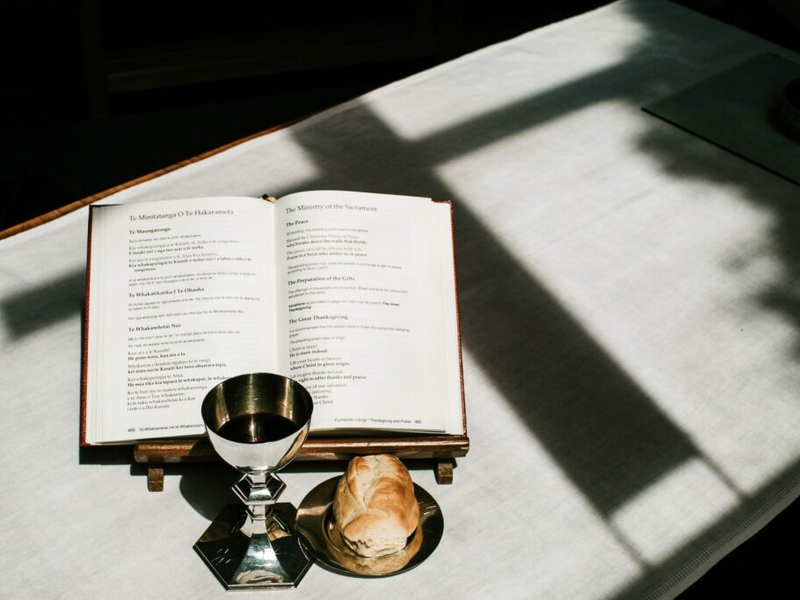
Doing the Lord’s Supper

From time to time I am asked how I think the Lord’s Supper should be done. This essay is my response to that question. To start with, we should agree that the Lord’s Supper is the only ritual we are obligated to do in the New Covenant on a routine…

by James B. JordanNovember 5, 1995

Showing page 268 of 309

See all
See all

Kiss of peace

David Cunningham writes, “What was one a ‘kiss of peace,’ uniting bodies in an almost frighteningly intimate way, now often consists only of a tentative handshake and a mumbled greeting.  Of course, this does still provide an opportunity to meet the other face to face, body to body; and so…

November 12, 2009

Children in the church

In his Adults and Children in the Roman Empire (1989), Thomas Wiedemann remarks on the difference between pagan and Christian conceptions of infant death: “For the pagan, premature death was a disaster because the child’s life was wasted; for Augustine, a child who died prematurely might have had as complete…

November 12, 2009
Philosophy

Prodigal words revisited

A friend, Aaron Cummings, writes in response to my comments about Derrida and prodigal words: “A few days ago, you alluded to Derrida, that words run prodigal from the speaker/writer. You said that this was true of Mankind’s words, but not of God’s. It seems to me that this is…

November 11, 2009

Multiplicity

For Athanasius, creation’s multiplicity is not a defect but part of its glory.  No created thing supplies all need; no single light illuminates day and night.  So there are many lights.  Each light is its own essence, but these essences cooperate to fill what is lacking in the others.  The…

November 11, 2009
Theology

God of small things

Arianism is not just about Christology.  It’s about theology proper. Arius said that God made His Son before the creation because the creation could not endure the “untempered hand” of the Father.  It needed the Son as mediator.  Athanasius sees in this a false idea of God.  God, He says,…

November 11, 2009

Cur Deus Homo?

Athanasius notes that before the incarnation humanity was under the dominion of false gods, enslaved to corruption and idolatry.  The Word took flesh to deliver us from that slavery, and the form of that deliverance was an act of worship: “in this body offering Himself for all, He might deliver all from false worship and…

November 11, 2009

Showing page 1324 of 2212

Browse by Category

In Medias Res

Your weekly digest for all things Theopolis.

Donate

Theopolis is nearly 100% donor-supported. Consider joining us on our mission.