Theopolis Logo

Writing

Explore our collection of theological essays, biblical studies, and reflections on faith and culture.

See all
e99a2191
Theopolis News

New Season & New Relationships

We have moved from death to new life, from Lenten darkness to Easter light. And while Easter Sunday may have come and gone, it's effects are continually with us. This season has brought with it several new relationships, events, and signs of growth for Theopolis. We have been networking with…

by Peter LeithartMay 9, 2016

eucharist-2
Eucharist

Social Eucharist in the Middle Ages

In The People's Work , a social history of Christian Worship, Frank Senn summarizes the developments of the medieval period with regard to the Eucharist. He begins by challenging the assumption that medieval society was held together by “the church.” He notes that the church was often divided and conflicted,…

by Peter LeithartMay 5, 2016
turing-machine
Biblical Theology

What Is Systematic Typology? Part 4: Wheels Within Wheels

The structure of the Bible resembles something which was grown rather than built, composed rather than assembled. Its employment of “structure-as-sign” at every level from micro- to macrocosmic leads to the conclusion that a hermeneutic worthy of Scripture requires not only training in history, art and music but also the…

by Mike BullMay 3, 2016
giotto-noli-me-3
Luke

Eighth Day, Eighth Verdict

For some in first-century Israel, Easter was anything but good news. It was a terrifying surprise. For the rulers and powers that put Jesus to death, the idea that He had been raised by some power beyond their control was chilling. Early in Luke’s gospel, we're told that Herod thought…

by Peter LeithartApril 28, 2016
sebastian-pena-lambarri-yv593oymkmo-unsplash
Hermeneutics

153 Large Fish

Simon Peter went up, and drew the net to land, full of large fish, a hundred and fifty-three; and although there were so many, the net was not torn. (John 21:11) This is one of those texts in the Bible that many people puzzle over. It is not a puzzle…

by James B. JordanApril 26, 2016
jesus-on-trial
Philemon

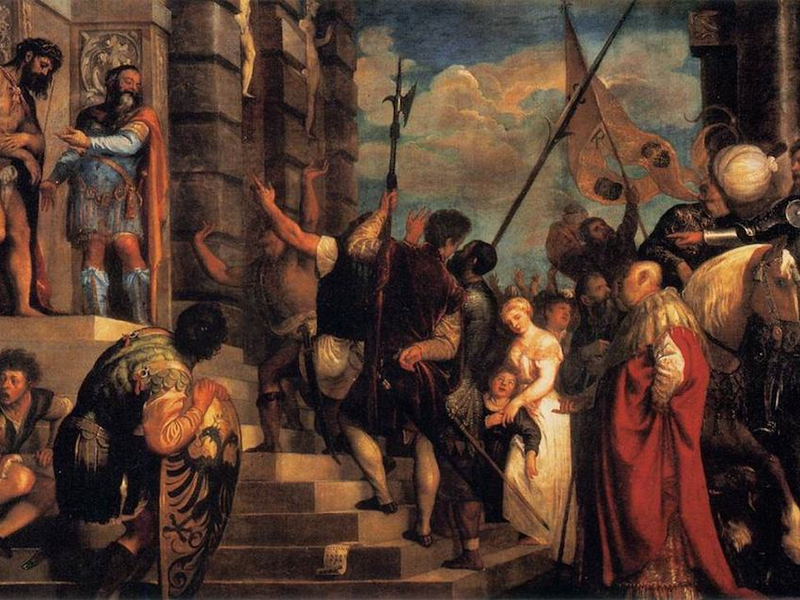
Pilate the Kingmaker

God is not mocked, Paul says. God is mocked, says Matthew. Who’s right? The two are in perfect harmony, but to see that, we need to run through the passage again. We’ll see that at every point, the mockery is being turned against the mockers. At every point, mockery is…

by Peter LeithartApril 21, 2016

Showing page 132 of 309

See all
See all

Sermon Notes

INTRODUCTION After the Olivet Discourse, Jesus “finished all these words” (26:1; cf. 7:28; 11:1; 13:53; 19:1).  His public ministry of teaching Israel is over.  Like Moses (Deuteronomy 32:45), nothing remains for Him but to die. THE TEXT “Now it came to pass, when Jesus had finished all these sayings,  that…

October 26, 2009

Eros Deleted

Protestants agreed with Catholics that the Song elaborates a nuptial analogy to the church’s relation to Christ, but Scheper finds a significant difference between Protestants and Catholics when they explain why that analogy is apt in the first place.  Protestants, consistent with the emphasis on legal categories for justification and…

October 25, 2009

Puritan Prudery

The Puritans were not prudes, but the caricature has some basis in fact. Again the Song of Songs provides a neat barometer.  Scheper juxtaposes a medieval monk’s interpretation of the “breasts” of the Song with that of two Protestant interpreters.  The results are fascinating: “the Cistercian monk Gilbert of Hoilandia does…

October 25, 2009

Medieval Protestantism

the Protestant commentaries almost uniformly adopt a primarily ecclesial allegory, with the tropological dimension as a valid application. But so, in fact, is the medieval tradition built on the foundation of the ecclesial interpretation, and even those commentaries devoted most strikingly to the Christsoul allegory, such as Bernard’s, recognize that…

October 25, 2009

Superlative Song

The modern oblivion of the book has tended to blind us to the really crucial position it holds in exegetic history, not only for the question of allegory but for the central matter of the relation of divine to profane love, and in fact, as Ruth Wallerstein has said, the…

October 25, 2009

Reformation allegory

there is a certain discrepancy between the purity of these theoretical statements, polemical in context, and the actual exegetic practice of the Reformers. Moreover, the rejection of allegory and the insistence on one undivided sense hinged for the early Reformers on maintaining a radical distinction between typology and allegory. But…

October 25, 2009

Showing page 1335 of 2212

Browse by Category

In Medias Res

Your weekly digest for all things Theopolis.

Donate

Theopolis is nearly 100% donor-supported. Consider joining us on our mission.