Theopolis Logo

Writing

Explore our collection of theological essays, biblical studies, and reflections on faith and culture.

See all
aaron-burden-h8s0pf2rcqs-unsplash
Galatians

The Restoration of the Galatians

While controversies over the writings of Paul continue in various corners of the intellectual globe, the word of God given through Paul and his scribe and all of the church’s interpreters and translators over the last two millennia is still readily available to the lofty and the lowly. Paul, as…

by Grace LangnessMarch 25, 2013

kiwihug-l4gw27xzn1i-unsplash
Deuteronomy

Law and History: How to Read the Law of Moses (Part 2)

The second in a series of studies in Deuteronomy. Deuteronomy 22:30: A man shall not take his father’s wife, and shall not uncover his father’s wing (Hebrew: kanaf ). There are a number of unusual features in this law that mark it out from the previous context, indicating that it…

by Ralph Allan SmithMarch 20, 2013
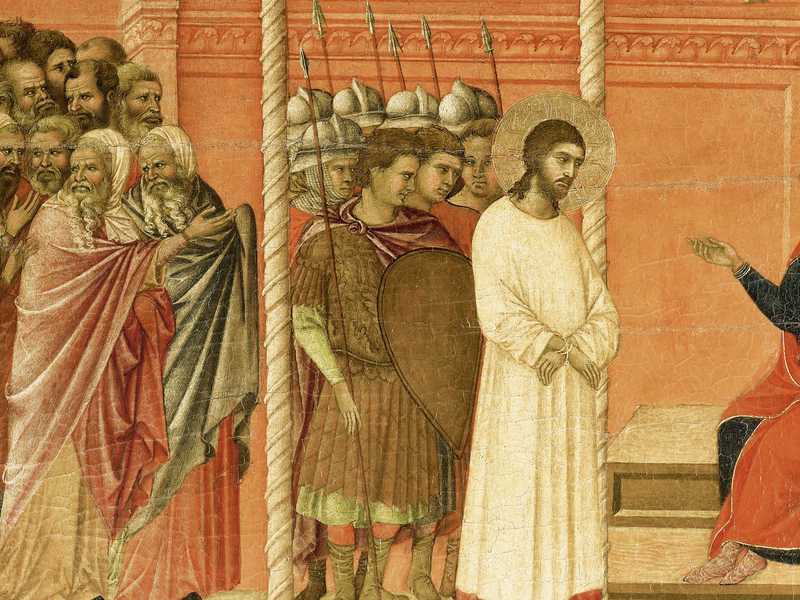
200403-moss-pilate-tease_pncfq5
History

Victimhood and the Gospel

The texts of Christianity have been slowly at work, under the power of the Holy Spirit for 2000 years now. If we could be magically transported back into the world of two millennia ago, modern Americans would be shocked at the cruelty of that world. There was no concern for…

by Richard BledsoeMarch 18, 2013
aaron-burden-1ebsmyrau-s-unsplash
Luke

The Dysfunctional Family of the Gadarene Madman

The Story of the Gadarene Madman is told in all three synoptic Gospels (Matthew 8:28-34, Mark 5:1-20, Luke 8:26-37). Jesus ventures into a Gentile area when He passes over the Sea of Galilee. Upon disembarking from his boat, he is immediately met by a demon-possessed madman. Upon meeting Jesus, he…

by Richard BledsoeMarch 13, 2013
aaron-burden-1ebsmyrau-s-unsplash
Deuteronomy

Law and History: How to Read the Law of Moses

Part 1 of a multi-part series of studies on Deuteronomy 22:30-23:8. Eric Auerbach, in his classic work on Western literature, devotes his first chapter to contrasting Homer with the Bible. Of Homer, he writes of the “need of Homeric style to leave nothing which it mentions half in darkness and…

by Ralph Allan SmithMarch 12, 2013
markus-winkler-aid-xyrtlec-unsplash
Theopolis News

James Jordan in Korea, Japan

Trinity House Fellow James B. Jordan will be a speaker at an International Conference on Biblical Symbolism that will be held in Seoul on Monday, May 27 in 2013. He will address "The Importance of Biblical Symbolism and Symbolic Interpretation of the Bible." The conference will have three other speakers…

by Peter LeithartMarch 9, 2013

Showing page 197 of 309

See all
See all

Atonement and the Afflicted

Leviticus 23 has five speeches of Yahweh: A. Sabbath, Passover, Unleavened Bread, vv 1-8 B. First Sheaf, Pentecost, Gleaning, vv 9-22 C. Trumpets, vv 23-26 B’. Day of Coverings, vv 26-32 A’. Booths, vv 33-44 Several links in this structure are worth noting. First, the chapter begins and ends with…

September 29, 2009

Bread feast

Pentecost is a bread feast, a feast of leaven (Leviticus 23:17).  Animals are brought as offerings, plenty of them, but these are brought “with the bread,” accompaniments to the bread rather than the other way round. It’s quite fitting, then, that after the leaven of the Spirit came upon the…

September 29, 2009

First sheaf

The presentation of the first sheaf (Leviticus 23:9-13) provides a neat little allegory of redemption.  The first sheaf is presented on the day after the sabbath, the day of resurrection.  It is the “beginning” of the harvest (v. 10), and Leviticus uses the same word as is used in Genesis…

September 29, 2009

Fullness of time

When Paul talks about the “fullness of time,” he’s likely alluding back to the calendar of Leviticus 23.  Pentecost is calculated from the day of the first sheaf, and the time is described as a “complete” set of sabbaths.  The word translated as “complete” is tamim , which describes perfect…

September 29, 2009
Art

Kantian aesthetics

Adorno neatly sums up the intention and result of Kant’s aesthetics in a cople of lines: “the significance of Kantian subjectivism as a whole lies in its objective intention, its attempt to salvage objectivity by means of an analysis of subjective moments.” And, noting that Kant “posits something as form…

September 28, 2009

Eucharistic meditation

1 Peter 1:3: Blessed by the God and Father of our Lord Jesus Christ, who according to His great mercy has caused us to be born again to a living hope through the resurrection of Jesus Christ from the dead. As Pastor Sumpter mentioned in the sermon this morning, Peter’s…

September 27, 2009

Showing page 1344 of 2212

Browse by Category

In Medias Res

Your weekly digest for all things Theopolis.

Donate

Theopolis is nearly 100% donor-supported. Consider joining us on our mission.