Theopolis Logo

Writing

Explore our collection of theological essays, biblical studies, and reflections on faith and culture.

See all
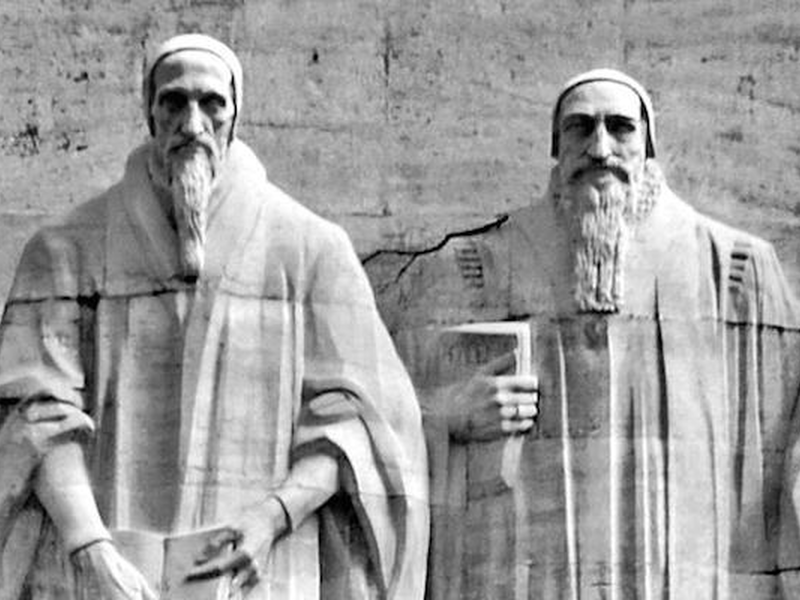
reformation-wall
History

How the Reformation Failed

The Reformers did not start out with a plan to found separated churches. Their goal was to reform the entire Latin church. In this they failed. The paradox is sharp, and we need to feel its point and its edge if we Protestants are to reckon honestly with our history…

by Peter LeithartApril 18, 2017
img_7521
Federal Vision

What is Conversion?

Conversion is a turning from sin to Christ. Now, let's think about that. Does conversion happen only once in a lifetime, or does it happen many times? That is the question, I believe, that needs answering. From my experience, and from my understanding of the Bible and of Christianity, there…

by James B. JordanApril 13, 2017
sky-from-bridge
Biblical Studies

Priests to the Nations

Israel was supposed to be a priest to the nations (Ex. 19:6). Her water would cause their trees to grow. This was signified to all men when Israel came out of Egypt, for "then they came to Elim, where they were twelve springs of water and seventy date palms, and…

by James B. JordanApril 11, 2017
holodomor
Ukraine

Borderland

Rousing Soviet songs surround us as we pass through a gloomy gauntlet of titanic statues on our way to Kyiv’s Museum of the Great Patriotic War. My friends, a Polish and a Ukrainian pastor, remember the songs, which played incessantly on the radio during their childhood. The sculpture complex depicts…

by Peter LeithartApril 6, 2017
img_0166
Eucharist

Worship and Ceremony, Part II: The Lord's Supper

This is the second installment of a two-part article. Click HERE to read Part I. The fourth perspective on ceremony is that of the action of the Lord's Supper. As we noted before, the inauguration of the Lord's Supper preceded its interpretation. Jesus did not at that point give an…

by James B. JordanApril 4, 2017
e99a9380
Course Recap

Architecture Course Recap

The best courses are those that make you see the Bible, the church, or the world differently. The recent Theopolis Architecture Course with Daniel Lee did exactly that. Architect Daniel Lee began the week with architectural theory, continued through the week taking students through a history of architectural practice, and…

by Brian MoatsMarch 31, 2017

Showing page 114 of 309

See all
See all

Articulated time

According to Pickstock, Augustine’s musical ontology is not a mere subordination of space to time, or a univocal “Dionysian flow”: “just as important as the priority of time, for Augustine, is the insistence on articulation into distinct musical units or phrases, the very move which allows a stress upon the simultaneity…

September 14, 2009

Creation ex nihilo

Nothing comes from nothing.  That seems obvious, and Christians have traditionally had some difficulty explaining why creatio ex nihilo is a defensible violation of that basic principle. According to Catherine Pickstock, Augustine viewed creation ex nihilo as the most rational position.  All around us, “things are continuously coming to be…

September 14, 2009
Politics

Secular

In responding to Milbank’s analysis of Augustine on the secular, RA Markus ( Christianity And the Secular (Blessed Pope John XXIII Lecture Series in Theology and Culture) ) borrows MJ Hollerich’s summary of Milbank that there is no “neutral public sphere in which people can act politically without reference to…

September 14, 2009
Art

Kantradictions

Jean-Marie Schaeffer ( Art of the Modern Age: Philosophy of Art from Kant to Heidegger (New French Thought Series) has a blast pointing out the contradictions in Kant’s aesthetics. Most of them arise from Kant’s insistence that the judgment of taste is founded on “the form of a finality” that…

September 12, 2009
Philosophy

Effects and Causes

Can effects double as causes? Kant, still working with some form of final causality, thinks so: There are cases when “the thing that for the moment is designated effect deserves none the less, if we take the series regressively, to be called the cause of the thing of which it…

September 12, 2009
Art

Gnostikant

Evidence that Hamann had Kant right: In explaining taste as a common sense, he notes that this common sense of beauty can be arrived at by a process of stripping off whatever belongs to our perception and prejudice. That is, we put “ourselves in the position of every one else,…

September 12, 2009

Showing page 1351 of 2212

Browse by Category

In Medias Res

Your weekly digest for all things Theopolis.

Donate

Theopolis is nearly 100% donor-supported. Consider joining us on our mission.