Theopolis Logo

Writing

Explore our collection of theological essays, biblical studies, and reflections on faith and culture.

See all
ben-white-mo9vkbg5csg-unsplash
Masculinity

Ringing the Brothel Door

Bruce Marshall once wrote that every young man who rings the bell at a brothel is unconsciously looking for God. While it is not necessarily true that the inward desire of every man is ultimately a thirst for righteousness, it is true that every sin is the disordering of a…

by Garrett SoucyOctober 31, 2023

screenshot-2023-08-08-at-11-13-28-am
Ruth

Work and Gratitude in Ruth

In a previous essay , I argued that the story which begins with Lot and culminates in Ruth’s great-grandson David follows God’s five-fold pattern of creative work as laid out by Jim Jordan: taking something in hand (in this case, the Abrahamic family), restructuring it, distributing the product of labor,…

by Josh JensenOctober 27, 2023
screenshot-2023-10-17-at-11-05-18-am
Books

Men, Marriage, and the Feminine Imperative: A Review of "Men and Marriage"

Gilder, George. Men and Marriage. Moscow, ID: Canon Press, 2023. 1 By 1973, the hightide of second-wave feminism had flooded the beaches of American culture. Betty Friedan’s The Feminine Mystique eroded the shores of traditional female roles by naming and stirring up further domestic discontentment. Kate Millet wrote her dissertation-turned-book,…

by Bill SmithOctober 17, 2023
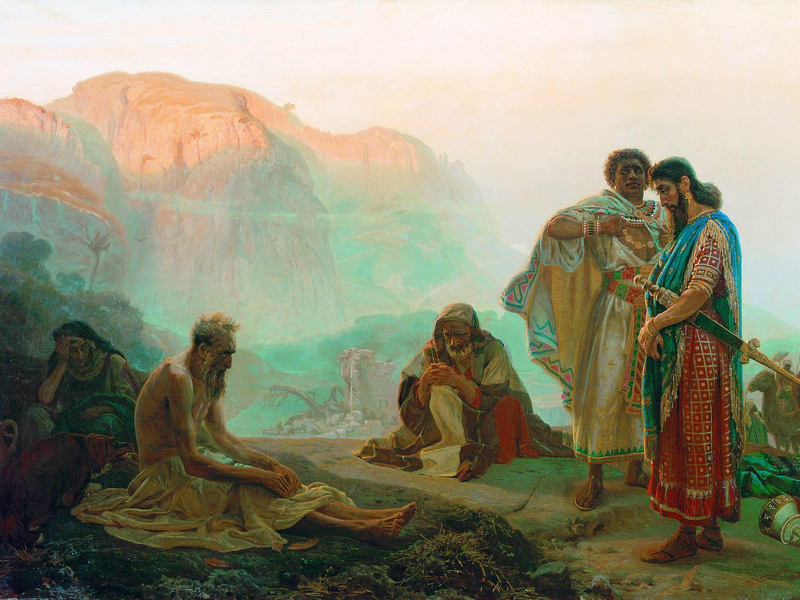
job_and_his_friends
Galatians

Get Behind Me, Eliphaz!

The Book of Job is a very tortuous book. The arguments of Job and his friends are shot through with truth and error hopelessly mixed together. Every line of contentious poetry stands locked in deadly battle with every other line. As maddening as this can be for a reader who…

by Jonathan WhiteOctober 10, 2023
13071-probablyvalentindeboulogne-saintpaulwritinghi-1
Apostle Paul

Before His Conversion, Paul Knew Jesus

More than once in the last 50 years it has occurred to me that Paul might have known Jesus before He appeared to Paul on the Damascus road, but I had never taken up the notion in earnest until recently when I ran into a book by Stanley Porter titled…

by Ralph Allan SmithOctober 4, 2023
mathew-schwartz-s87bbfzviau-unsplash
Acts

Did Peter Found the Church in Rome?

The question in the title is genuine, not polemic. I could be perfectly happy to follow an ancient — and what is regarded as a well-attested — tradition. But I do not feel compelled to follow it simply because it is tradition. I would like to have arguments that Peter…

by Ralph Allan SmithSeptember 26, 2023

Showing page 27 of 309

See all
See all

Articulated time

According to Pickstock, Augustine’s musical ontology is not a mere subordination of space to time, or a univocal “Dionysian flow”: “just as important as the priority of time, for Augustine, is the insistence on articulation into distinct musical units or phrases, the very move which allows a stress upon the simultaneity…

September 14, 2009

Creation ex nihilo

Nothing comes from nothing.  That seems obvious, and Christians have traditionally had some difficulty explaining why creatio ex nihilo is a defensible violation of that basic principle. According to Catherine Pickstock, Augustine viewed creation ex nihilo as the most rational position.  All around us, “things are continuously coming to be…

September 14, 2009
Politics

Secular

In responding to Milbank’s analysis of Augustine on the secular, RA Markus ( Christianity And the Secular (Blessed Pope John XXIII Lecture Series in Theology and Culture) ) borrows MJ Hollerich’s summary of Milbank that there is no “neutral public sphere in which people can act politically without reference to…

September 14, 2009
Art

Kantradictions

Jean-Marie Schaeffer ( Art of the Modern Age: Philosophy of Art from Kant to Heidegger (New French Thought Series) has a blast pointing out the contradictions in Kant’s aesthetics. Most of them arise from Kant’s insistence that the judgment of taste is founded on “the form of a finality” that…

September 12, 2009
Philosophy

Effects and Causes

Can effects double as causes? Kant, still working with some form of final causality, thinks so: There are cases when “the thing that for the moment is designated effect deserves none the less, if we take the series regressively, to be called the cause of the thing of which it…

September 12, 2009
Art

Gnostikant

Evidence that Hamann had Kant right: In explaining taste as a common sense, he notes that this common sense of beauty can be arrived at by a process of stripping off whatever belongs to our perception and prejudice. That is, we put “ourselves in the position of every one else,…

September 12, 2009

Showing page 1351 of 2212

Browse by Category

In Medias Res

Your weekly digest for all things Theopolis.

Donate

Theopolis is nearly 100% donor-supported. Consider joining us on our mission.