Theopolis Logo

Writing

Explore our collection of theological essays, biblical studies, and reflections on faith and culture.

See all
johann-siemens-epy0gbjzzzu-unsplash
Apologetics

A Sabbath Conversation: How Old is the Earth?

As Adam and Eve walked to the center of the Garden of Eden to meet with the LORD on their first Sabbath they conversed about the origin and age of the earth. Adam: You know, honey, we spent a lot of time yesterday making preparations for our house, and we…

by Jeff MeyersOctober 3, 1997

img_1043
Biblical Horizons

Psalms for Exile: The Narrative Progression in the Fifth Book of the Psalter

Some of our forefathers believed in reading/singing the psalms in order. Today, when the psalms are even used at all, they tend to be used randomly, though sometimes tied to a church calendar or to the pastor’s sermon. The Bible does not bind us to any particular practice, but there…

by James B. JordanSeptember 4, 1997
jordan-wozniak-xp_agmeea6s-unsplash-2
Biblical Chronology

The Anthropomorphic Days of C. John Collins, Part 2

Dr. Collins begins his essay with a brief statement of the Day Age view and then a brief statement of the Six Day view, focussing on the challenge to that view posed by modern "science." He ends this discussion by writing: "Two crucial points are at stake here: first, the…

by James B. JordanSeptember 4, 1997
john-salzarulo-wtjrpjzabcq-unsplash
Biblical Horizons

Paperweights and the Puzzles of Secularism

In his The Construction of Social Reality , Berkeley philosopher John Searle puzzles over the ontology of the products of human construction. Certain things – granite, platypi, weeping willows – occur naturally; while other realities – stone walls, zoos and parks, Chase Manhattan Bank – exist only as products of…

by Peter LeithartAugust 27, 1997
ales-krivec-4mibe6zg5r0-unsplash
Biblical Chronology

The Anthropomorphic Days of C. John Collins, Part 1

In the journal Presbyterion 20 (1994):109-130, published by Covenant Theological Seminary, Dr. C. John Collins sets forth a revision of the Day Age approach in his essay, "How Old Is the Earth? Anthropomorphic Days in Genesis 1:1–2:3." Dr. Collins’s essay has been widely accepted in evangelical Presbyterian circles as an…

by James B. JordanAugust 4, 1997
screenshot-2023-09-04-at-10-37-01-am
Biblical Horizons

The Sin of Ham and the Curse of Canaan, Part 3 (An Exposition of Genesis 9:20-27)

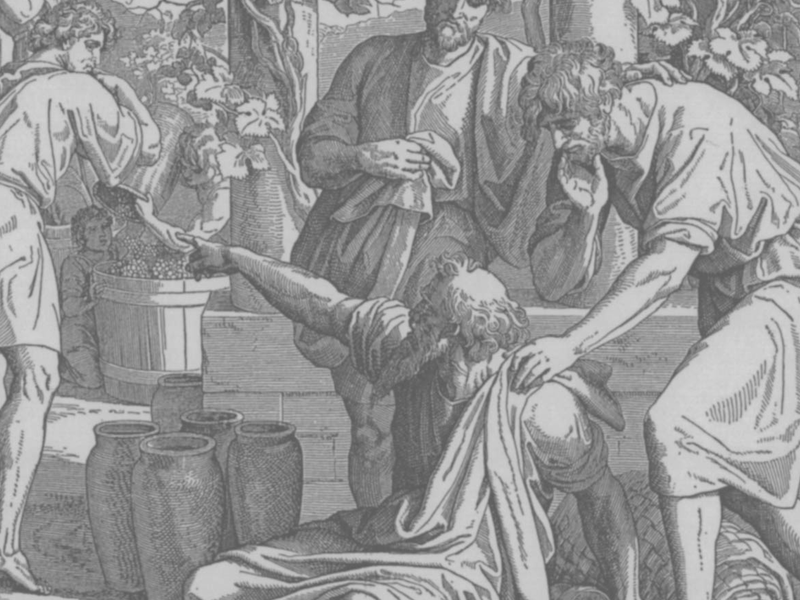
The Righteousness of Shem and Japheth As noted above, the action of Shem and Japheth was purely symbolic. They did not need to cover Noah with a garment, for he was already covered by the tent. Their action was a symbolic affirmation of Noah’s authority, a symbolic rejection of Ham’s…

by James B. JordanAugust 4, 1997

Showing page 254 of 309

See all
See all
History

Missing Sunday School

Robin Lane Fox ( Pagans and Christians ) summarizes Constantine’s telling of the story of Daniel: In the court of Cambyses, Daniel “worked his miracles and prayed intently three times a day. The Magi became jealous of this new superior, and so he cast him to lions in the royal…

March 26, 2009
History

Religion of the Paperback

That’s how Stroumsa describes early Christianity, because of its preference for the small, portable codex over the traditional, sacred but quite cumbersome scroll. The codex had practical advantages, but Stroumsa thinks that something else was at work: “In going against all religious and cultural norms, the Christians manifestly knew that…

March 25, 2009
History

End of Sacrifice

Guy Stroumsa’s book, The End of Sacrifice (just released from the University of Chicago) is small in size but raises huge questions. Based on lectures delivered at the College de France, Stroumsa’s book examines religious, religio-political and religio-anthropological shifts during the first centuries after Christ. He sees several new emphases…

March 25, 2009
History

Human sacrifice

Eusebius ( Gospel Preparation , 4.17) charges that human sacrifice was regularly practiced by ancient peoples: “And whether it is Phylarchus, or any one else, who records that all the Greeks, before going out to their wars, offer a human sacrifice, do not thou hesitate to take him also as…

March 25, 2009

Magnanimity

Aristotle defined magnanimity or “great-mindedness” as a proper estimate of one’s merits: “The Great-minded man is then, as far as greatness is concerned, at the summit, but in respect of propriety he is in the mean, because he estimates himself at his real value (the other characters respectively are in…

March 25, 2009
Uncategorized

Moses and philosophy

In his Oration to the Saints , Constantine repeats the patristic commonplace that Greek philosophy owed a debt to Moses: “Moses excelled his predecessors in wisdom to such a degree that even those who were praised by the nations as wise men and philosophers came to emulate his wisdom. For…

March 25, 2009

Showing page 1401 of 2212

Browse by Category

In Medias Res

Your weekly digest for all things Theopolis.

Donate

Theopolis is nearly 100% donor-supported. Consider joining us on our mission.