Theopolis Logo

Writing

Explore our collection of theological essays, biblical studies, and reflections on faith and culture.

See all
screen-shot-2023-05-02-at-1-14-25-pm
Poetry

Seed-bearing Fruit

Ten-thousand ‘yeses’ and a single ‘no.’ From bough it dangles, beauty to the eyes, For belly, food, a fruit to make one wise. Too soon, they eat; they know; the leaves they sew, But, oh! the Love who asks, “Where did you go?” Confessions flow from under leaf’s disguise; A…

by Marc HaysAugust 16, 2023
screenshot-2023-08-15-at-8-22-28-am
Augustine

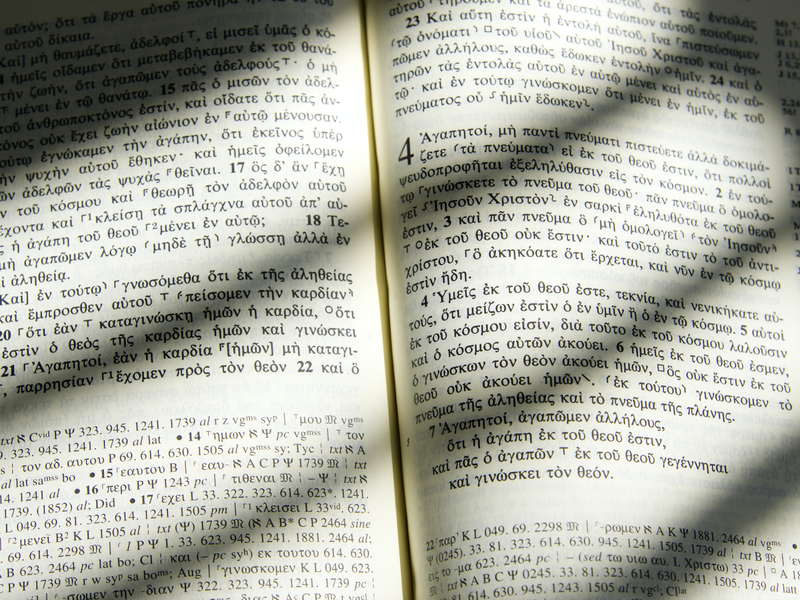
Eternal Life Chiasm in John's Gospel

In his masterful work, De Doctrina Christiana , Augustine of Hippo writes: I would have learned men to know that the authors of our Scriptures use all those forms of expression which grammarians call by the Greek name tropes, and use them more freely and in greater variety than people…

by Doug PonderAugust 15, 2023
screenshot-2023-08-08-at-11-13-28-am
Ruth

Lot, Ruth, and the Work of New Creation

“In accordance with the creation pattern, God sovereignly took hold of Adam and put him to sleep. Then God divided Adam by removing flesh and bone from his side, and restructured humanity into male and female. When Adam awoke, God distributed the woman to him. Adam gazed upon her and…

by Josh JensenAugust 8, 2023
rev-1-barbie-tp-0002-high-res-jpeg-647e152f50df6-2
Culture

The Barbie Movie

Greta Gerwig’s new film, Barbie, has been criticized, probably rightly, for having too many ideas and layers to properly bring in any for a landing. Gerwig herself thought the script was so “ wild and anarchic ” that she was surprised WB agreed to make it. Many see it as…

by Robin HarrisAugust 1, 2023
mariam-soliman-ht5xmeulydg-unsplash-2
Matthew

Why Does John the Baptizer Look Like a Camel?

“Now John wore a garment of camel’s hair and a leather belt around his waist, and his food was locusts and wild honey” (Matt. 3:4). Why is John the Baptizer clothed with camel’s hair? Why does he want to look like a camel? Or at least: what does he expect…

by Jeff MeyersJuly 26, 2023
darwin
Literature

Stinking, Rotten Ministers of the Gospel

In the second greatest story ever told, The Brothers Karamazov , Fyodor Dostoyevsky tells the story of a family plagued by the lasting legacy of sin’s destructive power and the all-surpassing truth that God is Light and in Him is no darkness. The young protagonist, Alyosha, is a monk committed…

by Garrett SoucyJuly 18, 2023

Showing page 29 of 309

See all
See all
History

Constantine, ecumenist

In 325, Constantine wrote a letter announcing the deposition of Eusebius of Nicomedia. As Timothy Barnes points out, it exemplifies the “pattern of respect tempered with frustration” that characterized Constantine’s relations with the bishops. One passage is reminiscent of Paul’s rebuke of the Galatians: “it was truly worthy of wonder…

November 19, 2008

Eucharistic meditation

2 Chronicles 3:1: Solomon began to build the house of Yahweh in Jerusalem on Mount Moriah, where the Lord had appeared to his father David, at the place that David had prepared, on the threshing floor of Ornan the Jebusite. Naomi gives Ruth specific instructions for her approach to Boaz:…

November 16, 2008

Exhortation

Ruth 3 begins and ends with “rest.” Naomi seeks “rest” for Ruth (v. 1), and after Ruth meets Boaz on the threshing floor, Naomi assures her daughter-in-law and Boaz will not “rest” until he has finished the task. That’s his job as a redeemer: To bring rest. Redeemers buy brothers…

November 16, 2008

Public liturgy

Fenn quotes Daniel Bell’s complaints that liturgies “drain” energies that should belong to useful institutions like political parties and comments “On this view, the genuine public sphere is outside the church, which becomes the sphere of private self-absorption and self-celebration.” By contrast, “to the believer, it is the liturgy that…

November 15, 2008

Liturgical politics

Fenn again: Liturgy is the public work of the people and thus “to be a person . . . meant [for the Greeks] precisely to have a role in the public work of the community.” Thus, “to take part in the Christian liturgy is to take on one’s role in…

November 15, 2008
History

Witness, Liturgy, Modernity

Richard Fenn writes, “In secularized Western societies . . . many individuals are caught in a double-bind. On the one hand, they take seriously the role of the credible witness, and seek, on grounds of their own testimony, to be taken seriously, whether they are reporting what they saw on…

November 15, 2008

Showing page 1447 of 2212

Browse by Category

In Medias Res

Your weekly digest for all things Theopolis.

Donate

Theopolis is nearly 100% donor-supported. Consider joining us on our mission.