Theopolis Logo

Writing

Explore our collection of theological essays, biblical studies, and reflections on faith and culture.

See all
johann-siemens-epy0gbjzzzu-unsplash
Apologetics

A Sabbath Conversation: How Old is the Earth?

As Adam and Eve walked to the center of the Garden of Eden to meet with the LORD on their first Sabbath they conversed about the origin and age of the earth. Adam: You know, honey, we spent a lot of time yesterday making preparations for our house, and we…

by Jeff MeyersOctober 3, 1997

img_1043
Biblical Horizons

Psalms for Exile: The Narrative Progression in the Fifth Book of the Psalter

Some of our forefathers believed in reading/singing the psalms in order. Today, when the psalms are even used at all, they tend to be used randomly, though sometimes tied to a church calendar or to the pastor’s sermon. The Bible does not bind us to any particular practice, but there…

by James B. JordanSeptember 4, 1997
jordan-wozniak-xp_agmeea6s-unsplash-2
Biblical Chronology

The Anthropomorphic Days of C. John Collins, Part 2

Dr. Collins begins his essay with a brief statement of the Day Age view and then a brief statement of the Six Day view, focussing on the challenge to that view posed by modern "science." He ends this discussion by writing: "Two crucial points are at stake here: first, the…

by James B. JordanSeptember 4, 1997
john-salzarulo-wtjrpjzabcq-unsplash
Biblical Horizons

Paperweights and the Puzzles of Secularism

In his The Construction of Social Reality , Berkeley philosopher John Searle puzzles over the ontology of the products of human construction. Certain things – granite, platypi, weeping willows – occur naturally; while other realities – stone walls, zoos and parks, Chase Manhattan Bank – exist only as products of…

by Peter LeithartAugust 27, 1997
ales-krivec-4mibe6zg5r0-unsplash
Biblical Chronology

The Anthropomorphic Days of C. John Collins, Part 1

In the journal Presbyterion 20 (1994):109-130, published by Covenant Theological Seminary, Dr. C. John Collins sets forth a revision of the Day Age approach in his essay, "How Old Is the Earth? Anthropomorphic Days in Genesis 1:1–2:3." Dr. Collins’s essay has been widely accepted in evangelical Presbyterian circles as an…

by James B. JordanAugust 4, 1997
screenshot-2023-09-04-at-10-37-01-am
Biblical Horizons

The Sin of Ham and the Curse of Canaan, Part 3 (An Exposition of Genesis 9:20-27)

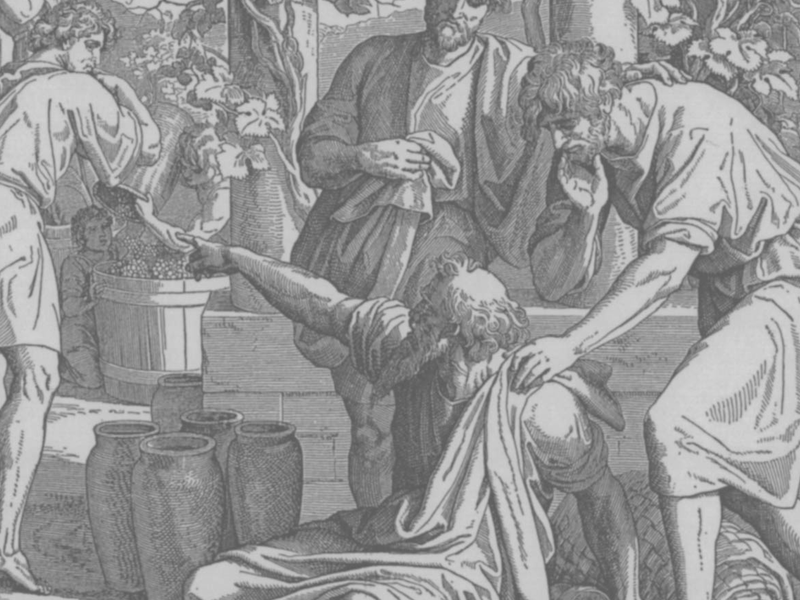
The Righteousness of Shem and Japheth As noted above, the action of Shem and Japheth was purely symbolic. They did not need to cover Noah with a garment, for he was already covered by the tent. Their action was a symbolic affirmation of Noah’s authority, a symbolic rejection of Ham’s…

by James B. JordanAugust 4, 1997

Showing page 254 of 309

See all
See all

Word of the Lord

“The Word was God,” says John. Where’d he get that? Genesis 15:1 is the first place where Scripture uses the phrase “word of Yahweh” ( dabar-YHWH ), and already here the use of the phrase hints that the dabar is a person. The word of Yahweh “came” to Abram (15:1,…

October 27, 2008
Uncategorized

Olivi’s timetable

Peter Olivi set out a scheme of prophecy chronology from Adam to Abraham to the destruction of Jerusalem. The accuracy of this is not the point, but rather the claim that the end of the temple was a decisive redemptive-historical event. “Ab Adam usque ad primam primissionem factam Abrahe, Genesis…

October 25, 2008
Uncategorized

Athanasius on nothing

A number of readers have suggested that I was wrongly critical of Athanasius’s claim that without God’s sustenance creation tends toward nothing; I said that this implied that creation has some tendency “independent” of God. The readers point out that Athanasius’s claim is exactly that creation has no independence and…

October 24, 2008
Philosophy

Mystical Encyclopedia

Diderot’s D’Alembert’s Dream develops a mythological monistic materialist ontology in which multiplicity develops from an original “polyp” but where nothing ever becomes really distinct from the whole or from anything else. There is no freedom, no real otherness, no real possibility of love. D’Alembert describes this ontology while masturbating in…

October 24, 2008

Movement toward nothing

Athanasius repeatedly says that created things, having come from nothing, have an inherent tedency to move toward nothing again. They have to be sustained by God to remain in existence. No problem with the conclusion that God keeps things in existence. But the notion that things tend toward nothing seems…

October 23, 2008
History

Medieval Preterism

Peter Olivi is one of a number of medieval exegetes who placed enormous significance on the fall of Jerusalem. In part, this was driven by anti-Jewish polemics; they argued that prophecies foretold that the Messiah would come and the temple sacrifice would be ended - since the temple sacrifice has…

October 23, 2008

Showing page 1457 of 2212

Browse by Category

In Medias Res

Your weekly digest for all things Theopolis.

Donate

Theopolis is nearly 100% donor-supported. Consider joining us on our mission.