Theopolis Logo

Writing

Explore our collection of theological essays, biblical studies, and reflections on faith and culture.

See all
johann-siemens-epy0gbjzzzu-unsplash
Apologetics

A Sabbath Conversation: How Old is the Earth?

As Adam and Eve walked to the center of the Garden of Eden to meet with the LORD on their first Sabbath they conversed about the origin and age of the earth. Adam: You know, honey, we spent a lot of time yesterday making preparations for our house, and we…

by Jeff MeyersOctober 3, 1997

img_1043
Biblical Horizons

Psalms for Exile: The Narrative Progression in the Fifth Book of the Psalter

Some of our forefathers believed in reading/singing the psalms in order. Today, when the psalms are even used at all, they tend to be used randomly, though sometimes tied to a church calendar or to the pastor’s sermon. The Bible does not bind us to any particular practice, but there…

by James B. JordanSeptember 4, 1997
jordan-wozniak-xp_agmeea6s-unsplash-2
Biblical Chronology

The Anthropomorphic Days of C. John Collins, Part 2

Dr. Collins begins his essay with a brief statement of the Day Age view and then a brief statement of the Six Day view, focussing on the challenge to that view posed by modern "science." He ends this discussion by writing: "Two crucial points are at stake here: first, the…

by James B. JordanSeptember 4, 1997
john-salzarulo-wtjrpjzabcq-unsplash
Biblical Horizons

Paperweights and the Puzzles of Secularism

In his The Construction of Social Reality , Berkeley philosopher John Searle puzzles over the ontology of the products of human construction. Certain things – granite, platypi, weeping willows – occur naturally; while other realities – stone walls, zoos and parks, Chase Manhattan Bank – exist only as products of…

by Peter LeithartAugust 27, 1997
ales-krivec-4mibe6zg5r0-unsplash
Biblical Chronology

The Anthropomorphic Days of C. John Collins, Part 1

In the journal Presbyterion 20 (1994):109-130, published by Covenant Theological Seminary, Dr. C. John Collins sets forth a revision of the Day Age approach in his essay, "How Old Is the Earth? Anthropomorphic Days in Genesis 1:1–2:3." Dr. Collins’s essay has been widely accepted in evangelical Presbyterian circles as an…

by James B. JordanAugust 4, 1997
screenshot-2023-09-04-at-10-37-01-am
Biblical Horizons

The Sin of Ham and the Curse of Canaan, Part 3 (An Exposition of Genesis 9:20-27)

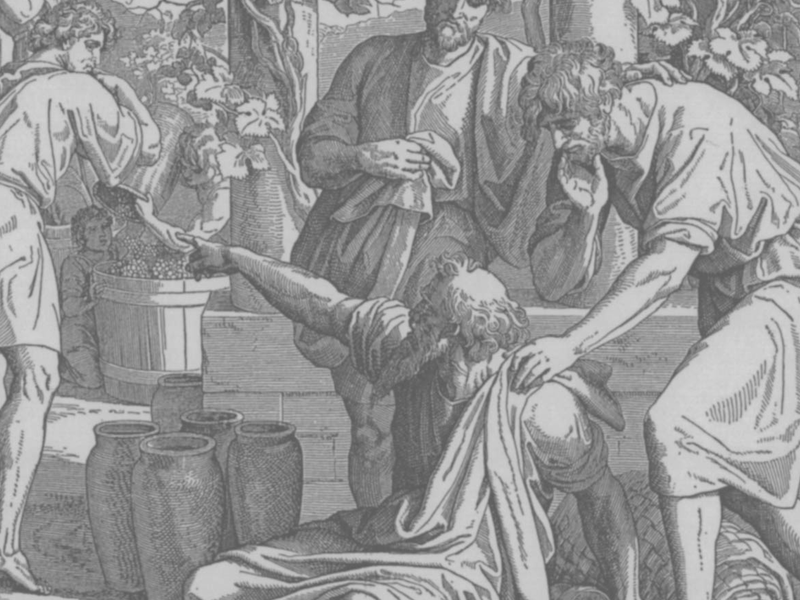
The Righteousness of Shem and Japheth As noted above, the action of Shem and Japheth was purely symbolic. They did not need to cover Noah with a garment, for he was already covered by the tent. Their action was a symbolic affirmation of Noah’s authority, a symbolic rejection of Ham’s…

by James B. JordanAugust 4, 1997

Showing page 254 of 309

See all
See all

Epicurean indifference revisited

Wes Callihan writes, in response to my brief quotation from Lucretius: “Possibly, however, Lucretius wouldn’t consider the indifferent watcher from the porch outside Pompeii a true Epicurean. Doesn’t the very next line go on to say something about how the pleasure is *not* in the other person’s suffering but in…

October 15, 2008
Philosophy

Direction revelation

Isaiah Berlin’s book on Hamann is lively engaging, but Berlin doesn’t get Hamann. For instance: “Hamann’s constantly repeated point is that revelation is direct contact between one spirit and another, God and ourselves.” Not. The opposite is the case: His constantly repeated point is that God speaks to the creature…

October 15, 2008

Lucretian wisdom

Book 2 of De rerum natura begins with “It is sweet on the great sea to watch from the shore other people drowning.” The words were found on a wall on a house in Pompeii. Perhaps someone sweetly watched from a perch opposite Vesuvius as the lava flow swallowed up…

October 14, 2008

Arian incoherence

Athanasius ties the Arians up in knots with an order-of-decrees argument. If the Son is created for the sake of creating us, then the Son exists for our need rather than we for His sake. That suggests a particular ordering of God’s will: “It is not that God, having the…

October 14, 2008

Speech-act Christology?

Athanasius says that “the words of human beings do not act.” Instead, “it is not by words but by hands that a human being works, for human hands have subsistence while words do not.” Hence, he is willing to adopt Irenaeus’s notion that the Son and Spirit are the two…

October 14, 2008

Creator-creature

Athanasius ( Orations Against the Arians ) writes that “God is not like us.” This is in the context of explaining how the eternal Word differs from the ephemeral words of human beings, and how the divine Word actually does what it says: “the Word of God is not, as…

October 14, 2008

Showing page 1460 of 2212

Browse by Category

In Medias Res

Your weekly digest for all things Theopolis.

Donate

Theopolis is nearly 100% donor-supported. Consider joining us on our mission.