Theopolis Logo

Writing

Explore our collection of theological essays, biblical studies, and reflections on faith and culture.

See all
little-girl
Children

Honor God With Your Body

I am making a new rule in our house! We are actually kind of skimpy on the house rules. I try very hard to keep things simple: love God, love others, be joyful. It’s not complicated to avoid discipline here. But I have found myself repeating this new rule over…

by Lindsey TollefsonApril 9, 2015

giotto-noli-me-3
John

The Gardener and the Beloved, (Part 3)

Click HERE for Part 2 The voice of Jesus transforms and changes Mary when she hears him speak her name. This is her last “turning.” So also the woman in the Song of Songs longs to hear the voice of her beloved. Let me see your face, let me hear…

by Jeff MeyersApril 6, 2015
giotto-noli-me-2
John

The Gardener and the Beloved, (Part 2)

Click HERE for Part 1. The details of this story call the attentive reader back to the drama of Solomon’s Song of Songs. And the Song of Song’s alludes to, ties us into the story of Adam and Eve in the Garden and the promise of a coming Messiah that…

by Jeff MeyersApril 4, 2015
easter-term-2015-2
Theopolis News

Easter Term, 2015

“The course was a paradigm shift for me,” said Jonathan Sedlak, a Milwaukee electrical contractor who attended Theopolis’s course on Revelation. “I am left with a book that is far more practical than it has ever seemed before.” Jonathan Anderson of Louisville, Kentucky found the course “refreshing.” “I finished with…

by TheopolisApril 2, 2015
psalm-singing
Genesis

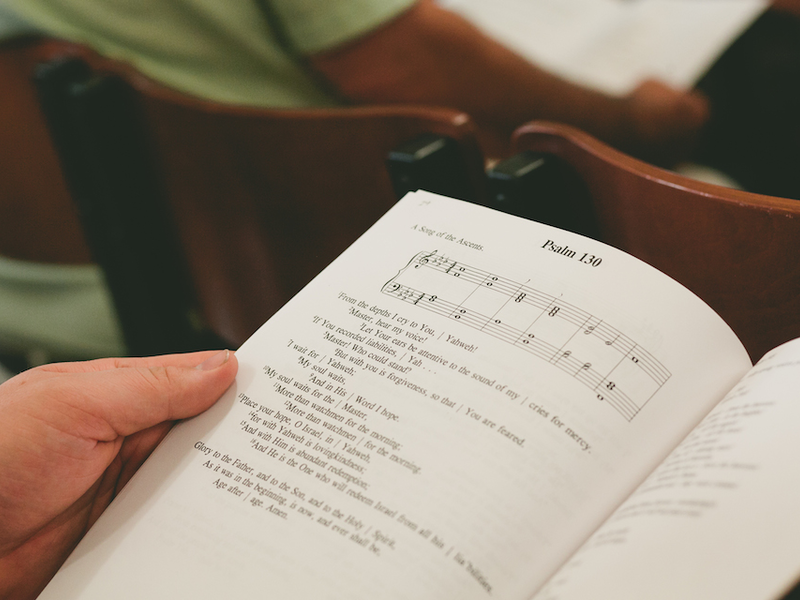
Worship as Response: Liturgical Logic, (Part 1)

“It is only by participation in a rational, practice-based community that one becomes rational.” – Alasdair MacIntyre It may be perfectly clear to a chef why adding unsifted powdered sugar to a hot frosting is a bad idea. But for an amateur cook, this may be the kind of rule…

by Jonathan BarlowApril 2, 2015
giotto-noli-me
John

The Gardener and the Beloved, (Part 1)

On a fresco in a chapel in Padua, Italy, there is a famous painting depicting the dramatic post-resurrection scene in John 20 with Mary and Jesus outside of the garden tomb. Giotto di Bondone painted it in the early 14th century. Jesus is striding from the tomb with a victor’s…

by Jeff MeyersApril 1, 2015

Showing page 156 of 309

See all
See all

Eucharistic meditation

Ephesians 2:13-14: But now in Christ Jesus you who formerly were far off have been brought near by the blood of Christ. For He Himself is our peace, who made both groups into one, and broke down the barrier of the dividing wall. Why can’t we all just get along?…

August 17, 2008

Baptismal meditation

Ephesians 4:4-6: There is one body and one Spirit, just as also you were called in one hope of your called; one Lord, one faith, one baptism; one God and Father of all who is over all and through all and in all. After Paul describes how Jesus unites Jew…

August 17, 2008

Ancient etymology

In a volume on Philo’s etymology of Hebrew names, Lester Grabbe notes that allegory and etymology played an important role in Greek interpretation of myths: ” In the physical types of allegory the gods were related directly and baldly to the nature elements by etymology, so that Hera was air…

August 16, 2008

John and Creation

The inventive Calum Carmichael ( The Story of Creation ) argues that “John, in an imaginative, allusive approach to the text of Genesis that is akin to Philo’s approach before him does indeed lay out the equivalent of the seven days of creation. The elements of each day in Genesis…

August 16, 2008

Reader Response

Anthony Thiselton ( New Horizons in Hermeneutics ) notes that “It may readily be granted, without any difficulty that some (or even in principle many) biblical texts do function in ways which invite a reader-oriented hermeneutic.” A very wise statement, that. Wise, first, in acknowledging the strength of reader-oriented modes…

August 14, 2008
Philosophy

Eco on Derrida

Eco is not uncritical of Derrida, but he disagrees with Searle’s claim that “Derrida has a distressing penchant for saying things that are obviously false,” insisting instead that “Derrida has a fascinating penchant for saying things that are nonobviously true, or true in a nonobvious way.” He elaborates: “When he…

August 14, 2008

Showing page 1481 of 2212

Browse by Category

In Medias Res

Your weekly digest for all things Theopolis.

Donate

Theopolis is nearly 100% donor-supported. Consider joining us on our mission.