Theopolis Logo

Writing

Explore our collection of theological essays, biblical studies, and reflections on faith and culture.

See all
49980-nicolas_poussin_-_the_judgment_of_solomon_-_wga18330-800w-tn
Biblical Studies

Advice From a Sojourner, Part 2

In our first essay in this series ( part 1 ), we saw that Proverbs 30 opens with a puzzle, a cryptic sentence that challenges the reader to search out a matter in order to gain understanding. "It is the glory of God to conceal a matter, but the glory…

by James B. JordanOctober 26, 1989
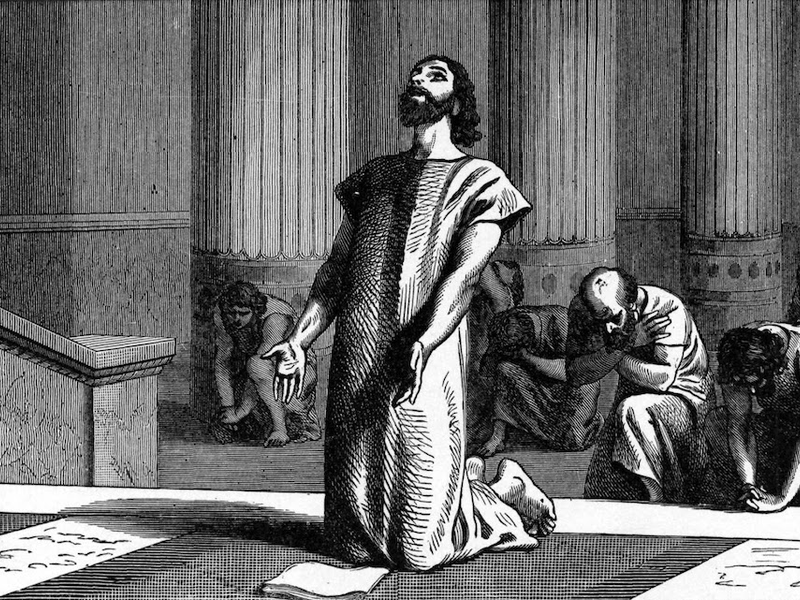
hezekiahs-prayer-2
Isaiah

Hezekiah’s Sign

The story of Hezekiah’s illness and recovery is familiar to every child who has attended Sunday School. Informed that he would die, faithful King Hezekiah pleaded in tears for a longer life. God heard his prayers and saw his tears, and promised fifteen more years. As a sign that He…

by Peter LeithartOctober 13, 1989
screen-shot-2021-08-12-at-2-57-54-pm
Proverbs

An Antidote for Yuppie Postmillennialism

1. The Blessed Hope "Looking for the blessed hope and the appearing of the glory of our great God and Savior, Christ Jesus." Titus 2:13 I was recently asked how I as a postmillennialist would preach on "The Blessed Hope." This is often a sticky question, because postmillennialists believe that…

by James B. JordanAugust 26, 1989
screen-shot-2022-01-10-at-5-52-39-pm
American Culture

Elijah’s War with Baal

1. Jeroboam and Ahab After Solomon died, the people came to his son, King Rehoboam, and asked for tax relief. Rehoboam refused to give it, and indeed told the people that he was going to tax them even more severely than his father had. At that point, with the blessing…

by James B. JordanJuly 26, 1989
screen-shot-2020-08-31-at-10-35-03-am
Biblical Horizons

The Love Feast

One aspect of truth is unity. It was Truth Incarnate who prayed for the unity of His people in John 17, which certainly makes unity a priority for them as well. In one sense, we know by faith that the Church is always invisibly unified in Christ, but there is…

by James B. JordanJune 16, 1989
screen-shot-2022-01-07-at-6-38-22-pm
Biblical Studies

The Son of Joseph, Revisited

Mr. Paul Miller of Vancouver writes that he is not persuaded by my remarks on Luke 4 on " The Son of Joseph ." He calls attention to Mark 6:1-6, where Jesus came "to His own part of the country," taught in the synagogue, and astonished many. The people said,…

by James B. JordanMay 16, 1989
See all
See all
Theology

Barthes’s transcendental argument

That’s Barthes not Barth. As in Roland. Prickett suggests that Barthes’ proclamation of the death of the author, his manumission of interpretation from the obsession with the limited, final, “secret” meaning, and his hope for a liberated “anti-theological” and “revolutionary” reading that refuses “to fix meaning” in fact opens the…

August 5, 2008

Conservatism of Poststructuralism

Poststructuralism likes to think itself radical, but Stephen Prickett (Words and the Word) points out that it excludes the possibility of novelty. Barthes says that a text is “a tissue of quotations drawn from the unnumerable centres of culture.” And Kristeva’s notion of intertextuality, on Prickett’s reading, encloses a text…

August 5, 2008
Literature

Novelistic language

A few highlights from James Wood’s chapter on language in How Fiction Works . Early on, he mentions the “old modernist hope” that prose can be “as well written as poetry.” This will require readers and novelists to develop what Nietzsche called a “third ear”: “We have to read musically,…

August 4, 2008
Literature

Bad Books

Lewis remarks on the high difficulty of adverse criticism, noting that the difficulty lies partly in the fact that the defects of bad literature are found in good literature: “The novel before you is bad - a transparent compensatory fantasy projected by a poor, plain woman, erotically starving. Yes, but…

August 4, 2008

Terms of abuse

Lewis describes the process by which words that once expressed and aroused emotions by appealing to the imagination have been emptied of image-content and become purely emotional. “Damn you” used to be a real curse, because people believed in damnation. Now that fewer do, it’s a more or less purely…

August 4, 2008

Limits of language

In Lewis’s defense, he is trying to explain some of the limits of language, which are worth noting (this in the last chapter of Studies in Words ). One limitation has to do with language’s inability “to inform us about complex physical shapes and movements. Hence descriptions of such things…

August 4, 2008

Showing page 1485 of 2212

Browse by Category

In Medias Res

Your weekly digest for all things Theopolis.

Donate

Theopolis is nearly 100% donor-supported. Consider joining us on our mission.