
Theopolis Logo

Writing

Explore our collection of theological essays, biblical studies, and reflections on faith and culture.

See all
jez-timms-8muutamcwu4-unsplash
Leviticus

Savage Judaism

​Should anthropological categories and tools be applied to Judaism? Seems a narrow and academic question, of interest to maybe ten people on the planet. It's one of the many virtues of Howard Eilberg-Schwartz's 1990 ​The Savage In Judaism to show that the question is a central one in the origins…

by Peter LeithartMarch 10, 2014
Leviticus

Obsessed with Sex?

Christians are often accused of being obsessed with sexual sin. Why can't two people, of whatever sex, do whatever they please in the enclosure of their own room? Who is hurt if a guy wants to get off looking at tantalizing pictures and videos on his computer? What's the big…

by Peter LeithartMarch 5, 2014
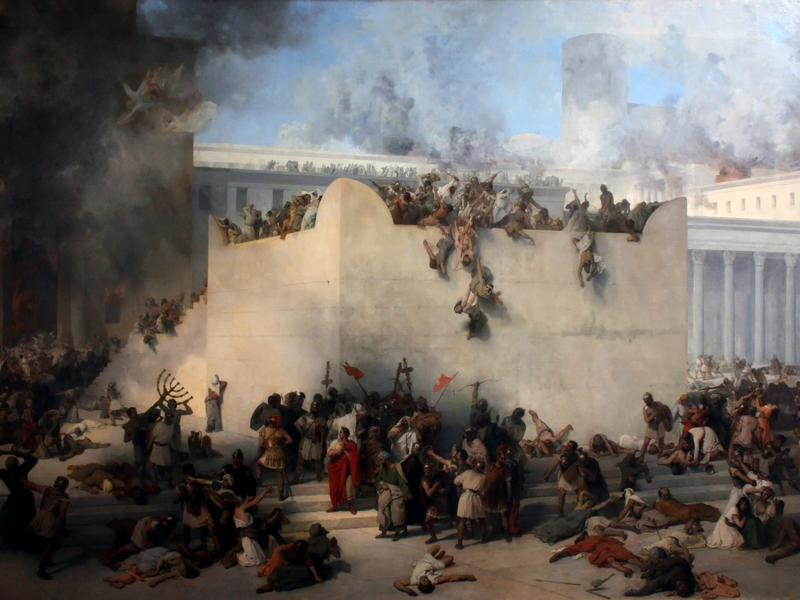
francesco_hayez_017
Mark

Binding and Loosing

“No one can enter a strong man’s house and plunder his goods, unless he first binds the strong man. And then he will plunder his house” (Mark 3:27 NKJV). Much commentary on the Revelation seems oblivious to its allusions to the Pentateuch (although there are many that do enlighten us…

by Mike BullMarch 3, 2014
Leviticus

Holiness, Ethics, Ritual

Leigh M. Trevaskis's 2011 monograph, Holiness, Ethics and Ritual in Leviticus , is an outstanding contribution to the study of Leviticus. His main thesis is directed at the world of Old Testament scholarship, in which there is a consensus that the ritual laws of Leviticus 1-16 come from a school…

by Peter LeithartMarch 1, 2014
6273e95e0f5ac766258d8cf3_joshuasconquestoftheland-2
Hermeneutics

Joshua Typology

Richard Ounsworth begins his Joshua Typology in the New Testament with an excellent discussion of what he calls "ontological" typology, which he handily summarizes in four points. Typology involves "correspondences between real historical events, personalities, institutions, etc. described in scripture," a correspondence that is discerned (not created) by the reader…

by Peter LeithartFebruary 26, 2014
alfons-morales-ylswjsy7stw-unsplash-1
Theopolis News

Book Release

Baylor University Press is sponsoring a reception to celebrate the official release of Peter Leithart's Gratitude: An Intellectual History . The reception will be held at the First Things offices in Manhattan on Thursday, March 6, at 6 PM. For more details, click here .

by Peter LeithartFebruary 26, 2014

Showing page 178 of 309

See all
See all

Music and words

CS Lewis says that language cannot do what music and gesture do, that is, “do more than one thing at once.” He admits that “the words in a great poet’s phrase interinanimate one another and strike the mind as a quasi-instantaneous chord, yet, strictly speaking, each word must be read…

August 4, 2008

Sermon Notes

INTRODUCTION At the middle of Matthew’s story of Jesus, Peter confesses that Jesus is the Christ ( 16:16 ). But he doesn’t yet understand what that means. He still has to learn that being Christ means taking up a cross and losing life to find it. THE TEXT “When Jesus…

August 4, 2008

Showing signs

Matthew uses the word “sign” in only four contexts. In the closely parallel passages 12:38-45 and 16:1-4, the Jewish leaders ask Jesus for a sign; the word is used several times in chapter 24, and a last time in 26:48 to describe Judas’s kiss. Chapters 12 and 16 are obviously…

August 3, 2008

Testing God

Yahweh rained bread from heaven to test Israel, to see if they would follow His instructions (Exodus 16:4). They didn’t follow Him. Instead, they disobeyed the instructions about manna (16:13-21) and turned the tables to put God to the test (17:2, 7). Jesus follows the same pattern. He is Bread…

August 3, 2008

Sign from heaven

The Pharisees and Sadducees ask Jesus for a sign from heaven (Matthew 16:1). The first “signs” in the heavens were the sun, moon, and stars. A sign from heaven is a sign of new creation, and Jesus’ response, alluding to the evening-morning pattern of the creation week, continues the creation…

August 3, 2008
Uncategorized

Etymology rejected?

The tide started turning against the etymologists during the Renaissance. In Praise of Folly , Erasmus mocked the theologians for their obsessions with the minutiae of words: “I met with another, some eighty years of age, and such a divine that you’d have sworn Scotus himself was revived in him.…

August 1, 2008

Showing page 1486 of 2212

Browse by Category

In Medias Res

Your weekly digest for all things Theopolis.

Donate

Theopolis is nearly 100% donor-supported. Consider joining us on our mission.







