Theopolis Logo

Writing

Explore our collection of theological essays, biblical studies, and reflections on faith and culture.

See all
kristina-flour-bcjdbykwquw-unsplash
Culture

On Foul Language

The Stranger: Do you have to use so many cuss words? The Dude: What the f*ck you talking about? - The Big Lebowski There was a man I knew, an elder at his church, who, whenever he was called upon to announce a pregnancy, preferred the euphemism “with child” because…

by Remy WilkinsJanuary 12, 2016

organ-pipes
How to Worship

Pipes Worth Playing

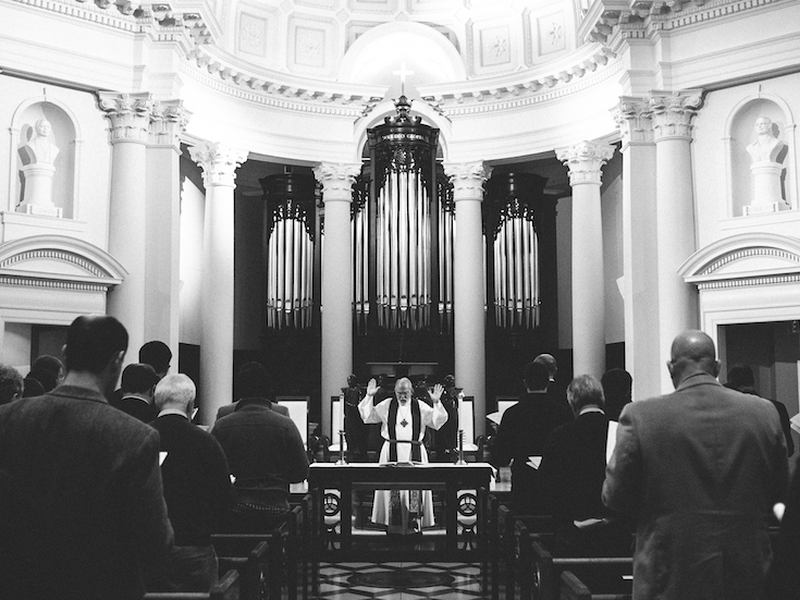
I know what you’re thinking. Organ: funeral, ball game, grand dusty cathedral. Why should modern Christians of such a technological age revisit a thousand year-old instrument? Don’t worry, I will not be trying to punch another hole in my Weird Music Preferences and Opinions card here. The truth is, our…

by Jarrod RicheyJanuary 7, 2016
tree-2
James

Do Things Have Natures?

Do things have natures? As I am posing the question, it is not simply a question of whether there are particular kinds of things in the world that have characteristic features, patterns of behavior, trajectories of growth and development. If that is what the word means, then the answer is…

by Peter LeithartJanuary 5, 2016
jim-leading-worship
Theopolis News

2016 Nevin Lectures with Father John Behr

We are excited to announce our 2016 Nevin Lectures featuring Father John Behr. Fr. John is the Dean of St. Vladimir's Seminary and Professor of Patristics, as well as the author of multiple works. He will be delivering three lectures over the course of two days dealing with "What Protestants…

by Brian MoatsJanuary 4, 2016
times-square
Creation

Time, Curse or Gift?

New Year's Day makes one reflective, at least about the past year, perhaps about life, perhaps, more broadly, about time itself. Many view time as a curse. Some see it as a curse because of missed chances. As one day or year moves on to the next, all we can…

by Peter LeithartDecember 31, 2015
nativity-2
Advent

The Manger

It seems a truism to say that we live in the world: that the world is outside of us. In reality the world is very much inside of us too. In fact the world passes through us as much as we pass through it. We breathe in its air, using…

by Arthur KayDecember 29, 2015

Showing page 138 of 309

See all
See all

Etymology

Peter Cotterell and Max Turner summarize James Barr’s case against etymology, dismissing TF Torrance’s claims about the links between ekklesia and kaleo , qahal and qol : “Even if qahal derives from qol , ‘voice’, (which is no more than merely possible ) it remains highly questionable whether anyone would…

July 18, 2008

Emotive Speech

Ogden and Richards, whose triangle of signification (word, concept, reference) has had a significant impact in evangelical hermeneutics, begin their book on the “meaning of meaning” by acknowledging that words have other functions than referential, “which may be grouped together as emotive. These can best be examined when the framework…

July 18, 2008

Unending lawsuit

In his book, Liturgies and Trials , Richard Fenn writes, “The individual is perpetually facing judgment by abstract and impersonal criteria that are only partially revealed while always calling into question the individual’s own sense of worthiness . . . the theme of the ‘last judgment’ loses its theological framework,…

July 16, 2008

Justification and modern man

In Arthur Miller’s After the Fall , a character says, “When you’re young, you prove how brave you are, or smart; when what a good lover; then a good father; finally how wise or powerful or what-the-hell-ever. But underlying it all, I see now, there was a presumption. That I…

July 16, 2008

Higher criticism

I like J. Louis Martyn. His commentary on Galatians is a masterpiece, and the other essays I’ve read are all very stimulating. I begin with a disclaimer because what has been called Martyn’s “seminal proposal” concerning the gospel of John is remarkable mainly for the absence of evidence and argument.…

July 16, 2008
History

Civilization of Word

In the introduction to his Elements of Semiology (1964), Roland Barthes argues that for all the icons and images that surround us, we remain a civilization of the word: “Semiology has so far concerned itself with codes of no more than slight interest, such as the Highway Code; the moment…

July 15, 2008

Showing page 1492 of 2212

Browse by Category

In Medias Res

Your weekly digest for all things Theopolis.

Donate

Theopolis is nearly 100% donor-supported. Consider joining us on our mission.