Theopolis Logo

Writing

Explore our collection of theological essays, biblical studies, and reflections on faith and culture.

See all
johann-siemens-epy0gbjzzzu-unsplash
Apologetics

A Sabbath Conversation: How Old is the Earth?

As Adam and Eve walked to the center of the Garden of Eden to meet with the LORD on their first Sabbath they conversed about the origin and age of the earth. Adam: You know, honey, we spent a lot of time yesterday making preparations for our house, and we…

by Jeff MeyersOctober 3, 1997

img_1043
Biblical Horizons

Psalms for Exile: The Narrative Progression in the Fifth Book of the Psalter

Some of our forefathers believed in reading/singing the psalms in order. Today, when the psalms are even used at all, they tend to be used randomly, though sometimes tied to a church calendar or to the pastor’s sermon. The Bible does not bind us to any particular practice, but there…

by James B. JordanSeptember 4, 1997
jordan-wozniak-xp_agmeea6s-unsplash-2
Biblical Chronology

The Anthropomorphic Days of C. John Collins, Part 2

Dr. Collins begins his essay with a brief statement of the Day Age view and then a brief statement of the Six Day view, focussing on the challenge to that view posed by modern "science." He ends this discussion by writing: "Two crucial points are at stake here: first, the…

by James B. JordanSeptember 4, 1997
john-salzarulo-wtjrpjzabcq-unsplash
Biblical Horizons

Paperweights and the Puzzles of Secularism

In his The Construction of Social Reality , Berkeley philosopher John Searle puzzles over the ontology of the products of human construction. Certain things – granite, platypi, weeping willows – occur naturally; while other realities – stone walls, zoos and parks, Chase Manhattan Bank – exist only as products of…

by Peter LeithartAugust 27, 1997
ales-krivec-4mibe6zg5r0-unsplash
Biblical Chronology

The Anthropomorphic Days of C. John Collins, Part 1

In the journal Presbyterion 20 (1994):109-130, published by Covenant Theological Seminary, Dr. C. John Collins sets forth a revision of the Day Age approach in his essay, "How Old Is the Earth? Anthropomorphic Days in Genesis 1:1–2:3." Dr. Collins’s essay has been widely accepted in evangelical Presbyterian circles as an…

by James B. JordanAugust 4, 1997
screenshot-2023-09-04-at-10-37-01-am
Biblical Horizons

The Sin of Ham and the Curse of Canaan, Part 3 (An Exposition of Genesis 9:20-27)

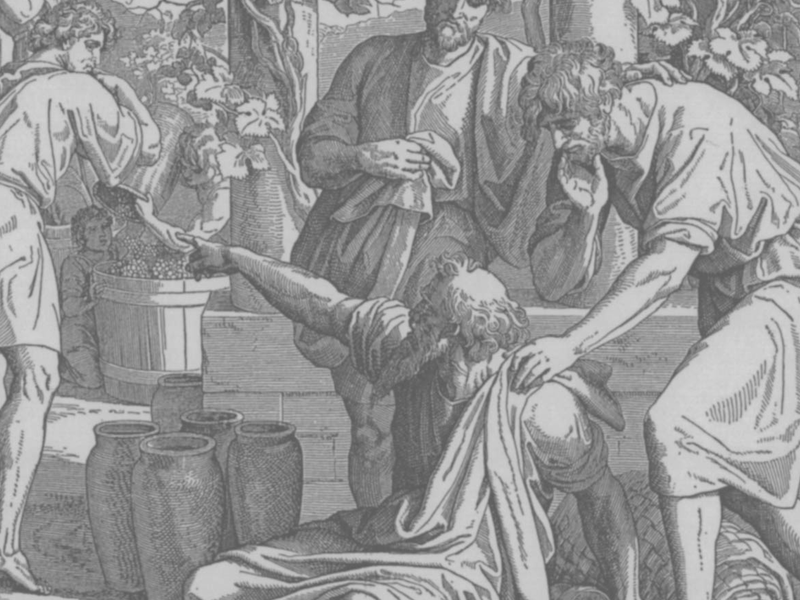
The Righteousness of Shem and Japheth As noted above, the action of Shem and Japheth was purely symbolic. They did not need to cover Noah with a garment, for he was already covered by the tent. Their action was a symbolic affirmation of Noah’s authority, a symbolic rejection of Ham’s…

by James B. JordanAugust 4, 1997

Showing page 254 of 309

See all
See all

Eucharistic meditation

Matthew 15:27: She said, Yes, Lord; but even the dogs feed on the crumbs which fall from their masters’ table. We don’t belong at this table. I’m not referring here to the fact that we are all sinners who aren’t worthy to be considered our Lord’s table companions. That’s true,…

July 6, 2008

Baptismal meditation

Matthew 15:22: A Canaanite woman came out from that region, and began to cry out, saying, Have mercy on me, O Lord, Son of David; my daughter is cruelly demon-possessed. What is baptism? What is it for? Why do we baptize infants? There are many answers to that, and throughout…

July 6, 2008

Worship service

In Matthew 15:29-31, Jesus moves back from the region of Tyre and Sidon to the sea of Galilee. He goes on a mountain and sits down. He has been on mountains a number of times already to do various things. Most recently, he ascended to a mountain to pray as…

July 5, 2008

Proverbs 22:8-16

PROVERBS 22:8 Solomon uses agricultural imagery to describe realities of life. Like Paul and Jesus, he says that we reap as we sow. Our actions are always a kind of planting. We are always sowing seed that will come to fruition later on. If we sow righteousness, we will reap…

July 3, 2008

Defending the incarnation?

The iconodules staked their argument on the incarnation, but Besancon notices that after the iconoclast controversy, figures in icons became less carnal rather than more: “In the few primitive icons, which come for the most part from Egypt . . . , Christ or the saints have stocky, thick-set, vigorous,…

July 2, 2008
Art

Reverse perspective

In his history of iconoclasm ( The Forbidden Image ), Alain Besancon describes some of the artistic features of Russian iconography: “Nature is stylized in such a way that trees, rocks, and houses defy gravity. The buildings are not represented within a unified space: each floats in its own perspective.…

July 2, 2008

Showing page 1495 of 2212

Browse by Category

In Medias Res

Your weekly digest for all things Theopolis.

Donate

Theopolis is nearly 100% donor-supported. Consider joining us on our mission.