Theopolis Logo

Writing

Explore our collection of theological essays, biblical studies, and reflections on faith and culture.

See all
aaron-burden-h8s0pf2rcqs-unsplash
Galatians

The Restoration of the Galatians

While controversies over the writings of Paul continue in various corners of the intellectual globe, the word of God given through Paul and his scribe and all of the church’s interpreters and translators over the last two millennia is still readily available to the lofty and the lowly. Paul, as…

by Grace LangnessMarch 25, 2013

kiwihug-l4gw27xzn1i-unsplash
Deuteronomy

Law and History: How to Read the Law of Moses (Part 2)

The second in a series of studies in Deuteronomy. Deuteronomy 22:30: A man shall not take his father’s wife, and shall not uncover his father’s wing (Hebrew: kanaf ). There are a number of unusual features in this law that mark it out from the previous context, indicating that it…

by Ralph Allan SmithMarch 20, 2013
200403-moss-pilate-tease_pncfq5
History

Victimhood and the Gospel

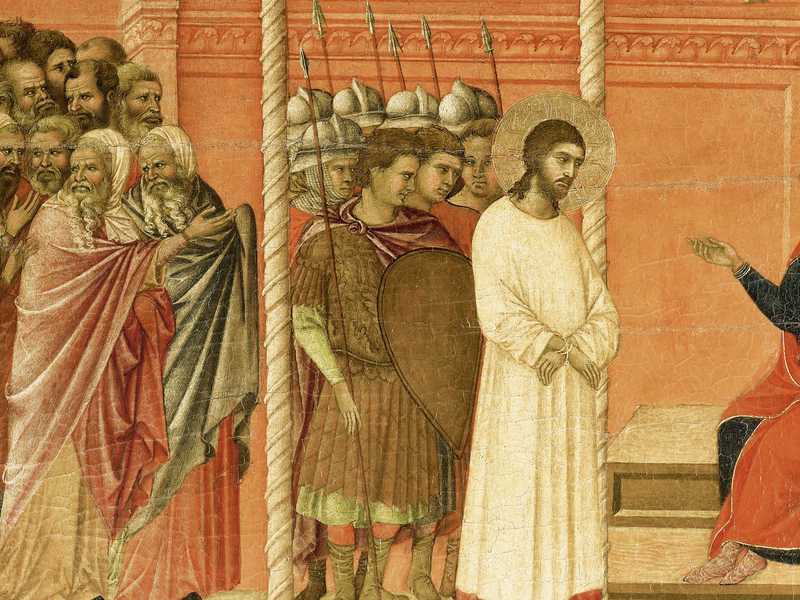
The texts of Christianity have been slowly at work, under the power of the Holy Spirit for 2000 years now. If we could be magically transported back into the world of two millennia ago, modern Americans would be shocked at the cruelty of that world. There was no concern for…

by Richard BledsoeMarch 18, 2013
aaron-burden-1ebsmyrau-s-unsplash
Luke

The Dysfunctional Family of the Gadarene Madman

The Story of the Gadarene Madman is told in all three synoptic Gospels (Matthew 8:28-34, Mark 5:1-20, Luke 8:26-37). Jesus ventures into a Gentile area when He passes over the Sea of Galilee. Upon disembarking from his boat, he is immediately met by a demon-possessed madman. Upon meeting Jesus, he…

by Richard BledsoeMarch 13, 2013
aaron-burden-1ebsmyrau-s-unsplash
Deuteronomy

Law and History: How to Read the Law of Moses

Part 1 of a multi-part series of studies on Deuteronomy 22:30-23:8. Eric Auerbach, in his classic work on Western literature, devotes his first chapter to contrasting Homer with the Bible. Of Homer, he writes of the “need of Homeric style to leave nothing which it mentions half in darkness and…

by Ralph Allan SmithMarch 12, 2013
markus-winkler-aid-xyrtlec-unsplash
Theopolis News

James Jordan in Korea, Japan

Trinity House Fellow James B. Jordan will be a speaker at an International Conference on Biblical Symbolism that will be held in Seoul on Monday, May 27 in 2013. He will address "The Importance of Biblical Symbolism and Symbolic Interpretation of the Bible." The conference will have three other speakers…

by Peter LeithartMarch 9, 2013

Showing page 197 of 309

See all
See all
Theology

Angels and progress again

From Australia, reader Mike Bull responds to my earlier post: I recently heard a pastor from southern India speak, and it sounds like ‘enchantment’ is still as powerful as it ever was (although, despite his hair-raising stories, it seems the best Satan can do to the saints in India at…

June 17, 2008
History

Idle warriors

An eighteenth-century French missionary, Joseph-Francois Lafitau, wrote of the Iroquois: “The men who are so idle in their villages, regard their indolence as a sign of glory in order to make everyone understand that they are actually only born for the great things and particularly for war. For there they…

June 17, 2008
Theology

Angels and progress

Thoughts from what Jim Jordan calls the “deep weird”:In Revelation, the angelic elders give up their crowns at the outset, and at the end of the book the saints are enthroned for a thousand years. Revelation depicts a transition from angelic to human government. Angels, Scripture tells us, are somehow…

June 17, 2008
History

Masks and clocks

Elias wryly comments that in urban societies the manufacture and use of clocks is similar to the use of masks in tribal cultures: “one knows they are made by people but they are experienced as if they represented an extra-human existence. Masks appear as embodiments of spirits. Clocks appear as…

June 17, 2008
Philosophy

Trained Ego

Elias challenges the Cartesian method of doubt, arguing that Descartes scrums around to get beneath all he’s picked up and finds, at bottom, things he’s picked up: “he is supposed to penetrate in his meditation, all on his own, to a layer of his own intellect believed, in accordance with…

June 17, 2008
History

January 1

Norbert Elias ( An Essay on Time ) writes that “for a long time . . . there were, even within one and the same state, traditional local diversities with regard to the beginning of a year, and thus to its end. As far as one can see, it was…

June 17, 2008

Showing page 1504 of 2212

Browse by Category

In Medias Res

Your weekly digest for all things Theopolis.

Donate

Theopolis is nearly 100% donor-supported. Consider joining us on our mission.