Theopolis Logo

Writing

Explore our collection of theological essays, biblical studies, and reflections on faith and culture.

See all
johann-siemens-epy0gbjzzzu-unsplash
Apologetics

A Sabbath Conversation: How Old is the Earth?

As Adam and Eve walked to the center of the Garden of Eden to meet with the LORD on their first Sabbath they conversed about the origin and age of the earth. Adam: You know, honey, we spent a lot of time yesterday making preparations for our house, and we…

by Jeff MeyersOctober 3, 1997

img_1043
Biblical Horizons

Psalms for Exile: The Narrative Progression in the Fifth Book of the Psalter

Some of our forefathers believed in reading/singing the psalms in order. Today, when the psalms are even used at all, they tend to be used randomly, though sometimes tied to a church calendar or to the pastor’s sermon. The Bible does not bind us to any particular practice, but there…

by James B. JordanSeptember 4, 1997
jordan-wozniak-xp_agmeea6s-unsplash-2
Biblical Chronology

The Anthropomorphic Days of C. John Collins, Part 2

Dr. Collins begins his essay with a brief statement of the Day Age view and then a brief statement of the Six Day view, focussing on the challenge to that view posed by modern "science." He ends this discussion by writing: "Two crucial points are at stake here: first, the…

by James B. JordanSeptember 4, 1997
john-salzarulo-wtjrpjzabcq-unsplash
Biblical Horizons

Paperweights and the Puzzles of Secularism

In his The Construction of Social Reality , Berkeley philosopher John Searle puzzles over the ontology of the products of human construction. Certain things – granite, platypi, weeping willows – occur naturally; while other realities – stone walls, zoos and parks, Chase Manhattan Bank – exist only as products of…

by Peter LeithartAugust 27, 1997
ales-krivec-4mibe6zg5r0-unsplash
Biblical Chronology

The Anthropomorphic Days of C. John Collins, Part 1

In the journal Presbyterion 20 (1994):109-130, published by Covenant Theological Seminary, Dr. C. John Collins sets forth a revision of the Day Age approach in his essay, "How Old Is the Earth? Anthropomorphic Days in Genesis 1:1–2:3." Dr. Collins’s essay has been widely accepted in evangelical Presbyterian circles as an…

by James B. JordanAugust 4, 1997
screenshot-2023-09-04-at-10-37-01-am
Biblical Horizons

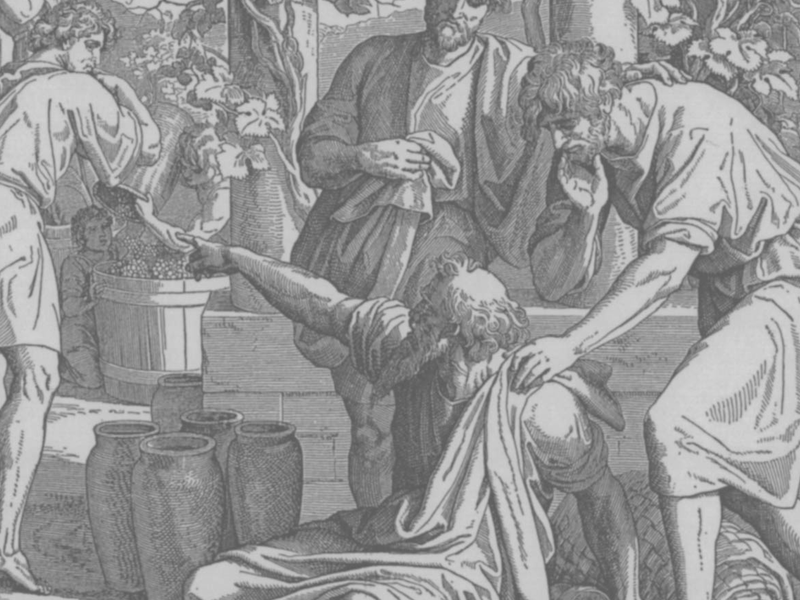
The Sin of Ham and the Curse of Canaan, Part 3 (An Exposition of Genesis 9:20-27)

The Righteousness of Shem and Japheth As noted above, the action of Shem and Japheth was purely symbolic. They did not need to cover Noah with a garment, for he was already covered by the tent. Their action was a symbolic affirmation of Noah’s authority, a symbolic rejection of Ham’s…

by James B. JordanAugust 4, 1997

Showing page 254 of 309

See all
See all
Science

Sentient plants

R. Fischer says, “The relativity of our reference point can be demonstrated by taking a moving picture of a plant at one frame a minute and then speeding it up to thirty frames a second. The plant will appear to behave like an animal, clearly perceiving stimuli and reacting to…

June 17, 2008
History

Freud and the Steam Engine

Barbara Adam points out that the leading metaphors for nature in the seventeenth and eighteenth century were mechanical. Creation was a clock. By the nineteenth century, though, steam technology had taken over the European imagination, and metaphors of “letting off steam” and “safety valve” were applied to social and psychological…

June 17, 2008

Participatory Exegesis

My review of Matthew Levering’s latest book is up at First Things : http://www.firstthings.com.

June 17, 2008
Science

Replaceable parts

Behind much of today’s biotechnology is the (Newtonian?) notion that living organisms are machine-like. And living organisms can look like machines in some respects. But they aren’t. Barbara Adam points out that the cells of our bodies are incessantly self-renewing - our limbs aren’t like gears that stay the same…

June 16, 2008
Science

Dance of life

Summarizing findings in physics and biology that should inform social science, Barbara Adam writes, “All organisms, from single cells to human beings and even ecosystems, display rhythmic behaviour. Rhythmicity is a universal phenomenon. Scientists conceptualise atoms as probability waves, molecules as vibrating structures, and organisms as symphonies. Living beings, they…

June 16, 2008
Science

Real time

KG Denbigh wrote in 1981 that physics treats time as a simple continuum: “It knows of no means of picking out a unique moment, the now or the present. The t-coordinate is an undifferentiated continuum, and, if this coordinate is ‘taken for real’ as has been the tendency among many…

June 16, 2008

Showing page 1505 of 2212

Browse by Category

In Medias Res

Your weekly digest for all things Theopolis.

Donate

Theopolis is nearly 100% donor-supported. Consider joining us on our mission.