Theopolis Logo

Writing

Explore our collection of theological essays, biblical studies, and reflections on faith and culture.

See all
e99a2191
Theopolis News

New Season & New Relationships

We have moved from death to new life, from Lenten darkness to Easter light. And while Easter Sunday may have come and gone, it's effects are continually with us. This season has brought with it several new relationships, events, and signs of growth for Theopolis. We have been networking with…

by Peter LeithartMay 9, 2016

eucharist-2
Eucharist

Social Eucharist in the Middle Ages

In The People's Work , a social history of Christian Worship, Frank Senn summarizes the developments of the medieval period with regard to the Eucharist. He begins by challenging the assumption that medieval society was held together by “the church.” He notes that the church was often divided and conflicted,…

by Peter LeithartMay 5, 2016
turing-machine
Biblical Theology

What Is Systematic Typology? Part 4: Wheels Within Wheels

The structure of the Bible resembles something which was grown rather than built, composed rather than assembled. Its employment of “structure-as-sign” at every level from micro- to macrocosmic leads to the conclusion that a hermeneutic worthy of Scripture requires not only training in history, art and music but also the…

by Mike BullMay 3, 2016
giotto-noli-me-3
Luke

Eighth Day, Eighth Verdict

For some in first-century Israel, Easter was anything but good news. It was a terrifying surprise. For the rulers and powers that put Jesus to death, the idea that He had been raised by some power beyond their control was chilling. Early in Luke’s gospel, we're told that Herod thought…

by Peter LeithartApril 28, 2016
sebastian-pena-lambarri-yv593oymkmo-unsplash
Hermeneutics

153 Large Fish

Simon Peter went up, and drew the net to land, full of large fish, a hundred and fifty-three; and although there were so many, the net was not torn. (John 21:11) This is one of those texts in the Bible that many people puzzle over. It is not a puzzle…

by James B. JordanApril 26, 2016
jesus-on-trial
Philemon

Pilate the Kingmaker

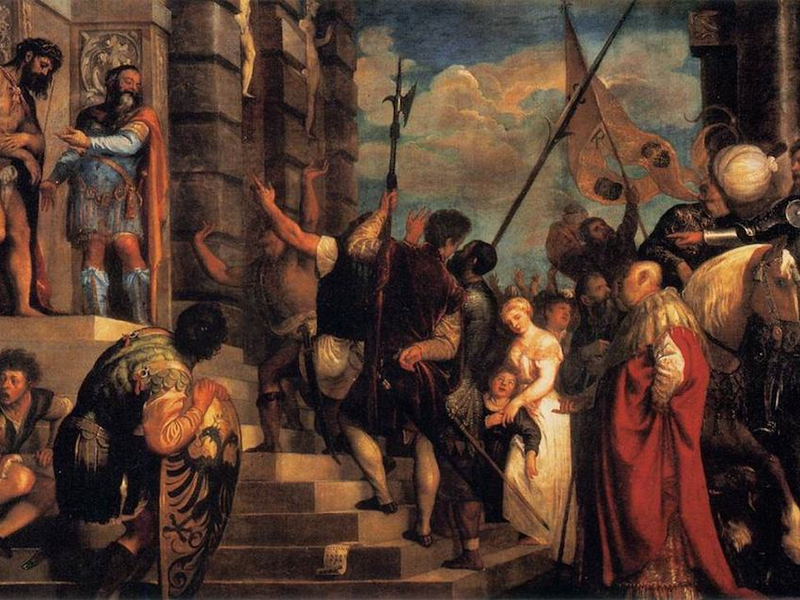
God is not mocked, Paul says. God is mocked, says Matthew. Who’s right? The two are in perfect harmony, but to see that, we need to run through the passage again. We’ll see that at every point, the mockery is being turned against the mockers. At every point, mockery is…

by Peter LeithartApril 21, 2016

Showing page 132 of 309

See all
See all

Jesus in the Fatherland

According to Davies and Allison, Matthew organizes the incident at Nazareth as a chiasm: A. Jesus comes to his patris and teaches in the synagogue B. People are amazed C. Where did he get these powers? Don’t we know his family? B’. People are scandalized A’. Jesus speaks about His…

May 31, 2008

Discipled scribe

Matthew quotes Jesus in 13:52 saying that a scribe “discipled by the kingdom” brings out old and new treasures. Davies and Allison note that this has sometimes been taken as a play on the author’s name: “Matthew” puns with the Greek of “disciple” ( matheteutheis ). Davies and Allison dismiss…

May 31, 2008
History

Marketing Time

Levine again: “Samuel P. Langley, who was eventually to become Secretary of the Smithsonian Institution, was the first to cash in on the growing demand for time coordination. In 1867, Langley took over the directorship of a struggling observatory in Allegheny, Pennsylvania, and quickly developed its timekeeping capabilities. He then…

May 30, 2008
History

Aromatic time

Levine writes, “The Chinese developed an incense clock. This wooden device consisted of a series of connect small same-sized boxes. Each box held a different fragrance of incense. By knowing the time it took for a box to burn its supply, and the order in which the scents burned, observers…

May 30, 2008
History

Labor saving

Robert Levine ( Geography of Time ) notes that “recent research indicates that farm wives in the 1920’s, who were without electricity, spend significantly less time at housework than did suburban women, with all their modern machinery, in the latter half of the century. One reason for this is that…

May 30, 2008
History

What Hath the Clock Wrought?

Why don’t longshoremen or sailors or assembly-line workers sing as they work? Blame it on the clock. Lewis Mumford wrote in the 1950s, “To keep time was once a peculiar attribute of music: it gave industrial value to the workshop song or the tattoo or the chantey of the sailors…

May 30, 2008

Showing page 1511 of 2212

Browse by Category

In Medias Res

Your weekly digest for all things Theopolis.

Donate

Theopolis is nearly 100% donor-supported. Consider joining us on our mission.