Theopolis Logo

Writing

Explore our collection of theological essays, biblical studies, and reflections on faith and culture.

See all
johann-siemens-epy0gbjzzzu-unsplash
Apologetics

A Sabbath Conversation: How Old is the Earth?

As Adam and Eve walked to the center of the Garden of Eden to meet with the LORD on their first Sabbath they conversed about the origin and age of the earth. Adam: You know, honey, we spent a lot of time yesterday making preparations for our house, and we…

by Jeff MeyersOctober 3, 1997

img_1043
Biblical Horizons

Psalms for Exile: The Narrative Progression in the Fifth Book of the Psalter

Some of our forefathers believed in reading/singing the psalms in order. Today, when the psalms are even used at all, they tend to be used randomly, though sometimes tied to a church calendar or to the pastor’s sermon. The Bible does not bind us to any particular practice, but there…

by James B. JordanSeptember 4, 1997
jordan-wozniak-xp_agmeea6s-unsplash-2
Biblical Chronology

The Anthropomorphic Days of C. John Collins, Part 2

Dr. Collins begins his essay with a brief statement of the Day Age view and then a brief statement of the Six Day view, focussing on the challenge to that view posed by modern "science." He ends this discussion by writing: "Two crucial points are at stake here: first, the…

by James B. JordanSeptember 4, 1997
john-salzarulo-wtjrpjzabcq-unsplash
Biblical Horizons

Paperweights and the Puzzles of Secularism

In his The Construction of Social Reality , Berkeley philosopher John Searle puzzles over the ontology of the products of human construction. Certain things – granite, platypi, weeping willows – occur naturally; while other realities – stone walls, zoos and parks, Chase Manhattan Bank – exist only as products of…

by Peter LeithartAugust 27, 1997
ales-krivec-4mibe6zg5r0-unsplash
Biblical Chronology

The Anthropomorphic Days of C. John Collins, Part 1

In the journal Presbyterion 20 (1994):109-130, published by Covenant Theological Seminary, Dr. C. John Collins sets forth a revision of the Day Age approach in his essay, "How Old Is the Earth? Anthropomorphic Days in Genesis 1:1–2:3." Dr. Collins’s essay has been widely accepted in evangelical Presbyterian circles as an…

by James B. JordanAugust 4, 1997
screenshot-2023-09-04-at-10-37-01-am
Biblical Horizons

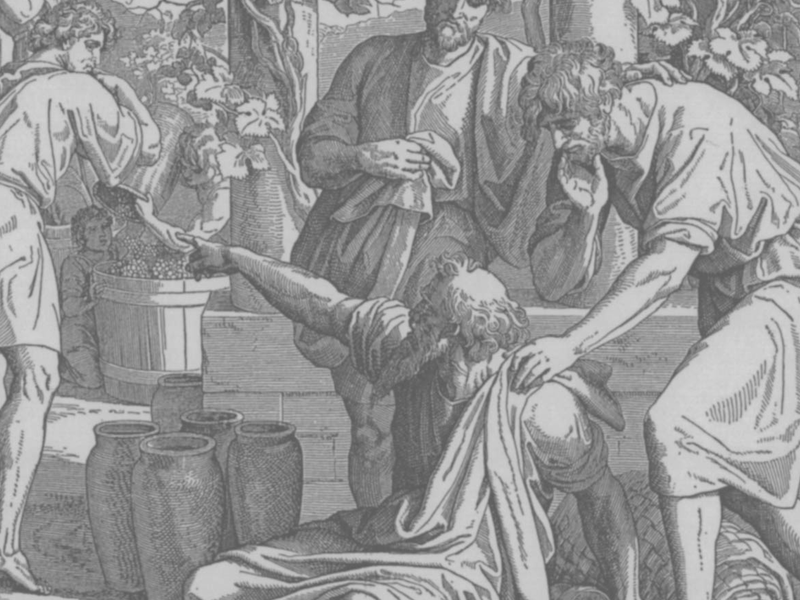
The Sin of Ham and the Curse of Canaan, Part 3 (An Exposition of Genesis 9:20-27)

The Righteousness of Shem and Japheth As noted above, the action of Shem and Japheth was purely symbolic. They did not need to cover Noah with a garment, for he was already covered by the tent. Their action was a symbolic affirmation of Noah’s authority, a symbolic rejection of Ham’s…

by James B. JordanAugust 4, 1997

Showing page 254 of 309

See all
See all

Jesus in the Fatherland

According to Davies and Allison, Matthew organizes the incident at Nazareth as a chiasm: A. Jesus comes to his patris and teaches in the synagogue B. People are amazed C. Where did he get these powers? Don’t we know his family? B’. People are scandalized A’. Jesus speaks about His…

May 31, 2008

Discipled scribe

Matthew quotes Jesus in 13:52 saying that a scribe “discipled by the kingdom” brings out old and new treasures. Davies and Allison note that this has sometimes been taken as a play on the author’s name: “Matthew” puns with the Greek of “disciple” ( matheteutheis ). Davies and Allison dismiss…

May 31, 2008
History

Marketing Time

Levine again: “Samuel P. Langley, who was eventually to become Secretary of the Smithsonian Institution, was the first to cash in on the growing demand for time coordination. In 1867, Langley took over the directorship of a struggling observatory in Allegheny, Pennsylvania, and quickly developed its timekeeping capabilities. He then…

May 30, 2008
History

Aromatic time

Levine writes, “The Chinese developed an incense clock. This wooden device consisted of a series of connect small same-sized boxes. Each box held a different fragrance of incense. By knowing the time it took for a box to burn its supply, and the order in which the scents burned, observers…

May 30, 2008
History

Labor saving

Robert Levine ( Geography of Time ) notes that “recent research indicates that farm wives in the 1920’s, who were without electricity, spend significantly less time at housework than did suburban women, with all their modern machinery, in the latter half of the century. One reason for this is that…

May 30, 2008
History

What Hath the Clock Wrought?

Why don’t longshoremen or sailors or assembly-line workers sing as they work? Blame it on the clock. Lewis Mumford wrote in the 1950s, “To keep time was once a peculiar attribute of music: it gave industrial value to the workshop song or the tattoo or the chantey of the sailors…

May 30, 2008

Showing page 1511 of 2212

Browse by Category

In Medias Res

Your weekly digest for all things Theopolis.

Donate

Theopolis is nearly 100% donor-supported. Consider joining us on our mission.