Theopolis Logo

Writing

Explore our collection of theological essays, biblical studies, and reflections on faith and culture.

See all
5f72533d0afa437fcaa7e5cf_hero_history
Apologetics

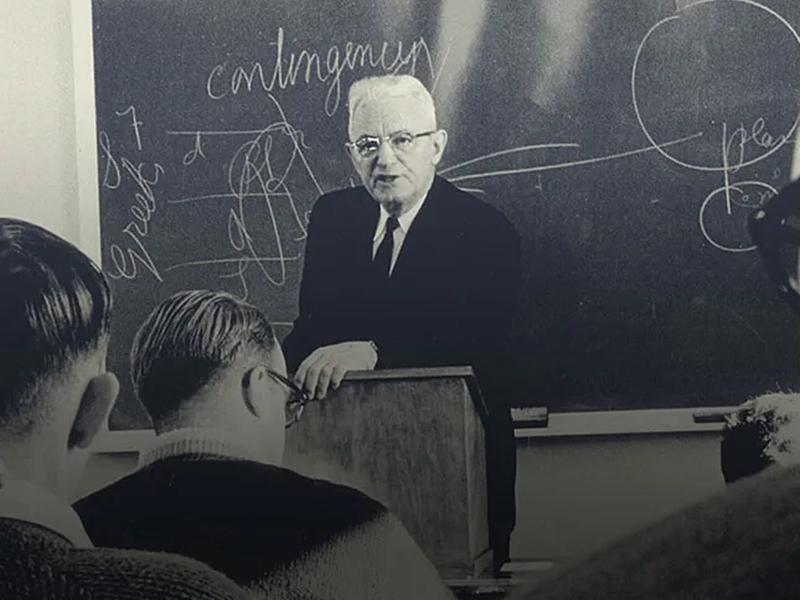
Presumptuous Presuppositions: The Apologetics of Cornelius Van Til

Whether one entirely agrees with him or not, no Christian interested in apologetics–the reasoned defense of the Faith–can afford to be uninterested in Cornelius Van Til, the late professor of Apologetics at Westminster Theological Seminary in Philadelphia. According to John Frame, Van Til “is perhaps the most important thinker since…

by Mark HorneJuly 15, 1997

trnava-university-beeyeib-am8-unsplash
Baptism

Richard Bacon’s “What Mean Ye By This Service? Paedocommunion in Light of the Passover” A Brief Response

Reverend Richard Bacon is the pastor of First Presbyterian Church of Rowlett, Texas. He has written a tract entitled “What Mean Ye By This Service? Paedocommunion in Light of Passover,” printed by Presbyterian Heritage Publications (P.O. Box 180922, Dallas, TX 75218). I am writing this brief response to set forth…

by Mark HorneJuly 6, 1997
aaron-burden-qjdzyt_k8xg-unsplash
Angels

Twelve Fundamental Avenues of Revelation, Part 5

As we move toward a consideration of Dynamic Cosmic Revelation, there is a further aspect of revelation through action that should be discussed here, and that is this: God is particularly revealed to us in times of crisis and distress. When things are going well, we forget God. When distress…

by James B. JordanJuly 3, 1997
jan-kahanek-g3o5ztrk2e4-unsplash
Biblical Chronology

John Sailhamer Weighs In, Part 4

We conclude our analysis of John Sailhamer’s book *Genesis Unbound: A Provocative New Look at the Creation Account* (Multnomah Books, 1996), which argues that Genesis 1:2ff. is not about the creation of the whole world, but about the preparation of the Land of Eden, which is also the Promised Land.…

by James B. JordanJuly 3, 1997
screenshot-2023-09-04-at-10-37-01-am
Biblical Horizons

The Sin of Ham and the Curse of Canaan, Part 2 (An Exposition of Genesis 9:20-27)

Commentary A. Noah’s God-like Labor: 8:20 And Noah, a master of the ground, was the first, And he planted a vineyard. 21 And he drank from the wine, And became drunk, And lay uncovered inside his tent. It appears to me that there is a balance between "ground" and "tent"…

by James B. JordanJuly 3, 1997
e99a4713
How to Worship

Why Does the Pastor Wear a Robe?

A Defense of the Use of the Ministerial Robe in Public Worship The purpose of this series of articles is to explain our biblical philosophy of worship and how we have sought to implement it here at Providence Reformed Presbyterian Church. We have thought through our worship services. We have…

by Jeff MeyersJune 20, 1997

Showing page 255 of 309

See all
See all
Science

Devil’s Delusion

Of all the people I’ve seen on film recently, the one I’d most want to be is David Berlinski, whom Ben Stein interviewed extensively in his Paris apartment that reeked with sophistication and culture. Berklinski, by his own definition a “secular Jew” with no memory of Hebrew, has just published…

May 21, 2008

Obama’s subtexts

In an intriguing piece in TNR , writer Cinque Henderson - who identifies himself as one of the few remaining Clinton supporters among African-Americans - explains Obama’s use of “hoodwinked” and “bamboozled” (not the first words to spring to Obama’s lips, one would think) in the South Carolina primary: “It…

May 21, 2008
Philosophy

Flat souls

Kristeva says that contemporary culture separates affects from language, which leads to a loss of soul. Souls are empty. To help, our culture offers drugs and entertainment. Drugs flatten experience to a drone; entertainment dazzles momentarily with two-dimensional images. So do our solutions increase the problem. Flat remedies for flat…

May 20, 2008

Body/Language

Kristeva’s distinction of semiotic and symbolic is intended to overcome the dualism of traditional linguistic theories, the dualism of body and language, or matter and language. For Kristeva, the “semiotic” is the way drives are organized or “discharged” in language, and thus includes everything that is meaningful in language but…

May 20, 2008

Langue without speakers

Julia Kristeva notes that Saussure’s linguistic theory permits “linguistics to claim a logical, mathematical formalization on the one hand, but on the other, it definitely prevents reducing a language or text to one law or one meaning.” This latter point is true because by splitting the sign into signified and…

May 20, 2008

Limits of Dialectic

Desmond thinks that dialectic makes some gains: It affirms the “complex sense of unity,” appreciates mediation, critiques dualism, defends the “interplay and community of immanence and transcendence.” But dialectic cannot be the final moment of metaphysics. Why? “The problem is that if we privilege self-mediation and erect this into the…

May 20, 2008

Showing page 1516 of 2212

Browse by Category

In Medias Res

Your weekly digest for all things Theopolis.

Donate

Theopolis is nearly 100% donor-supported. Consider joining us on our mission.









