Theopolis Logo

Writing

Explore our collection of theological essays, biblical studies, and reflections on faith and culture.

See all
little-girl
Children

Honor God With Your Body

I am making a new rule in our house! We are actually kind of skimpy on the house rules. I try very hard to keep things simple: love God, love others, be joyful. It’s not complicated to avoid discipline here. But I have found myself repeating this new rule over…

by Lindsey TollefsonApril 9, 2015

giotto-noli-me-3
John

The Gardener and the Beloved, (Part 3)

Click HERE for Part 2 The voice of Jesus transforms and changes Mary when she hears him speak her name. This is her last “turning.” So also the woman in the Song of Songs longs to hear the voice of her beloved. Let me see your face, let me hear…

by Jeff MeyersApril 6, 2015
giotto-noli-me-2
John

The Gardener and the Beloved, (Part 2)

Click HERE for Part 1. The details of this story call the attentive reader back to the drama of Solomon’s Song of Songs. And the Song of Song’s alludes to, ties us into the story of Adam and Eve in the Garden and the promise of a coming Messiah that…

by Jeff MeyersApril 4, 2015
easter-term-2015-2
Theopolis News

Easter Term, 2015

“The course was a paradigm shift for me,” said Jonathan Sedlak, a Milwaukee electrical contractor who attended Theopolis’s course on Revelation. “I am left with a book that is far more practical than it has ever seemed before.” Jonathan Anderson of Louisville, Kentucky found the course “refreshing.” “I finished with…

by TheopolisApril 2, 2015
psalm-singing
Genesis

Worship as Response: Liturgical Logic, (Part 1)

“It is only by participation in a rational, practice-based community that one becomes rational.” – Alasdair MacIntyre It may be perfectly clear to a chef why adding unsifted powdered sugar to a hot frosting is a bad idea. But for an amateur cook, this may be the kind of rule…

by Jonathan BarlowApril 2, 2015
giotto-noli-me
John

The Gardener and the Beloved, (Part 1)

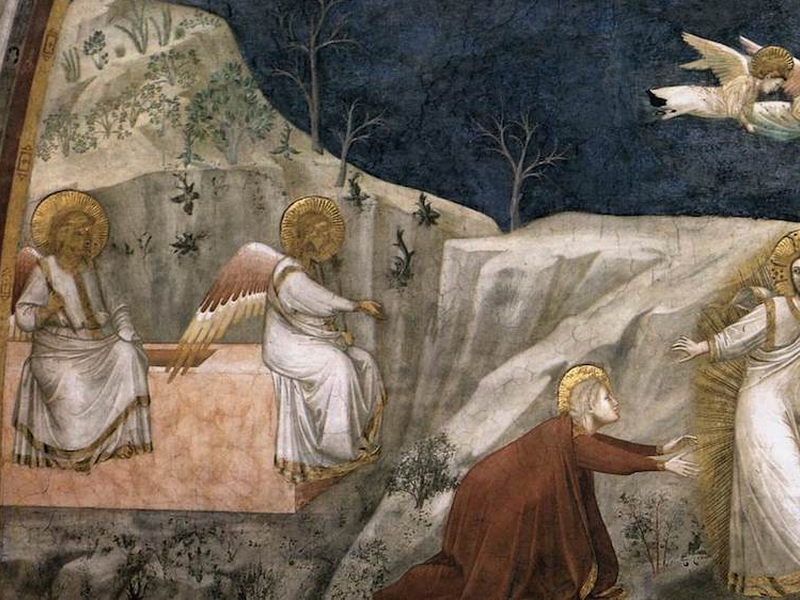
On a fresco in a chapel in Padua, Italy, there is a famous painting depicting the dramatic post-resurrection scene in John 20 with Mary and Jesus outside of the garden tomb. Giotto di Bondone painted it in the early 14th century. Jesus is striding from the tomb with a victor’s…

by Jeff MeyersApril 1, 2015

Showing page 156 of 309

See all
See all
History

Saving the flesh

Melanchthon wrote, “The views of Erasmus might have caused greater tumults if Luther had not arisen to arrest them . . . all of this tragedy about the Lord’s Supper started from him.” Melanchthon had in mind Erasmus’s Neo-platonic disparagement of matter, which infected Zwingli and filtered into Anabaptist theology.…

April 30, 2008

Tyre’s sacrifice

Zechariah predicts that Tyre will be dispossessed and her wealth cast into the sea (v. 4), and then the city will be “consumed with fire.” The verb is the common verb for “eating,” and the picture of an “eating fire” sends the mind back to the sacrificial system, where the…

April 29, 2008

Wisdom of Tyre

Zechariah 9:1-4 focuses on the conquest of Tyre, the “wise” city, shrewd at least in amassing wealth (v. 3). But the celebratory description contains a subversive pun. The Hebrew for Tyre is tsor (“rock”), and Zechariah says that Tyre has built herself a fortress, a word built on the same…

April 29, 2008
History

Counting years

In the second edition of African Religions and Philosophy (1989), John Mbiti says that Africans generally lack a concept of the future. Their future tenses reach only a short time into the past, and one people leave the present they are absorbed into an atemporal afterlife. Mbiti notes as well…

April 28, 2008
History

Scale of religions

E.B. Tylor was the first to characterize African religions as “animist,” remarking that “one great element of religion, that moral element which among the higher nations forms its most vital part, is indeed little represented in the religion of the lower races.” Others characterized the”lower religions” as “fetishist” because of…

April 28, 2008
History

Vindication of Barbarians

Tatian’s Oration to the Greeks is an attempt to vindicate the wisdom of Moses against Greek snobbery toward the barbarians. Aime Puech points out that chronology was central to Tatian’s argument: “In order to rehabilitate the Barbarians it was important to prove that they had contributed their share, indeed the…

April 28, 2008

Showing page 1525 of 2212

Browse by Category

In Medias Res

Your weekly digest for all things Theopolis.

Donate

Theopolis is nearly 100% donor-supported. Consider joining us on our mission.