Theopolis Logo

Writing

Explore our collection of theological essays, biblical studies, and reflections on faith and culture.

See all
little-girl
Children

Honor God With Your Body

I am making a new rule in our house! We are actually kind of skimpy on the house rules. I try very hard to keep things simple: love God, love others, be joyful. It’s not complicated to avoid discipline here. But I have found myself repeating this new rule over…

by Lindsey TollefsonApril 9, 2015

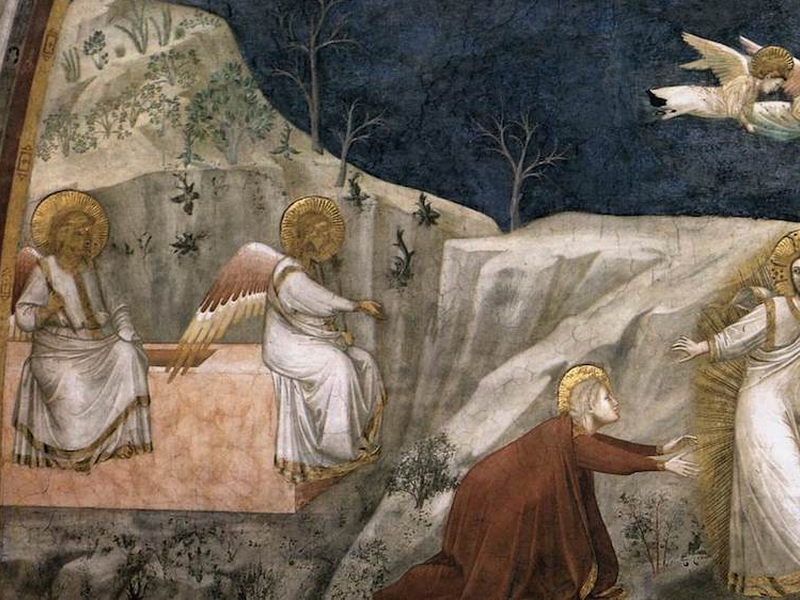
giotto-noli-me-3
John

The Gardener and the Beloved, (Part 3)

Click HERE for Part 2 The voice of Jesus transforms and changes Mary when she hears him speak her name. This is her last “turning.” So also the woman in the Song of Songs longs to hear the voice of her beloved. Let me see your face, let me hear…

by Jeff MeyersApril 6, 2015
giotto-noli-me-2
John

The Gardener and the Beloved, (Part 2)

Click HERE for Part 1. The details of this story call the attentive reader back to the drama of Solomon’s Song of Songs. And the Song of Song’s alludes to, ties us into the story of Adam and Eve in the Garden and the promise of a coming Messiah that…

by Jeff MeyersApril 4, 2015
easter-term-2015-2
Theopolis News

Easter Term, 2015

“The course was a paradigm shift for me,” said Jonathan Sedlak, a Milwaukee electrical contractor who attended Theopolis’s course on Revelation. “I am left with a book that is far more practical than it has ever seemed before.” Jonathan Anderson of Louisville, Kentucky found the course “refreshing.” “I finished with…

by TheopolisApril 2, 2015
psalm-singing
Genesis

Worship as Response: Liturgical Logic, (Part 1)

“It is only by participation in a rational, practice-based community that one becomes rational.” – Alasdair MacIntyre It may be perfectly clear to a chef why adding unsifted powdered sugar to a hot frosting is a bad idea. But for an amateur cook, this may be the kind of rule…

by Jonathan BarlowApril 2, 2015
giotto-noli-me
John

The Gardener and the Beloved, (Part 1)

On a fresco in a chapel in Padua, Italy, there is a famous painting depicting the dramatic post-resurrection scene in John 20 with Mary and Jesus outside of the garden tomb. Giotto di Bondone painted it in the early 14th century. Jesus is striding from the tomb with a victor’s…

by Jeff MeyersApril 1, 2015

Showing page 156 of 309

See all
See all

Product not sum

Saussure argues that syntagmatic relations are more like multiplication than addition. Adding - eux to desir is not putting together “independent units”; rather the two “form a product, a combination of interdependent elements, their value deriving solely from their mutual contributions within a higher unit.” At another level, we can…

March 27, 2008

Meaning and value

Would Saussure have agreed with Barr’s challenge to the notion that there is a difference between Greek and Hebraic mentalities evident in the differences between the languages? Barr appeals to Saussure at one or two points in his book ( Semantics ), and his project as a whole is reliant…

March 27, 2008
History

“Religion” in England

The English civil war, that is. Peter Harrison ( ‘Religion’ and the Religions in the English Enlightenment ) traces the notion of comparative religious study to the confessional disputes in England, and the “diachronic pluralism” of the English monarchy: “As Locke put it, the kings and queens of post-Reformation England…

March 27, 2008

Segmenting sounds

At a couple of points in his Course , Saussure suggests that the “primary characteristic of the spoken sequence is its linearity.” It is a “chain,” a “line.” I find this questionable, but he makes interesting use of the image: “In itself, it is merely a line, a continuous ribbon…

March 26, 2008

Chemical reaction

A “sign” in Saussure’s terminology consists of a signification (a concept or idea) and a signal (the “sound pattern” associated with the idea). He suggests some analogies: “This unified duality has often been compared with that of the human being, comprising body and soul. But the parallel is unsatisfactory. A…

March 26, 2008

Linguistic system

Saussure associates langue with collective social realities; it is the system created by society and existing, almost identically, in every member of a linguisitic community. He associates parole , in turn, with individual expressions within the system. The system is impervious to change: “changes are never made to the system…

March 26, 2008

Showing page 1545 of 2212

Browse by Category

In Medias Res

Your weekly digest for all things Theopolis.

Donate

Theopolis is nearly 100% donor-supported. Consider joining us on our mission.