Theopolis Logo

Writing

Explore our collection of theological essays, biblical studies, and reflections on faith and culture.

See all
little-girl
Children

Honor God With Your Body

I am making a new rule in our house! We are actually kind of skimpy on the house rules. I try very hard to keep things simple: love God, love others, be joyful. It’s not complicated to avoid discipline here. But I have found myself repeating this new rule over…

by Lindsey TollefsonApril 9, 2015

giotto-noli-me-3
John

The Gardener and the Beloved, (Part 3)

Click HERE for Part 2 The voice of Jesus transforms and changes Mary when she hears him speak her name. This is her last “turning.” So also the woman in the Song of Songs longs to hear the voice of her beloved. Let me see your face, let me hear…

by Jeff MeyersApril 6, 2015
giotto-noli-me-2
John

The Gardener and the Beloved, (Part 2)

Click HERE for Part 1. The details of this story call the attentive reader back to the drama of Solomon’s Song of Songs. And the Song of Song’s alludes to, ties us into the story of Adam and Eve in the Garden and the promise of a coming Messiah that…

by Jeff MeyersApril 4, 2015
easter-term-2015-2
Theopolis News

Easter Term, 2015

“The course was a paradigm shift for me,” said Jonathan Sedlak, a Milwaukee electrical contractor who attended Theopolis’s course on Revelation. “I am left with a book that is far more practical than it has ever seemed before.” Jonathan Anderson of Louisville, Kentucky found the course “refreshing.” “I finished with…

by TheopolisApril 2, 2015
psalm-singing
Genesis

Worship as Response: Liturgical Logic, (Part 1)

“It is only by participation in a rational, practice-based community that one becomes rational.” – Alasdair MacIntyre It may be perfectly clear to a chef why adding unsifted powdered sugar to a hot frosting is a bad idea. But for an amateur cook, this may be the kind of rule…

by Jonathan BarlowApril 2, 2015
giotto-noli-me
John

The Gardener and the Beloved, (Part 1)

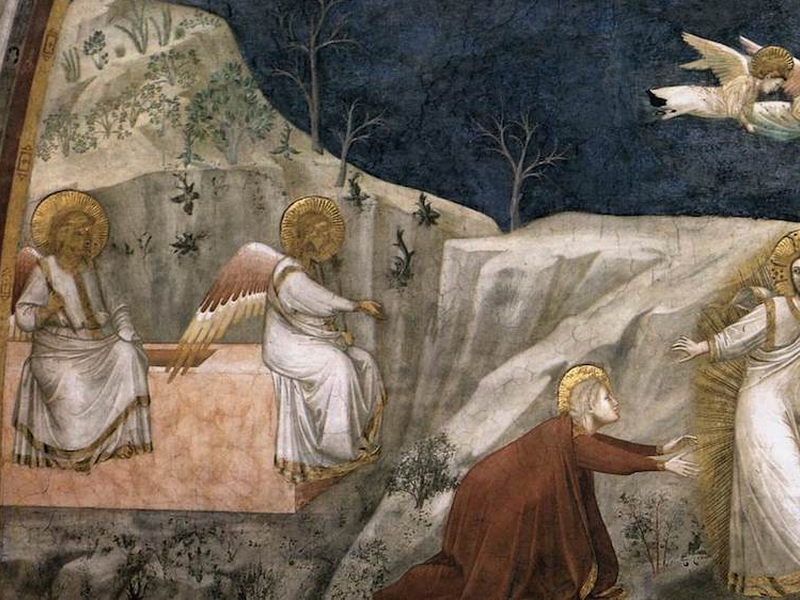
On a fresco in a chapel in Padua, Italy, there is a famous painting depicting the dramatic post-resurrection scene in John 20 with Mary and Jesus outside of the garden tomb. Giotto di Bondone painted it in the early 14th century. Jesus is striding from the tomb with a victor’s…

by Jeff MeyersApril 1, 2015

Showing page 156 of 309

See all
See all

Jesus the temple

Matthew quotes Isaiah 53:4 to explain how Jesus removes illness and uncleanness (Matthew 8:17). Jesus radiates life, and that life heals the sick and raises the dead. Jesus also accepts death and uncleanness on Himself, to be borne away on the cross. This latter process shows Jesus as temple. Milgrom…

January 26, 2008

Augustine, feminist

In City of God , Augustine condemns Rome for passing the Voconian law during the period between the second and third Punic war. This “forbade anyone to make a woman, not even an only daughter, an heir.” He adds, “I do not know of any law that could be said…

January 25, 2008
Politics

Clintons again

Peggy Noonan puts it this way in today’s Wall Street Journal online: “Bill Clinton, with his trembly, red faced rage, makes John McCain look young. His divisive and destructive daily comportment—this is a former president of the United States—is a civic embarrassment. It is also an education, and there is…

January 25, 2008

Eclipse

Augustine points out that the eclipse during Jesus’ death was not a natural occurrence, since Jesus’ death took place at Passover and eclipses normally take place only in the “last quarter of the moon.” So, why did the Lord rearrange the cycles of the heavens for this purpose? The symbolism…

January 25, 2008
Politics

Clinton

Jim Rogers of Texas A&M writes in response to my earlier post on Bill and Hillary: Re your question: ‘Why run a candidate who immediately alienates a large proportion of the voting population?’ Answer: Because the median voter determines elections. If you alienate 49.99% of the voting population, you still…

January 24, 2008
Literature

Nature and art

Nuttall describes Love’s Labour’s Lost as manifesting an “hysteria of style” like the hysteria of Titus , but with a concentration on a “feast of languages.” The setting for the play is a humanist academy, but one that also follows a medieval rule of renunciation of the flesh in favor…

January 24, 2008

Showing page 1577 of 2212

Browse by Category

In Medias Res

Your weekly digest for all things Theopolis.

Donate

Theopolis is nearly 100% donor-supported. Consider joining us on our mission.