Theopolis Logo

Writing

Explore our collection of theological essays, biblical studies, and reflections on faith and culture.

See all
kristina-flour-bcjdbykwquw-unsplash
Culture

On Foul Language

The Stranger: Do you have to use so many cuss words? The Dude: What the f*ck you talking about? - The Big Lebowski There was a man I knew, an elder at his church, who, whenever he was called upon to announce a pregnancy, preferred the euphemism “with child” because…

by Remy WilkinsJanuary 12, 2016

organ-pipes
How to Worship

Pipes Worth Playing

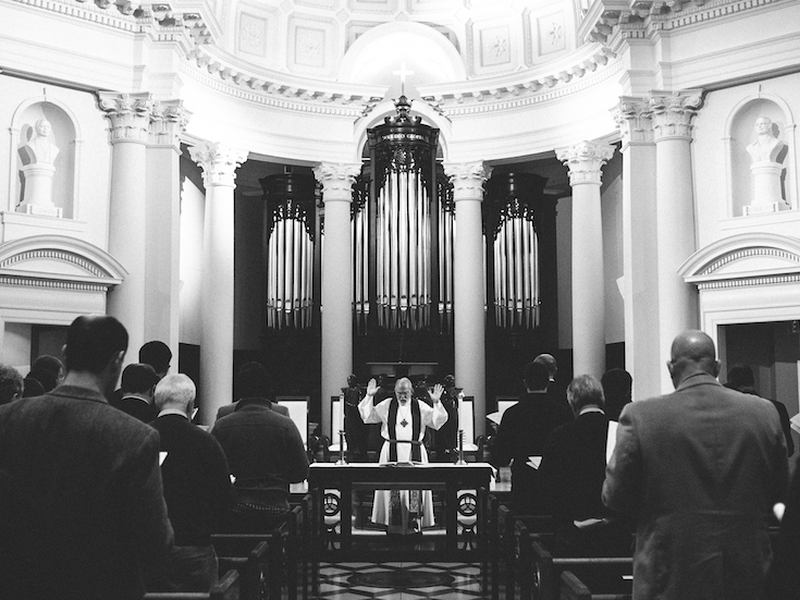
I know what you’re thinking. Organ: funeral, ball game, grand dusty cathedral. Why should modern Christians of such a technological age revisit a thousand year-old instrument? Don’t worry, I will not be trying to punch another hole in my Weird Music Preferences and Opinions card here. The truth is, our…

by Jarrod RicheyJanuary 7, 2016
tree-2
James

Do Things Have Natures?

Do things have natures? As I am posing the question, it is not simply a question of whether there are particular kinds of things in the world that have characteristic features, patterns of behavior, trajectories of growth and development. If that is what the word means, then the answer is…

by Peter LeithartJanuary 5, 2016
jim-leading-worship
Theopolis News

2016 Nevin Lectures with Father John Behr

We are excited to announce our 2016 Nevin Lectures featuring Father John Behr. Fr. John is the Dean of St. Vladimir's Seminary and Professor of Patristics, as well as the author of multiple works. He will be delivering three lectures over the course of two days dealing with "What Protestants…

by Brian MoatsJanuary 4, 2016
times-square
Creation

Time, Curse or Gift?

New Year's Day makes one reflective, at least about the past year, perhaps about life, perhaps, more broadly, about time itself. Many view time as a curse. Some see it as a curse because of missed chances. As one day or year moves on to the next, all we can…

by Peter LeithartDecember 31, 2015
nativity-2
Advent

The Manger

It seems a truism to say that we live in the world: that the world is outside of us. In reality the world is very much inside of us too. In fact the world passes through us as much as we pass through it. We breathe in its air, using…

by Arthur KayDecember 29, 2015

Showing page 138 of 309

See all
See all
Philosophy

Heidegger and the gift

Marion works from both Husserl and Heidegger, and we’ll focus on the latter, as he is slightly easier to grasp. (I am summarizing Robyn Horner’s discussion.) Heidegger begins from Husserl, but seeks to go beyond him. Husserl’s phenomenology was an effort, Heidegger says, to “let that which shows itself be…

November 28, 2007

Sermon Notes, First Advent

INTRODUCTION Isaiah is the great prophet of the incarnation, but Isaiah is a bit too large to cover during the four weeks of Advent. Micah, though, prophesied at the same time as Isaiah (Micah 1:1; Isaiah 1:1), and the prophecies overlap (Micah 4:1-3; Isaiah 2:1-4) and Micah includes a major…

November 26, 2007

Eucharistic meditation

Psalm 128:5-6: The LORD bless you out of Zion, and may you see the good of Jerusalem all the days of your life. Yes, may you see your children’s children. Peace be upon Israel. We saw in the sermon this morning that the man who fears Yahweh can hope for…

November 25, 2007
Theology

Exhortation

As soon as Adam sins, his marriage is disrupted, as he becomes Eve’s accuser instead of her guardian. In the next generation, sibling rivalry escalates to the first murder. The family is a fallen institution. It cannot redeem. It needs to be redeemed. The story continues throughout the Old Testament.…

November 25, 2007
Literature

Meta-Theater

During one scene of King Lear, Edgar, disguised as Mad Tom, leads his father, Gloucester to the cliffs of Dover, where his father intends to throw himself down to his death. Only Edgar doesn’t go to Dover. He tells his father that he has reached Dover, and Gloucester ceremoniously throws…

November 24, 2007
History

Stoic and Christian

For the Stoics, as for most ancient philosophers who reflected on signs, signs were examined as part of a theory of inference. A sign was a symptom, and the medical usage is often overt in examples; or a sign is a premise of an argument, from which something unknown can…

November 24, 2007

Showing page 1601 of 2212

Browse by Category

In Medias Res

Your weekly digest for all things Theopolis.

Donate

Theopolis is nearly 100% donor-supported. Consider joining us on our mission.