Theopolis Logo

Writing

Explore our collection of theological essays, biblical studies, and reflections on faith and culture.

See all
5f72533d0afa437fcaa7e5cf_hero_history
Apologetics

Presumptuous Presuppositions: The Apologetics of Cornelius Van Til

Whether one entirely agrees with him or not, no Christian interested in apologetics–the reasoned defense of the Faith–can afford to be uninterested in Cornelius Van Til, the late professor of Apologetics at Westminster Theological Seminary in Philadelphia. According to John Frame, Van Til “is perhaps the most important thinker since…

by Mark HorneJuly 15, 1997

trnava-university-beeyeib-am8-unsplash
Baptism

Richard Bacon’s “What Mean Ye By This Service? Paedocommunion in Light of the Passover” A Brief Response

Reverend Richard Bacon is the pastor of First Presbyterian Church of Rowlett, Texas. He has written a tract entitled “What Mean Ye By This Service? Paedocommunion in Light of Passover,” printed by Presbyterian Heritage Publications (P.O. Box 180922, Dallas, TX 75218). I am writing this brief response to set forth…

by Mark HorneJuly 6, 1997
aaron-burden-qjdzyt_k8xg-unsplash
Angels

Twelve Fundamental Avenues of Revelation, Part 5

As we move toward a consideration of Dynamic Cosmic Revelation, there is a further aspect of revelation through action that should be discussed here, and that is this: God is particularly revealed to us in times of crisis and distress. When things are going well, we forget God. When distress…

by James B. JordanJuly 3, 1997
jan-kahanek-g3o5ztrk2e4-unsplash
Biblical Chronology

John Sailhamer Weighs In, Part 4

We conclude our analysis of John Sailhamer’s book *Genesis Unbound: A Provocative New Look at the Creation Account* (Multnomah Books, 1996), which argues that Genesis 1:2ff. is not about the creation of the whole world, but about the preparation of the Land of Eden, which is also the Promised Land.…

by James B. JordanJuly 3, 1997
screenshot-2023-09-04-at-10-37-01-am
Biblical Horizons

The Sin of Ham and the Curse of Canaan, Part 2 (An Exposition of Genesis 9:20-27)

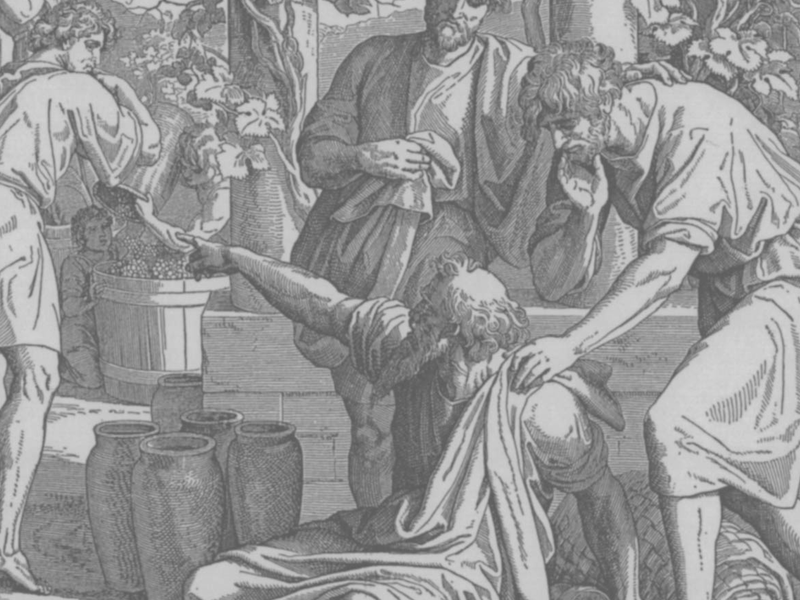
Commentary A. Noah’s God-like Labor: 8:20 And Noah, a master of the ground, was the first, And he planted a vineyard. 21 And he drank from the wine, And became drunk, And lay uncovered inside his tent. It appears to me that there is a balance between "ground" and "tent"…

by James B. JordanJuly 3, 1997
e99a4713
How to Worship

Why Does the Pastor Wear a Robe?

A Defense of the Use of the Ministerial Robe in Public Worship The purpose of this series of articles is to explain our biblical philosophy of worship and how we have sought to implement it here at Providence Reformed Presbyterian Church. We have thought through our worship services. We have…

by Jeff MeyersJune 20, 1997

Showing page 255 of 309

See all
See all
Theology

Abraham

Kant viewed Judaism as a narrow, particular, hostile political entity. The fact that God promised that He would bless the nations through Abraham seems not to have registered with Kant. Kant’s treatment of Judaism has central importance in his construction of modern, Enlightened religion. And in this context, recent work…

September 12, 2007
Philosophy

Kant’s eschatology

Postmodernism is rigorous disbelief in eschatology, in final judgment. And this arises from and is a reaction to Kant, who (as Hamann recognized) believed he had somehow arrived at the eschaton ahead of schedule and spend his life sending back reports.

September 12, 2007
Theology

Barth on post-Kantian Theology

Barth’s includes an extensive treatment of Kant in his history of 19th century Protestant theology. According to Barth, Kant represents the 18th-century’s coming to self-consciousness. He saw both the possibilities and the limits of the Enlightenment’s obsessions with reason. He announces that his age is the age of criticism, but…

September 12, 2007

Kant’s impossible atonement

Nicholas Wolterstorff analyzes the “conundrum” of atonement in Kant’s treatment of rational religion. We need to be forgiven for the evil we’ve done, and we are incapable of doing this ourselves. God has to do it. Yet, Kant assumes a radical form of autonomy, which makes our moral value depend…

September 11, 2007

Showing page 1631 of 2212

Browse by Category

In Medias Res

Your weekly digest for all things Theopolis.

Donate

Theopolis is nearly 100% donor-supported. Consider joining us on our mission.