Theopolis Logo

Writing

Explore our collection of theological essays, biblical studies, and reflections on faith and culture.

See all
little-girl
Children

Honor God With Your Body

I am making a new rule in our house! We are actually kind of skimpy on the house rules. I try very hard to keep things simple: love God, love others, be joyful. It’s not complicated to avoid discipline here. But I have found myself repeating this new rule over…

by Lindsey TollefsonApril 9, 2015

giotto-noli-me-3
John

The Gardener and the Beloved, (Part 3)

Click HERE for Part 2 The voice of Jesus transforms and changes Mary when she hears him speak her name. This is her last “turning.” So also the woman in the Song of Songs longs to hear the voice of her beloved. Let me see your face, let me hear…

by Jeff MeyersApril 6, 2015
giotto-noli-me-2
John

The Gardener and the Beloved, (Part 2)

Click HERE for Part 1. The details of this story call the attentive reader back to the drama of Solomon’s Song of Songs. And the Song of Song’s alludes to, ties us into the story of Adam and Eve in the Garden and the promise of a coming Messiah that…

by Jeff MeyersApril 4, 2015
easter-term-2015-2
Theopolis News

Easter Term, 2015

“The course was a paradigm shift for me,” said Jonathan Sedlak, a Milwaukee electrical contractor who attended Theopolis’s course on Revelation. “I am left with a book that is far more practical than it has ever seemed before.” Jonathan Anderson of Louisville, Kentucky found the course “refreshing.” “I finished with…

by TheopolisApril 2, 2015
psalm-singing
Genesis

Worship as Response: Liturgical Logic, (Part 1)

“It is only by participation in a rational, practice-based community that one becomes rational.” – Alasdair MacIntyre It may be perfectly clear to a chef why adding unsifted powdered sugar to a hot frosting is a bad idea. But for an amateur cook, this may be the kind of rule…

by Jonathan BarlowApril 2, 2015
giotto-noli-me
John

The Gardener and the Beloved, (Part 1)

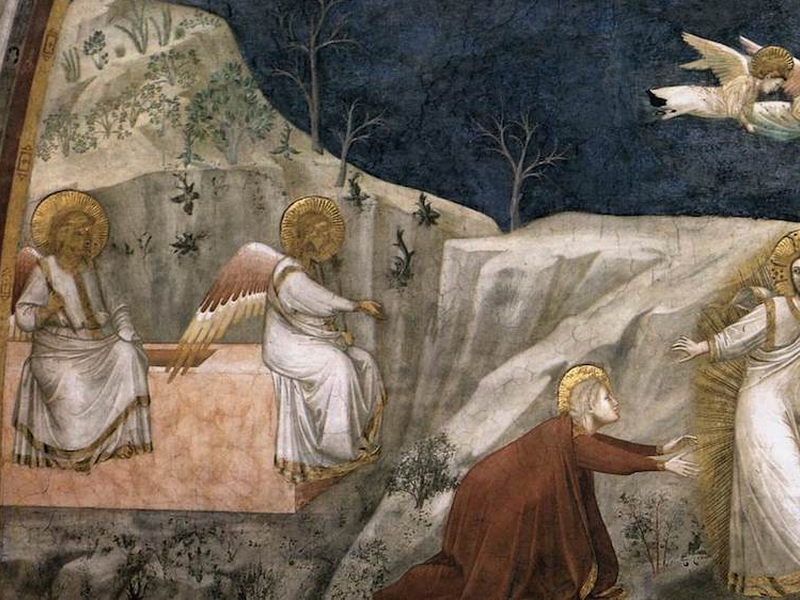
On a fresco in a chapel in Padua, Italy, there is a famous painting depicting the dramatic post-resurrection scene in John 20 with Mary and Jesus outside of the garden tomb. Giotto di Bondone painted it in the early 14th century. Jesus is striding from the tomb with a victor’s…

by Jeff MeyersApril 1, 2015

Showing page 156 of 309

See all
See all

Vestigia trinitatis

In an article on vestigia trinitatis in early modern thought, Dennis Klinck notes that the early 17th century saw a flowering of Trinitarian theology in England. Theologians, poets, and others saw the Trinity reflected in political life, human psychology, every sphere of knowledge. They agreed fully with the Augustinian doctrine…

August 21, 2007

Donne on the Trinity

In stanza 4 of Donne’s “Litanie,” he addresses the Trinity: O Blessed glorious Trinity, Bones to Philosophy, but milke to faith, Which, as wise serpents, diversly Most slipperinesse, yet most entanglings hath, As you distinguish’d undistinct By power, love, knowledge bee, Give mee a such selfe different instinct Of these;…

August 21, 2007
Philosophy

Intention and action

In his summary of “identity description,” which he ultimately applies to Jesus, Hans Frei speaks of “the irreversible passage or movement from . . . intention to action. The enactment of intention always differs from the intention to enact; and each person has inside knowledge of how he passes from…

August 21, 2007
Literature

Jane’s tough world

In early August, Lev Grossman wrote a piece for Time on the continuing apotheosis of Jane Austen: “It was a cliché 10 years ago to say that the Austen phenomenon was big. It has now burst completely out of its bodice. Jane Austen, who recorded the last gorgeous gasp of…

August 21, 2007
History

Slavery and self-interest

During his 1842 tour of the US, Charles Dickens met a southerner who tried to convince him that harsh treatment of slaves was against the self-interest of Southern slaveholders. Dickens’s response was devastating: “I told him quietly that it was not a man’s interest to get drunk, or to steal,…

August 21, 2007

Showing page 1643 of 2212

Browse by Category

In Medias Res

Your weekly digest for all things Theopolis.

Donate

Theopolis is nearly 100% donor-supported. Consider joining us on our mission.