Theopolis Logo

Writing

Explore our collection of theological essays, biblical studies, and reflections on faith and culture.

See all
aaron-burden-h8s0pf2rcqs-unsplash
Galatians

The Restoration of the Galatians

While controversies over the writings of Paul continue in various corners of the intellectual globe, the word of God given through Paul and his scribe and all of the church’s interpreters and translators over the last two millennia is still readily available to the lofty and the lowly. Paul, as…

by Grace LangnessMarch 25, 2013

kiwihug-l4gw27xzn1i-unsplash
Deuteronomy

Law and History: How to Read the Law of Moses (Part 2)

The second in a series of studies in Deuteronomy. Deuteronomy 22:30: A man shall not take his father’s wife, and shall not uncover his father’s wing (Hebrew: kanaf ). There are a number of unusual features in this law that mark it out from the previous context, indicating that it…

by Ralph Allan SmithMarch 20, 2013
200403-moss-pilate-tease_pncfq5
History

Victimhood and the Gospel

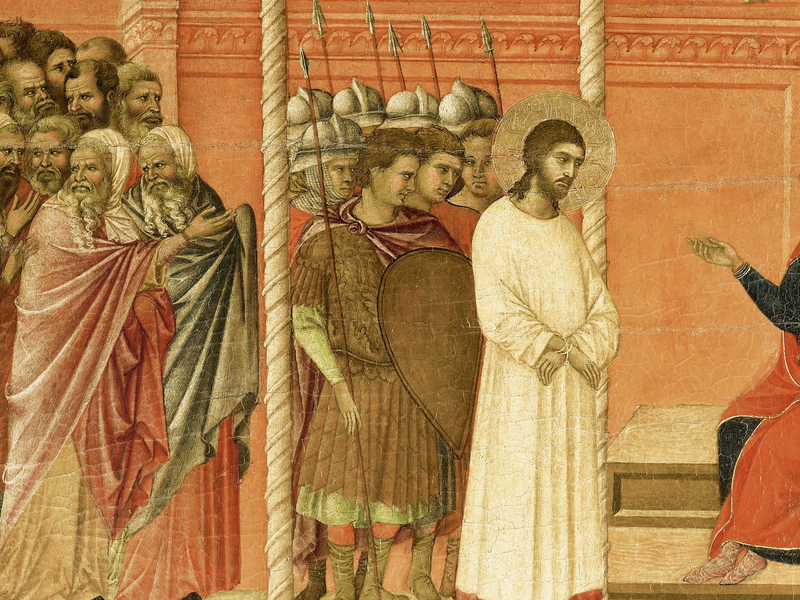
The texts of Christianity have been slowly at work, under the power of the Holy Spirit for 2000 years now. If we could be magically transported back into the world of two millennia ago, modern Americans would be shocked at the cruelty of that world. There was no concern for…

by Richard BledsoeMarch 18, 2013
aaron-burden-1ebsmyrau-s-unsplash
Luke

The Dysfunctional Family of the Gadarene Madman

The Story of the Gadarene Madman is told in all three synoptic Gospels (Matthew 8:28-34, Mark 5:1-20, Luke 8:26-37). Jesus ventures into a Gentile area when He passes over the Sea of Galilee. Upon disembarking from his boat, he is immediately met by a demon-possessed madman. Upon meeting Jesus, he…

by Richard BledsoeMarch 13, 2013
aaron-burden-1ebsmyrau-s-unsplash
Deuteronomy

Law and History: How to Read the Law of Moses

Part 1 of a multi-part series of studies on Deuteronomy 22:30-23:8. Eric Auerbach, in his classic work on Western literature, devotes his first chapter to contrasting Homer with the Bible. Of Homer, he writes of the “need of Homeric style to leave nothing which it mentions half in darkness and…

by Ralph Allan SmithMarch 12, 2013
markus-winkler-aid-xyrtlec-unsplash
Theopolis News

James Jordan in Korea, Japan

Trinity House Fellow James B. Jordan will be a speaker at an International Conference on Biblical Symbolism that will be held in Seoul on Monday, May 27 in 2013. He will address "The Importance of Biblical Symbolism and Symbolic Interpretation of the Bible." The conference will have three other speakers…

by Peter LeithartMarch 9, 2013

Showing page 197 of 309

See all
See all
Art

Museums, Agents of relativism

Aesthetic consciousness - the capacity to abstract the aesthetic component in all perception, so as to view everything “aesthetically” - also implies, Gadamer argues, a particular notion of simultaneity. Because it abstracts the aesthetic value of the work, and downplays or ignores all other aspects of an aesthetic object, the…

January 4, 2007
Art

Art and appearance

After Kant, and especially after Kant’s romantic disciples, art came to be viewed as a matter of beautiful appearance, consciously defined in contrast to practical reality. This had not always been the Western conception of art. Gadamer comments, “Traditionally the purpose of ‘art,’ which also includes all conscious transformation of…

January 3, 2007
History

Unintended consequences

In 1439, representatives of Eastern and Western churches met in Florence to heal the schism of 1054. An agreement was reached, but it remained a paper agreement only. But the event had enormous consequences for the future of the Western world. Because of the good will this ecumenical meeting produced,…

January 3, 2007

Politics of sleep

Still on Rosenstock-Huessy: “How could we enjoy a restful sleep without social peace? The Gestapo in many countries changes man back to the deer whose sleep is perfunctory and scanty.” No political theory, or sociology, can be complete if it does not “include those who must wake when we are…

January 3, 2007

The limits of loyalty

Rosenstock-Huessy cites Josiah Royce’s The Philosophy of Loyalty as an example of a reductive view of human life. Royce rightly emphasizes the importance of loyalty, but then “could not resist the temptation to explain everything in terms of this one power which essentially binds us to the past.” But the…

January 3, 2007
American Religion

Christian America

Rosenstock-Huessy again: He writes that Christian conversion always involves a break with an old way of life, a breach with old loyalties and commitments, and a “verification” of that experience by an induction into a new people, “formerly overlooked or even despised, who now enable us to strengthen experience into…

January 3, 2007

Showing page 1742 of 2212

Browse by Category

In Medias Res

Your weekly digest for all things Theopolis.

Donate

Theopolis is nearly 100% donor-supported. Consider joining us on our mission.