Theopolis Logo

Writing

Explore our collection of theological essays, biblical studies, and reflections on faith and culture.

See all
trnava-university-beeyeib-am8-unsplash
Biblical Horizons

Book Review: The Keys of This Blood: The Struggle for World Dominion Between Pope John Paul II, Mikhail Gorbachev & the Capitalist West

Malachi Martin, The Keys of This Blood: The Struggle for World Dominion Between Pope John Paul II, Mikhail Gorbachev & the Capitalist West (New York: Simon and Schuster, 1990). Reviewed by Peter J. Leithart. The subtitle of this massive volume gives a good idea of its major theme. Martin, the…

by Peter LeithartJuly 6, 1991

venice-la-distruzione-del-tempio-di-gerusalemme-francesco-hayez-gallerie-accademia-venice
Biblical Horizons

The Abomination of Desolation, Part 3: An Overview of the Pattern

The Abomination of Desolation: PART 1 The Abomination of Desolation: PART 2 What I intend to do in this series of studies is this: First, in the present essay we shall survey the occurrences of the Abomination of Desolation in the Bible in a cursory way, in order to get…

by James B. JordanJune 22, 1991
venice-la-distruzione-del-tempio-di-gerusalemme-francesco-hayez-gallerie-accademia-venice
2 Thessalonians

The Abomination of Desolation, Part 2: The Man of Sin

We previously surveyed what is meant by the abomination of desolation . We suggested that it refers to sacrilegious acts performed by the religious leaders of Israel, captained by their High Priest, right in front of God’s face in the Temple. Later studies in this series will provide evidence for…

by James B. JordanJune 22, 1991
greg-rakozy-ompaz-dn-9i-unsplash-2
Biblical Chronology

The Framework Hypothesis

Throughout history, the Christian Church has had to guard against the heresy of gnosticism. Gnosticism is not an ordinary heresy, because it does not manifest itself as a set of defined beliefs. Rather, gnosticism is a tendency, a tendency to replace the historic facts of Christianity with philosophical ideas. Gnosticism…

by James B. JordanJune 22, 1991
synod-holy-fathers-large
Biblical Horizons

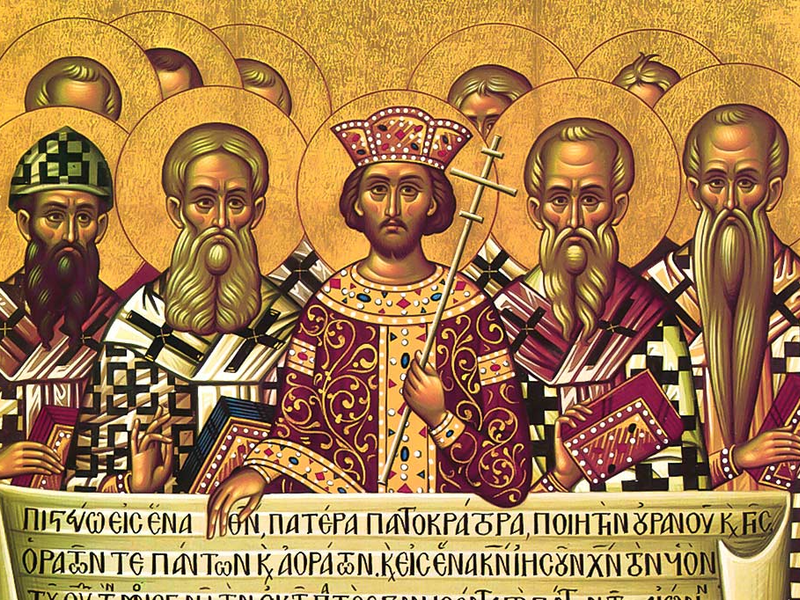
What About the “Seventh Ecumenical Council”?

In Rite Reasons Nos. 9-12, I discussed the errors of Roman Catholicism, Anglo-Catholicism, and Eastern Orthodoxy. I have had several requests to comment further on the so-called Seventh Ecumenical Council, held at Nicaea in A.D. 787. That Council ordered the excommunication of anyone who rejects the veneration of icons. 1…

by James B. JordanJune 22, 1991
debby-hudson-qa74yh6-xlc-unsplash
Philippians

The Theology of the Drink Offering

The drink offering or libation ( nesek ) is mentioned in only three places in the book of Leviticus. When the sheaf of the firstfruits was waved before the Lord, a grain offering was to be burned, along with "its libation, a fourth of a hin of wine [approx. one…

by Peter LeithartMay 30, 1991

Showing page 296 of 309

See all
See all
Philosophy

Heidegger in his woods

Latour is tired of being accused of having forgotten Being, and offers this clever brush-off of Heidegger: “If, scorning empiricism, you opt out of the exact sciences, then the human sciences,, then traditional philosophy, then the sciences of language, and you hunker down in your forest - then you will…

November 15, 2006
History

Semi-modernism

Postmoderns, Latour suggests, think they are still modern, but in fact they have greatly oversimplified the modern Constitution. Postmoderns might emphasize the separation of subject and world, and stretch that opposition to a breaking point (Latour vividly describes them as doing the splits to keep subject and world apart); but…

November 15, 2006
History

Modern temporality

In his very good section on modern temporality, Latour argues that modernity assumes that everything in the present, modern moment, is purely modern, novel. Anything that appears that is not up-to-date is a “archaism,” and moderns worry constantly that this or that event or trend might “turn back the clock.”…

November 15, 2006
History

Representation

One of the key moves made since the 17th century, Latour argues, is a distinction between modes of “representation.” In the laboratory Boyle is representing things before selected witnesses through scientific experiments, giving mute nature a voice through the scientist, while in politics Hobbes suggests that the Sovereign speaks for…

November 15, 2006
History

We Have Never Been Modern

Bruno Latour’s We Have Never Been Modern (Harvard 1993) is a rich study. He describes modernity in terms of a dual process of “purification” and “hybridization.” Purification involves the clean construction of a nature (and science) separated off from society and the self, while hybridization involves mixtures of nature and…

November 15, 2006

Tears of things

And/Or: Virgil is aware that the furor of civil war can be curbed only by an opposing, and more intense, furor. That, as Milbank says, is the way of paganism - peace established only by superior violence against violence. But in those tears Virgil expresses the the painful recognition -…

November 13, 2006

Showing page 1763 of 2212

Browse by Category

In Medias Res

Your weekly digest for all things Theopolis.

Donate

Theopolis is nearly 100% donor-supported. Consider joining us on our mission.