Theopolis Logo

Writing

Explore our collection of theological essays, biblical studies, and reflections on faith and culture.

See all
little-girl
Children

Honor God With Your Body

I am making a new rule in our house! We are actually kind of skimpy on the house rules. I try very hard to keep things simple: love God, love others, be joyful. It’s not complicated to avoid discipline here. But I have found myself repeating this new rule over…

by Lindsey TollefsonApril 9, 2015

giotto-noli-me-3
John

The Gardener and the Beloved, (Part 3)

Click HERE for Part 2 The voice of Jesus transforms and changes Mary when she hears him speak her name. This is her last “turning.” So also the woman in the Song of Songs longs to hear the voice of her beloved. Let me see your face, let me hear…

by Jeff MeyersApril 6, 2015
giotto-noli-me-2
John

The Gardener and the Beloved, (Part 2)

Click HERE for Part 1. The details of this story call the attentive reader back to the drama of Solomon’s Song of Songs. And the Song of Song’s alludes to, ties us into the story of Adam and Eve in the Garden and the promise of a coming Messiah that…

by Jeff MeyersApril 4, 2015
easter-term-2015-2
Theopolis News

Easter Term, 2015

“The course was a paradigm shift for me,” said Jonathan Sedlak, a Milwaukee electrical contractor who attended Theopolis’s course on Revelation. “I am left with a book that is far more practical than it has ever seemed before.” Jonathan Anderson of Louisville, Kentucky found the course “refreshing.” “I finished with…

by TheopolisApril 2, 2015
psalm-singing
Genesis

Worship as Response: Liturgical Logic, (Part 1)

“It is only by participation in a rational, practice-based community that one becomes rational.” – Alasdair MacIntyre It may be perfectly clear to a chef why adding unsifted powdered sugar to a hot frosting is a bad idea. But for an amateur cook, this may be the kind of rule…

by Jonathan BarlowApril 2, 2015
giotto-noli-me
John

The Gardener and the Beloved, (Part 1)

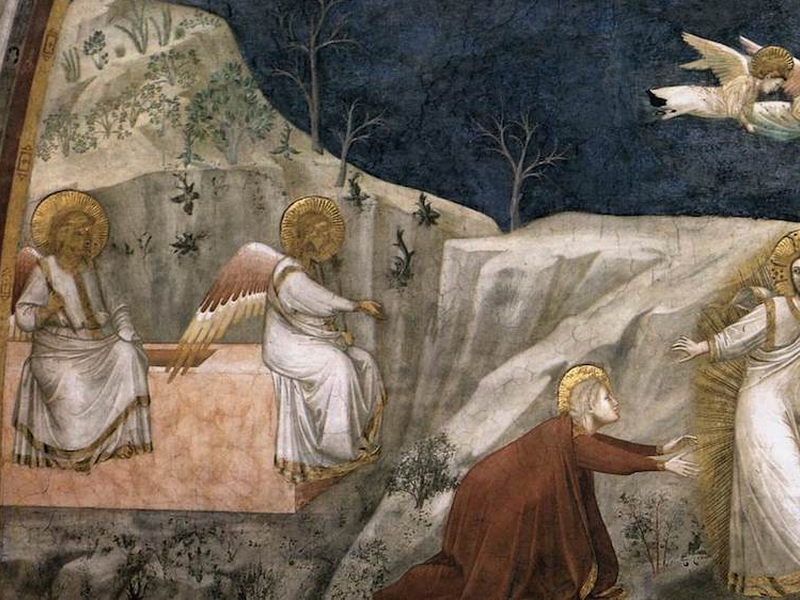
On a fresco in a chapel in Padua, Italy, there is a famous painting depicting the dramatic post-resurrection scene in John 20 with Mary and Jesus outside of the garden tomb. Giotto di Bondone painted it in the early 14th century. Jesus is striding from the tomb with a victor’s…

by Jeff MeyersApril 1, 2015

Showing page 156 of 309

See all
See all
History

Foucault’s eschatology

Berman offers this very sharp summary of Foucault’s work, whom he says is “about the only writer of the past decade who has had anything substantial to say about modernity” (Berman is writing in 1982). Then: “what he has to say is an endless, excruciating series of variations on the…

November 5, 2006
History

Flattened modernity

In the introduction to his All That Is Solid Melts Into Air , Marshall Berman argues that nineteenth century critics of modernity had a much richer grasp of the costs and promise of modernity than do twentieth century observers. Modern life is, Rousseau said, a whirlwind ( le tourbillon social…

November 5, 2006
History

Religious Liberty and the Whig Interpretation

The following is a portion of a lecture at the NSA disputatio. WHIGGISH HISTORY The Whigs were of course a loose British political alliance, the predecessor of today’s Liberal Democrats. The term was first applied, interestingly, to the Scottish Covenanters who marched on Edinburgh in 1648, and then to the…

November 3, 2006
American Religion

Innocent abroad

In a recent issue of TNR , Alan Wolfe reviewed David Kuo’s book telling the story of his service in the current Bush administration. Kuo worked in the office of faith-based initiatives, and though he left the administration he still praises Bush because of his Christian testimony. What strikes Wolfe…

November 3, 2006
History

World Cities again

Thinking again about Mike Featherstone’s comments on the fact that multiculturalism developed first in Southern Hemisphere cities (quoted in a post from September 2006), it strikes me that one of the dynamics of the current global situation is a reversal of colonialism. That’s true in the sense that Featherstone notes…

November 2, 2006
History

Mass culture

The point of theories of “mass culture” is not so much the “mass” as the “culture.” Goods and services may be distributed to a large number of people in economies where what is called “mass culture” doesn’t exist. When theorists use the phrase, they want to emphasize the fact that…

November 2, 2006

Showing page 1771 of 2212

Browse by Category

In Medias Res

Your weekly digest for all things Theopolis.

Donate

Theopolis is nearly 100% donor-supported. Consider joining us on our mission.