Theopolis Logo

Writing

Explore our collection of theological essays, biblical studies, and reflections on faith and culture.

See all
screenshot-2023-07-27-at-10-25-35-am
Federal Vision

Zacharias Ursinus & the Imputation of Christ’s Righteousnes

While I think Zacharias Ursinus’ thinking would be profitable to consider, I am not recording his reflections in order for readers to come to agreement with his position as a whole. Rather, my interest is twofold. First, I think the way the Heidelberg Catechisms is used as a “proof” of…

by Mark HorneJune 5, 2006

karsten-wurth-imegmbunara-unsplash
Covenant

Does the New Covenant have its own distinctive sanctions as well as blessings? We affirm

On this question Hebrews 10 is quite clear and really needs no additional argument. For if we go on sinning deliberately after receiving the knowledge of the truth, there no longer remains a sacrifice for sins, but a fearful expectation of judgment, and a fury of fire that will consume…

by Mark HorneMay 21, 2006
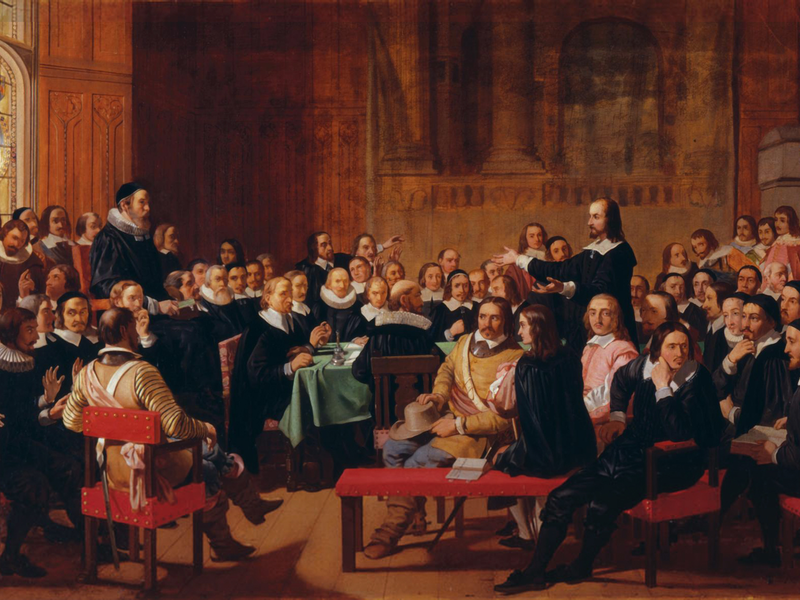
assertion_of_liberty_of_conscience_by_the_independents_of_the_westminster_assembly_of_divines_1644
Biblical Horizons

FV, NPP, PCA, AAPC, ETC.

Not all readers of this essay letter may be aware of it, but a tempest has been brewing in the Presbyterian Church in America (PCA), a tempest created by the liberal party in that denomination. It came about this way. In January 2002, a Pastor’s Conference on covenant theology was…

by James B. JordanAugust 5, 2005
screenshot-2023-09-18-at-12-32-26-pm
Biblical Horizons

The Closing of the Calvinistic Mind

Once upon a time there was such a thing as Calvinistic thought. It existed when I was younger, but seems to have largely disappeared in recent years. But let me elaborate. When I became a Calvinist, back in 1970, I bought a bunch of books. Over the next few years,…

by James B. JordanAugust 5, 2005
kelly-sikkema-ggs0_g6wi-i-unsplash
Ephesians

The Centrality of Preaching

CHRIST THE PREACHER How Ephesians Shows Us Why Preaching is Essential to Salvation & Sanctification Listen to me, O coastlands, and give attention, you peoples from afar. The Lord called me from the womb, from the body of my mother he named my name. He made my mouth like a…

by Mark HorneJune 5, 2005
screenshot-2024-04-04-at-4-49-39-pm
Baptism

Baptismal Theology Within Reformed Evangelicalism

Tracking the informal shifts in Protestant opinion regarding Baptism can be a difficult business. For example, in 1849 Anglican clergyman William Goode published his defense of Evangelicalism against the Anglo-Catholics under the title, The Doctrine of the Church of England as to the Effects of Baptism in the Case of…

by Mark HorneMay 29, 2005

Showing page 221 of 309

See all
See all

Objective/Subjective

McGrath notes that Augustine interpreted the genitive in the phrase “righteousness of God” in Rom 1 objectively, so that it was understood as the righteousness that God gives in saving sinners (in “making” them righteous). Ambrosiaster, as I pointed out in an earliet post, interpreted the genitive subjectively - the…

April 20, 2006

Old Perspective on Paul

Ambrosiaster writes, “Iustitia est Dei, quia quod promisit dedit, ideo credens hoc esse se consecutum quod promiserat Deus per prophetas suos, iustum Deum probat et testis est iustitiae eius” (PL, 17.56b). McGrath explains: “God, having promised to give salvation, subsequently gives it, and as a result is deemed to be…

April 20, 2006
History

Unfinished Reformation

Nevin wrote: “There is more a great deal in Christianity, I firmly believe, more in the idea of hte Holy Catholic Church, than has yet been attained, either in the way of knowledge or in the way of life, by the Protestant Reformation.”

April 20, 2006

Factitive Justification

There was a consensus among the theologians of Trent, McGrath argues, that justification was “factitive,” a view that excluded that “a sinner may be justified solely as a matter of reputation or imputation, while remaining a sinner in fact.” But of course that raises the question, What exactly is a…

April 20, 2006

True Lutherans

McGrath traces the odd development in Lutheran Orthodoxy of the notion that regeneration and faith precede justification in such a way that “where Luther had understood justification to concern the unbelieving sinner, orthodoxy revised this view, referring justification to the believing sinner.” This takes Lutheran Orthodoxy back in the direction…

April 20, 2006

Ontological change

McGrath notes, “While justification was universally understood to involve the regeneration of humanity, the opinion that an ontological change is thereby effected within humans is particularly associated with the period of High Scholasticism and the development of the concept of created grace. The earlier medieval theologians expressed the change effected…

April 20, 2006

Showing page 1854 of 2212

Browse by Category

In Medias Res

Your weekly digest for all things Theopolis.

Donate

Theopolis is nearly 100% donor-supported. Consider joining us on our mission.