Theopolis Logo

Writing

Explore our collection of theological essays, biblical studies, and reflections on faith and culture.

See all
25f3baab-e5a9-42ec-aab6-649e53879085-3
Revelation

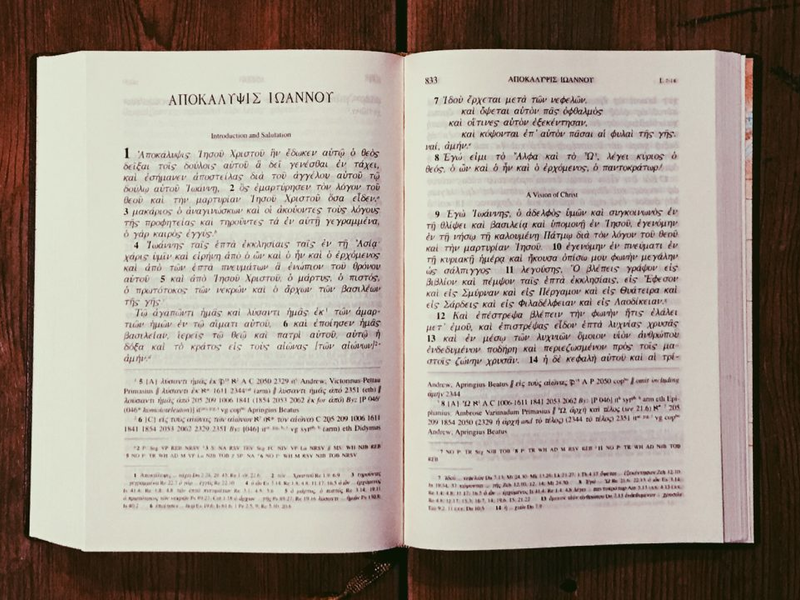
Rescuing Revelation: Part II

This is Part II of a 2-part essay. For Part 1, click HERE . Covenant context Most Bible teachers apply the teachings of Jesus and the Apostles directly to Christians today without any thought of the historical – and more importantly, legal – context. The ministry of Christ and the…

by Mike BullOctober 10, 2017

25f3baab-e5a9-42ec-aab6-649e53879085-3
Revelation

Rescuing Revelation: Part 1

Introduction The book of Revelation polarises Christians. Some become obsessed with ‘cracking its code’ while others throw it into the too hard basket. Thankfully, recent advances in biblical theology enable us to liberate this enigmatic book from both mistreatment and obscurity. The prophecy is attractive to some because of its…

by Mike BullOctober 5, 2017
aaron-burden-1ebsmyrau-s-unsplash
Biblical Theology

Abraham's Life as a Type

I'm considering the possibility that the life of Abraham as recounted in Genesis contains a typological prophecy of the history of Israel; that is, that the events in Abraham’s life broadly anticipate events in Israel’s history. This kind of pattern is seen in the case of Moses, for instance, because…

by James B. JordanOctober 3, 2017
e99a7787
Culture

Teenagers and the Smartphone Beast

According to this recent article in The Atlantic , teenage promiscuity is decreasing. Apparently there is a general "decline in dating" which also "tracks with a decline in sexual activity." The figures are startling: The drop is the sharpest for ninth-graders, among whom the number of sexually active teens has…

by Steve JefferySeptember 28, 2017
img_4660-2
Matthew

Fulfilling the First Commandment

"Jesus said to him, “‘You shall love the Lord your God with all your heart, with all your soul, and with all your mind.'" - Matthew 22:37 Jesus says that this is the most important commandment: to love God with our heart, soul, and mind. If we obey this command,…

by Lindsey TollefsonSeptember 26, 2017
david-weber-fwuo_zluhnw-unsplash
Eucharist

Strange and Glorious New Rites

At the last supper, Jesus took bread and, having given thanks, He broke it and gave it to His disciples while saying, "Take, eat, this is My body given for you. Do this for My memorial." What Jesus did was recognized by the disciples, because it took place every morning…

by James B. JordanSeptember 21, 2017

Showing page 105 of 309

See all
See all
Theology

Time and the end of actions

Why should there be a final judgment when God judges in time? Aquinas answers: “Judgment on something changeable cannot be rendered fully before its consummation. Thus judgment cannot be rendered fully regarding the quality of any action before its completion, both in itself and its results, because many actions appear…

April 6, 2006

Observations on 2 Corinthians 1

1) Verse 4 moves from the affliction of the apostles (“our”) to the comfort of “those who are in any affliction.” This movement does not depend on any similarity or identity between the affliction of the apostles and the affliction of other sufferers (though cf. v. 6b). Members of the…

April 6, 2006
Philosophy

Descartes, Meditations

A few notes on Descartes, Meditations 1-2, with lots of help from Jean-Luc Marion. Descartes’s ego cogito, ergo sum is not, Marion points out, original, at least in its form. It has origins in Augustine, who offered this response to the skeptics: “I have no fear of the arguments of…

April 6, 2006

Copernican Revolution

Some scattered thoughts inspired by comments from Chris Schlect and Doug Wilson at a faculty discussion of de Lubac today: How is it that theologians (like Norman Shepherd, Steve Wilkins, Rich Lusk, and others) who want to expunge the notion of merit from theology get accused of being “neo-nomians” and…

April 5, 2006
Theology

Surnaturel and Protestantism

Milbank asks the intriguing question of whether de Lubac’s surnaturel thesis “rather deconstructs the terms of the Schleiermacher/Barth divide.” He appears to mean that the polarization of Schleiermacher’s “intrinicism” and Barth’s “extrinicisim” is dissolved by de Lubac’s Thomist understand of nature and grace. To adopt, for the moment, an idiom…

April 5, 2006

Against Yale

Milbank contrasts de Lubac’s advocacy of patristic and medieval hermeneutics, which insists that the allegorical fulfills and completes the literal, with the Yale school, which he sees as living in “the no-man’s land of ‘history-like narrative’ which at once abolishes real history and ignores the essential allegorical underpinning of Christian…

April 5, 2006

Showing page 1862 of 2212

Browse by Category

In Medias Res

Your weekly digest for all things Theopolis.

Donate

Theopolis is nearly 100% donor-supported. Consider joining us on our mission.