Theopolis Logo

Writing

Explore our collection of theological essays, biblical studies, and reflections on faith and culture.

See all
kiwihug-l4gw27xzn1i-unsplash
Hermeneutics

Hermeneutical Polytheism

A couple of decades ago, when I was a young Reconstructionist (instead of a middle-aged post-Reconstructionist), I coined the phrase "political polytheism" to describe how modern evangelical Christians approach matters of social law and politics. Christians want the Bible for Church and family life, but turn to other gods for…

by James B. JordanJanuary 28, 1996

jan-kahanek-g3o5ztrk2e4-unsplash
Biblical Horizons

Concerning Contracts and Covenants

Gary North has from time to time taken note of some of the differences between contracts and covenants. For him, one of the most important is the oath-character of a covenant. Naturally, the English terms "contract" and "covenant" can be used with varying nuances by different writers, and their zone…

by James B. JordanJanuary 5, 1996
hebrew-manuscript-6
Biblical Studies

Rethinking the Order of the Old Testament

The Book of Chronicles is the last book in the Hebrew Canon of the Old Testament. The word "canon" means "authoritative list" when used in connection with the Bible. What we call the Hebrew Canon consists of 24 books arranged in three major divisions: the Law, the Prophets, and the…

by James B. JordanDecember 28, 1995
skyler-gerald-akljfvj5ym4-unsplash
Biblical Studies

At The Center of the Book of Kings

by: Peter Leithart and James Jordan The Book of Kings is structured chiastically, or concentrically. To see this clearly, we start in the middle and work our way outward. 2 Kings 3–7 record the central events of the ministry of Elisha. Elisha makes his first appearance in 1 Kings 19:19-21,…

by Peter LeithartNovember 5, 1995
lili-popper-lu15z1m_kfm-unsplash
Judges

Dynastic Aspirations in the Book of Judges

(The following is a supplement to my book, God’s War Against Humanism , a study of the book of Judges, available from Biblical Horizons for $20.00 – a photocopy of the original book, which is now out of print). The turning point in the book of Judges is 8:22-28. Here…

by James B. JordanNovember 5, 1995
james-coleman-orks2dpueo0-unsplash
Biblical Horizons

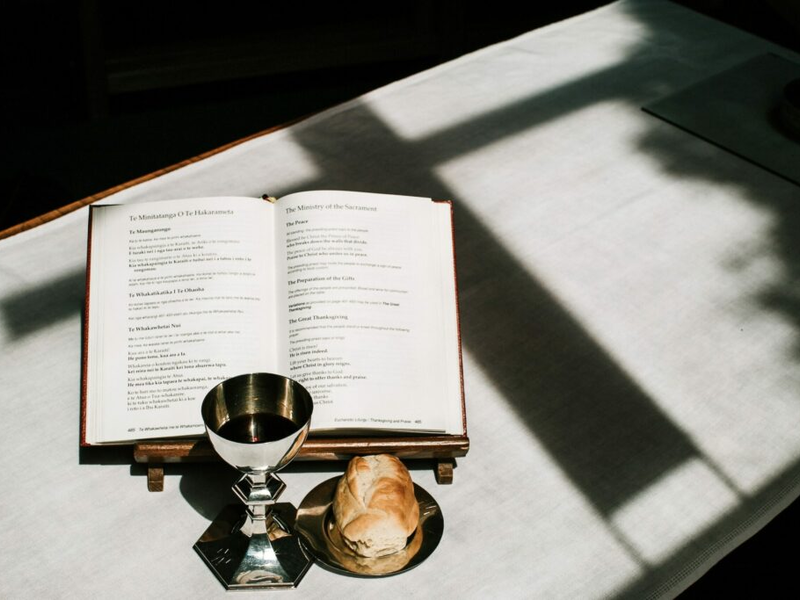
Doing the Lord’s Supper

From time to time I am asked how I think the Lord’s Supper should be done. This essay is my response to that question. To start with, we should agree that the Lord’s Supper is the only ritual we are obligated to do in the New Covenant on a routine…

by James B. JordanNovember 5, 1995

Showing page 268 of 309

See all
See all
Theology

Time and the end of actions

Why should there be a final judgment when God judges in time? Aquinas answers: “Judgment on something changeable cannot be rendered fully before its consummation. Thus judgment cannot be rendered fully regarding the quality of any action before its completion, both in itself and its results, because many actions appear…

April 6, 2006

Observations on 2 Corinthians 1

1) Verse 4 moves from the affliction of the apostles (“our”) to the comfort of “those who are in any affliction.” This movement does not depend on any similarity or identity between the affliction of the apostles and the affliction of other sufferers (though cf. v. 6b). Members of the…

April 6, 2006
Philosophy

Descartes, Meditations

A few notes on Descartes, Meditations 1-2, with lots of help from Jean-Luc Marion. Descartes’s ego cogito, ergo sum is not, Marion points out, original, at least in its form. It has origins in Augustine, who offered this response to the skeptics: “I have no fear of the arguments of…

April 6, 2006

Copernican Revolution

Some scattered thoughts inspired by comments from Chris Schlect and Doug Wilson at a faculty discussion of de Lubac today: How is it that theologians (like Norman Shepherd, Steve Wilkins, Rich Lusk, and others) who want to expunge the notion of merit from theology get accused of being “neo-nomians” and…

April 5, 2006
Theology

Surnaturel and Protestantism

Milbank asks the intriguing question of whether de Lubac’s surnaturel thesis “rather deconstructs the terms of the Schleiermacher/Barth divide.” He appears to mean that the polarization of Schleiermacher’s “intrinicism” and Barth’s “extrinicisim” is dissolved by de Lubac’s Thomist understand of nature and grace. To adopt, for the moment, an idiom…

April 5, 2006

Against Yale

Milbank contrasts de Lubac’s advocacy of patristic and medieval hermeneutics, which insists that the allegorical fulfills and completes the literal, with the Yale school, which he sees as living in “the no-man’s land of ‘history-like narrative’ which at once abolishes real history and ignores the essential allegorical underpinning of Christian…

April 5, 2006

Showing page 1862 of 2212

Browse by Category

In Medias Res

Your weekly digest for all things Theopolis.

Donate

Theopolis is nearly 100% donor-supported. Consider joining us on our mission.