Theopolis Logo

Writing

Explore our collection of theological essays, biblical studies, and reflections on faith and culture.

See all
jonathan-borba-lgj3qbhoqui-unsplash
Art

Toward a Biblical Definition of Obscenity

My copy of Webster’s New Collegiate Dictionary (1976: not so new, really) defines obscene as (1) "disgusting to the senses; repulsive" and (2) "abhorrent to morality or virtue; specif: designed to incite lust or depravity." Definitions such as this serve a useful purpose only when there is agreement on what…

by Peter LeithartMay 30, 1991
venice-la-distruzione-del-tempio-di-gerusalemme-francesco-hayez-gallerie-accademia-venice
Biblical Studies

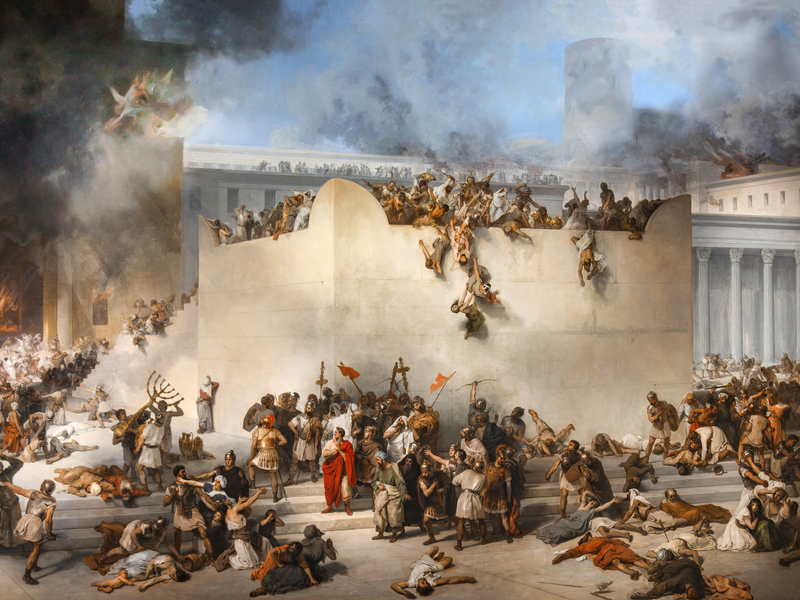
The Abomination of Desolation, Part 1

An Overview Here begins a series of studies in the Abomination of Desolation, or Desolating Sacrilege. This month and next I shall set out an overview of what I regard as the best interpretation of the phenomenon. Later essays will look at it in more detail. (The original form of…

by James B. JordanMay 22, 1991
49980-nicolas_poussin_-_the_judgment_of_solomon_-_wga18330-800w-tn
Biblical Studies

Advice From a Sojourner, Part 12

29. There are three things that are stately in their march, Even four that are stately when they walk: 30. The lion is mighty among beasts And does not turn back before any, 31. The strutting cock, The male goat, And a king with his army around him. 32. If…

by James B. JordanMay 22, 1991
tanner-mardis-xuxghzhibn4-unsplash-1-2
Biblical Studies

The Chronology of Ezra & Nehemiah, Part 4

We have seen that it is likely that the Artaxerxes of Ezra-Nehemiah is the same as Darius the Great. If this solution be correct, and I think it is, possibly there is another problem in Ezra that can be resolved by it. In Ezra 4:6 we are told that "in…

by James B. JordanMay 22, 1991
giammarco-zeh-ljawhtg-unsplash
Biblical Horizons

The Weight of Being

Czech novelist Milan Kundera, though hardly a household name in the English-speaking world, has achieved a certain notoriety in America in recent years, largely on the strength of the English translation and film version of his novel, The Unbearable Lightness of Being. 1 The Unbearable Lightness of Being — the…

by Peter LeithartMay 6, 1991
49980-nicolas_poussin_-_the_judgment_of_solomon_-_wga18330-800w-tn
Proverbs

Advice From a Sojourner, Part 11

24. Four things are small on the earth, But they are exceedingly wise; 25. The ants are not a strong folk, But they prepare their food in the summer; 26. The coneys are not a mighty folk, Yet they make their houses in the rocks; 27. The locusts have no…

by James B. JordanApril 22, 1991

Showing page 297 of 309

See all
See all
History

Modernity and antiquity

Kumar suggests that “some of the principal hall-marks of modernity” are already evident in the Christian notions of time and history. Both Christianity and modernity separate time from nature, and humanize time; time is seen by both as “linear and irreversible”; both see history as an Aristotelian drama with beginning,…

February 24, 2006
History

First Modernity

The Latin modernus was coined in the late fifth century, as an antonym to antiquus , and variations of modernus became particularly common after the 10th century. Thus, Krishan Kumar writes, “Modernity is . . . an invention of the Christian Middle Ages,” and was used to emphasize the radical…

February 24, 2006
Philosophy

Computer Communications and the Self

Poster lists four effects that computer communications (email, chat groups, etc) have on the self: “1 they introduce new possibilities for playing with identities; 2 they degender communications by removing gender cues; 3 they destabilize existing hierarchies in relationships and re-hierarchize communications according to criterio that were previously irrelevant; and…

February 24, 2006
Philosophy

Computers, subjects and objects

Descartes famously contrasted the mind (res cogitans) with the external world (res extensa), but Mark Poster suggests that computer writing fudges that distinction: “the computer dematerializes the written trace. As inputs are made to the computer through the keyboard, pixels of phosphor are illuminated on the screen, pixels that are…

February 24, 2006
Media

Community and New Communications

Mark Poster points to a tension between the modern institutions of production and the postmodern technologies of communication, particularly as they impact the formation of the self: “If modernity or the mode of production signifies patterned practices that elicit identities as autonomous and (instrumentally) rational, postmodernity or the mode of…

February 24, 2006
Media

Telephone

Prior to World War I, Telefon Hirmondo, the telephone system of Budapest, was used as a broadcast system, with a published schedule of programs that were restricted to certain classes of people in Hungary. Only later did it develop into a communications system in which everyone could pass information to…

February 24, 2006

Showing page 1878 of 2212

Browse by Category

In Medias Res

Your weekly digest for all things Theopolis.

Donate

Theopolis is nearly 100% donor-supported. Consider joining us on our mission.