Theopolis Logo

Writing

Explore our collection of theological essays, biblical studies, and reflections on faith and culture.

See all
800124htsdl
Authority

The Restrainer

When Samuel saw Saul, Yahweh answered him, "Behold, the man of whom I spoke to you! This one will restrain My people" (1 Samuel 9:17) Many English versions of 1 Samuel 9:17 read, "This one will rule over My people," but that is a mistranslation. The Hebrew verb is `atsar…

by James B. JordanDecember 4, 1992

screen-shot-2022-05-12-at-12-07-23-pm
Acts

Chronology of the Gospels

We have arrived at the tentative date of A.M. 3474 for the decree of Cyrus, and we have determined to operate as if the 70 weeks of Daniel 9 are literal years. We also decided that Messiah the Prince arrives at the beginning of the 70th week, after the 69…

by James B. JordanDecember 4, 1992
alex-shute-oz2yqcaszw-unsplash
Biblical Studies

The Dramatic Structure of Proverbs

The book of Proverbs appears as a largely random collection of aphorisms drawn from experience saturated in law. Despite its random arrangement, however, the book does have an over-arching structure that reinforces its main themes. One way to gather clues regarding the structure of a biblical book (or any book)…

by Peter LeithartNovember 17, 1992
sincerely-media-bhaswrjttzw-unsplash-2
Leviticus

Leviticus 27

I recently had the privilege and pleasure of reading the first draught of Gary North’s Economic Commentary on Leviticus , which will be out some time next year. Gary’s comments on Leviticus 27 were stimulating, and caused me to take another look at the passage. The results, which I sent…

by James B. JordanNovember 4, 1992
venice-la-distruzione-del-tempio-di-gerusalemme-francesco-hayez-gallerie-accademia-venice
Daniel

Bridging the Last Gap: Daniel’s Seventy Weeks Revisited

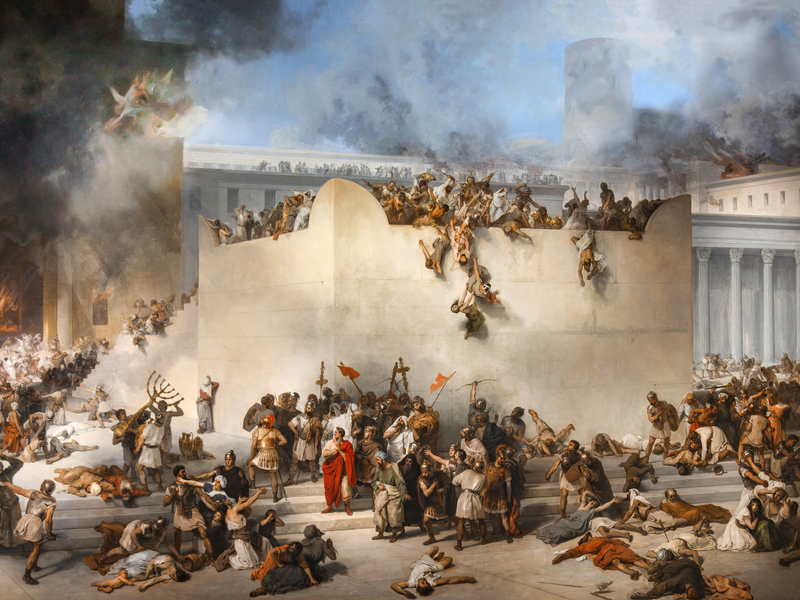
As we have seen in this series, each time there is a new covenant, there is a break in the year-by-year chronology. At the same time, each time the break is crossed by information provided in the text. Thus, the year-by-year chronology breaks down at the birth of Abraham, but…

by James B. JordanNovember 4, 1992
europeana-h-4wme4eooo-unsplash
Art

The Openness of Literature & the Mystery of Art

The Openness of Literature Let’s discuss literature for a moment. There are two ways a story or novel can close. The first is called poetic justice. When a story ends with poetic justice, the bad guys are all punished and the good guys are all rewarded. This kind of story…

by James B. JordanNovember 4, 1992

Showing page 287 of 309

See all
See all

Times

Choon-Leong Seow has some helpful comments about the “time for this, time for that” poem in Ecclesiastes 3. He points out that the thrust of the section is about God’s control of times and portions. As evidence, he notes that the word “season” us normally used “of predetermined or appointed…

January 7, 2006
Philosophy

Objectivity and incarnation

In his early work on Husserl’s treatise on the origins of geometry, Derrida highlights the critical insight that the objectivity and universality of geometric axioms depends, paradoxically, on their embodiment in writing. On the one hand, geometry is “there for ‘everyone.’” Yet, “how does geometrical ideality (just like that of…

January 7, 2006
Philosophy

The Hebraism of Postmodernism

Postmodernism, as I’ve indicated in previous posts, is many things, some of which are quite inimical to Christian faith. But in important respects, postmodernism - especially the thought of Derrida - is a Hebraic protest against Hellenized philosophy. In his fine recent book on Derrida, James KA Smith suggests that…

January 7, 2006
History

Paradox of Community

Bauman suggests that postmodernity, which is the “age of contingency fur sich,” is also the age of community. Yet, the communities that are possible within postmodern culture are inherently unstable; they are “clouds of communities”: “Such communities will never be anything like Tonnies’s cosy and unreflective (cosy because unreflective) homes…

January 6, 2006
Philosophy

Skepticism

The arguments in favor of skepticism were summarized by Aenesidemus in the first century B.C. in his Pyrrhonian Principles . Aenesidemus brought together the arguments under “ten modes” or “ten tropes,” helpfully summarized at http://plato.stanford.edu/entries/skepticism-ancient/#LPA as they were stated by Sextus Empricus. The ten modes are reproduced below. (Mates refers…

January 6, 2006

Quenching Spirit

Reflecting further on the pastoral applications of Solomon’s phrase “shepherding wind”: Every believer is born of the Spirit, and blows where he wills, and a pastor is in the business of shepherding wind. In this context, “quenching the Spirit” might refer to poor shepherding that tries to suppress the wind.…

January 6, 2006

Showing page 1902 of 2212

Browse by Category

In Medias Res

Your weekly digest for all things Theopolis.

Donate

Theopolis is nearly 100% donor-supported. Consider joining us on our mission.