Theopolis Logo

Writing

Explore our collection of theological essays, biblical studies, and reflections on faith and culture.

See all
rembrandt-main
Art

The Second Word V: On Images and Art, Part 3

The Failure of the Church Yet a third factor played an important role in this historical development, in addition to the imperial adoption of icons and the rise of the icons of the holy man. Brown writes: "The great Christian basilicas of the previous centuries tended to stand empty, except…

by James B. JordanSeptember 4, 1998
screenshot-2023-09-11-at-11-34-45-am
Biblical Horizons

Patriarchal Dominion

The three large patriarchal narratives of Genesis concern the three aspects of the cosmos: matter, space, and time. Over these three is man given dominion. Lucifer was originally appointed to train man in this dominion, but he chose to lead man into rebellion instead. Thus, the Angel of Yahweh replaced…

by James B. JordanAugust 4, 1998
trnava-university-beeyeib-am8-unsplash
Biblical Horizons

The Case Against Western Civilization, Part 6

Part 6: Living in a Dying World (continued) The "Trivium" (continued) The five stages of education are simply the five stages of the covenant as God administers it in human life and history, and in the liturgy of covenant renewal: First, God announces Himself. "I am Yahweh Your God." He…

by James B. JordanAugust 4, 1998
screen-shot-2022-05-12-at-12-07-23-pm
Biblical Studies

Re-creation in the Ascension Offering

The following essay is tentative and exploratory, offered for your consideration. It seems to me that the ritual of the Ascension Offering (incorrectly translated as Burnt Offering) of Leviticus 1 is a symbolic recapitulation of Genesis 1, which thereby portrays the sacrificial ritual as way of moving from a fallen…

by James B. JordanJuly 4, 1998
Biblical Horizons

The Framework Hypothesis: A Gnostic Heresy

Just as the vast majority of evangelical Christians in America today are Arminian and Baptist, so the vast majority do not believe in a creation around 4000 BC. I don’t expect any of these three situations to change anytime soon. Powerful presuppositions are at work in all three instances, along…

by James B. JordanJuly 4, 1998
picture-mosaic-cathedral-jesus-christ-cefalu-italy-copy
Art

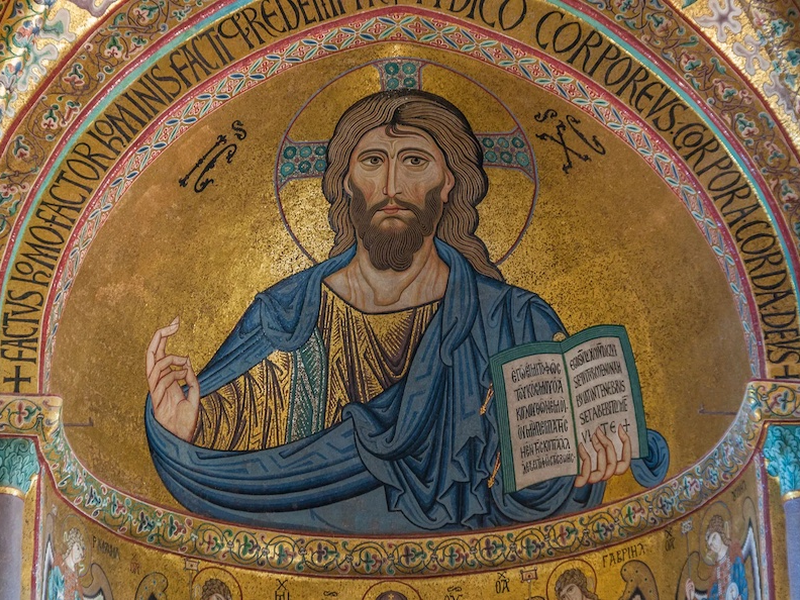
The Second Word V: On Images and Art, Part 2

The Iconoclastic Controversy Continuing Pagan Influence How did images creep in? To begin with, there was in the post-Constantinian Church a concerted effort on the part of the semi-pagans to interpret Christianity in essentially pantheistic terms. The heretics put God and man on a continuum of "being," so that God…

by James B. JordanJuly 4, 1998

Showing page 248 of 309

See all
See all

Ritual and Spontaneity

For the first 1500 years of its existence, Christianity was a liturgical faith. That began to change with Wyclif and the Hussites, and the Reformation produced permanent forms of un- and even anti-liturgical Christianity. Ceremony took on negative connotations, synonymous with hollowness and superstition. Ritual was no longer seen as…

October 13, 2015

Locusts and Honey

John the Baptist is presented in the gospels as the fulfillment of the Old Testament promise that God would send His messenger to prepare the way for the coming of the glory of the Lord (Isaiah 40), and the promise to send Elijah before Him to turn the people to…

October 12, 2015
Eucharist

Showing the Lord's Death

How does the Lord’s Supper proclaim the death of Jesus until He comes? (1 Corinthians 11:26). Historically, liturgists have attempted to locate some act in the rite of the Supper that corresponds to the death of Jesus: the fraction (breaking of bread), or the fact that bread and wine are…

October 12, 2015

Eucharistic Modalism

One of the earliest Trinitarian heresies is called “modalism.” It taught that the “persons” of the Trinity are not distinct persons, but only the masks or roles that the one Person of God adopts at various times. The fundamental problem with modalism is that it stretches out a veil, or…

October 12, 2015

Irritability and Intellect

We like to pretend our notions are the product of careful study and rational analysis. We like to pretend our likes and dislikes are deeply rooted in principle. Montaigne thought otherwise. In “An Apology for Raymond Sebond,” he wrote, “I have seen some, who without infringing their patience, could not…

October 12, 2015

From the Mouth

Four times Revelation refers to the sword that comes from the mouth of Jesus, twice at the beginning of the book (1:16; 2:16) and twice at the end (19:15, 21). Jesus' mouth-sword frames the book, and the four uses hint at His universal conquest: Jesus will extend the reign of…

October 9, 2015

Showing page 365 of 2212

Browse by Category

In Medias Res

Your weekly digest for all things Theopolis.

Donate

Theopolis is nearly 100% donor-supported. Consider joining us on our mission.