Theopolis Logo

Writing

Explore our collection of theological essays, biblical studies, and reflections on faith and culture.

See all
kristina-flour-bcjdbykwquw-unsplash
Culture

On Foul Language

The Stranger: Do you have to use so many cuss words? The Dude: What the f*ck you talking about? - The Big Lebowski There was a man I knew, an elder at his church, who, whenever he was called upon to announce a pregnancy, preferred the euphemism “with child” because…

by Remy WilkinsJanuary 12, 2016

organ-pipes
How to Worship

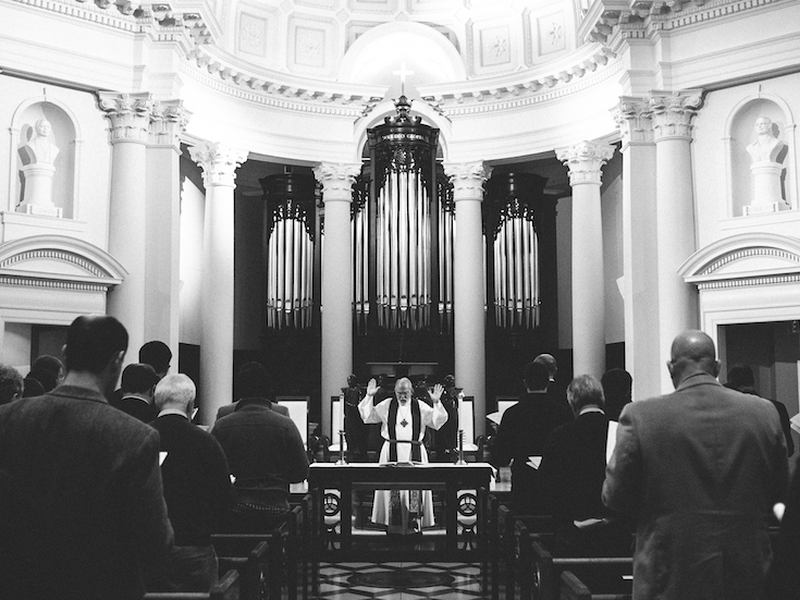
Pipes Worth Playing

I know what you’re thinking. Organ: funeral, ball game, grand dusty cathedral. Why should modern Christians of such a technological age revisit a thousand year-old instrument? Don’t worry, I will not be trying to punch another hole in my Weird Music Preferences and Opinions card here. The truth is, our…

by Jarrod RicheyJanuary 7, 2016
tree-2
James

Do Things Have Natures?

Do things have natures? As I am posing the question, it is not simply a question of whether there are particular kinds of things in the world that have characteristic features, patterns of behavior, trajectories of growth and development. If that is what the word means, then the answer is…

by Peter LeithartJanuary 5, 2016
jim-leading-worship
Theopolis News

2016 Nevin Lectures with Father John Behr

We are excited to announce our 2016 Nevin Lectures featuring Father John Behr. Fr. John is the Dean of St. Vladimir's Seminary and Professor of Patristics, as well as the author of multiple works. He will be delivering three lectures over the course of two days dealing with "What Protestants…

by Brian MoatsJanuary 4, 2016
times-square
Creation

Time, Curse or Gift?

New Year's Day makes one reflective, at least about the past year, perhaps about life, perhaps, more broadly, about time itself. Many view time as a curse. Some see it as a curse because of missed chances. As one day or year moves on to the next, all we can…

by Peter LeithartDecember 31, 2015
nativity-2
Advent

The Manger

It seems a truism to say that we live in the world: that the world is outside of us. In reality the world is very much inside of us too. In fact the world passes through us as much as we pass through it. We breathe in its air, using…

by Arthur KayDecember 29, 2015

Showing page 138 of 309

See all
See all

Cities Ascending and Descending

The Bible ends with a vision of the descent of a jeweled bridal city Jerusalem descending from heaven. Before the city descends, though. a city ascends: Babylon is destroyed and her smoke rises forever and ever. God's city descends only after the city of man is sent up to God…

August 14, 2015

Anti-Labor, Anti-Catholic

David Sehat argues ( The Myth of American Religious Freedom ) that the American moral establishment was undermined by the labor movement: “By the last quarter of the nineteenth century the corporation had joined the family, the church, and the school as an institution perpetuating Christian moral authority” (189). This…

August 13, 2015

Myth and the Fragmentation of Humanity

Paganism, writes Eugen Rosenstock-Huessy ( Christian Future ), “is best understood . . . as primitive man's response to the fear of death.” That means not only personal death but also the death of those groups to which he is bound—family, race, country. The problem is that “all finite forms…

August 13, 2015

The End For Which God Made Us

“The patristic concept of theosis is the most precise and compendious possible evocation of the end for which God creates us,” writes Robert Jenson in a characteristically dense essay in The Catholicity of the Reformation . It doesn't imply that the Creator-creature distinction is somehow erased; that difference is “indeed…

August 13, 2015

What Cantwell Achieved

David Sehat ( The Myth of American Religious Freedom , 222-3) observes that Cantwell v. Connecticut (1940) was the first Supreme Court decision to incorporate the religion clause of the First Amendment to the States. In the case, Jehovah's Witnesses were denied a license to proselytize. The Court struck down…

August 12, 2015

Creating Genocide

Emmanuel Katongole ( A Future for Africa , 98-101) argues, as others have, that the racial division behind the Rwandan genocide was forged during Western colonization. “Before the colonial occupation of Rwanda,” he writes, “the Hutu and Tutsi were not ‘clearly distinct and rigidly separated ethnic groups.'” The distinction existed,…

August 12, 2015

Showing page 390 of 2212

Browse by Category

In Medias Res

Your weekly digest for all things Theopolis.

Donate

Theopolis is nearly 100% donor-supported. Consider joining us on our mission.