Theopolis Logo

Writing

Explore our collection of theological essays, biblical studies, and reflections on faith and culture.

See all
sculptor
Art

The Artist's Litany

If we say that we have no sin, we deceive ourselves, and the truth is not in us. (1 John 1:8) O God the Father, creator of heaven and earth, Alpha and Omega, beginning and end, who inspired Creation with the breath of your nostrils, who placed Adam in the…

by Christian LeithartFebruary 2, 2016
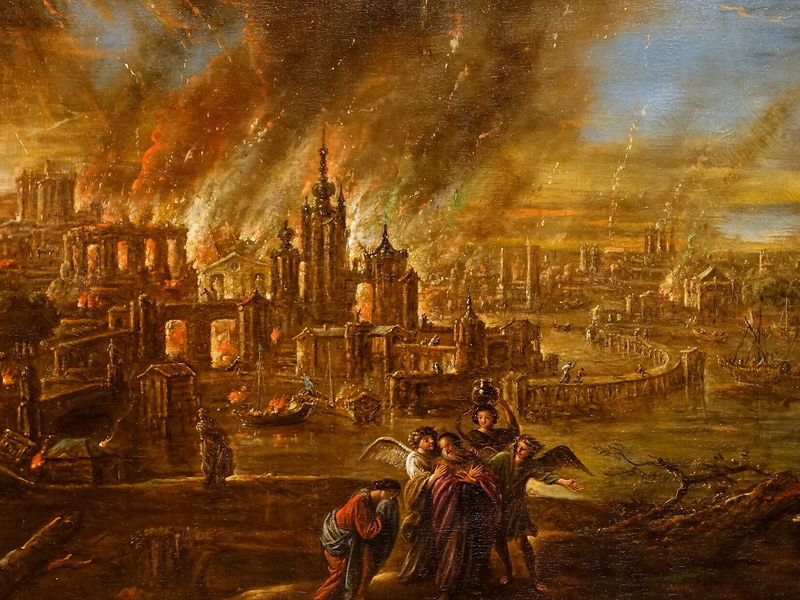
sodom_and_gomorrah_afire_by_jacob_jacobsz-_de_wet_d-_j-_probably_koln_c-_1680_oil_on_canvas_-_hessisches_landesmuseum_darmstadt_-_darmstadt_germany_-_dsc01149-e1632540497247
American Culture

American Sodom

For nearly a half-century, Sodom has been a key symbol in the American culture wars. On the one side, we have an aggressive movement among homosexuals that has first decriminalized homosexual conduct, then to force cultural and legal recognition of homosexuals as a minority and to normalize homosexual behaviors, finally…

by Peter LeithartJanuary 28, 2016
image-20150409-15244-1r08rsu
Biblical Theology

The Meaning of the Mount of Olives

Speaking of the Church, Romans 11:16-17 says, "And if the root be holy, the branches are also. But if some of the branches were broken off, and you, being a wild olive were grafted in among them and became partaker with them of the root of the fatness of the…

by James B. JordanJanuary 26, 2016
img_6134
Isaiah

No Sabbath for God

At the end of Isaiah 61, Yahweh's Servant rejoices because the Lord clothes Him with salvation and righteousness. He decks Him like a bridegroom with a garland on His head. He wears jewels like a bride. He is a new bridegroom in a new garden of Eden, a garden of…

by Peter LeithartJanuary 21, 2016
hebrew-manuscript-2
Biblical Law

Approaching the Torah

Before anything else, a word about “Torah” may be in order. I have been persuaded that “law” is a bad translation of “Torah,” even though it is evident that what is called “Torah” does have commandments, statutes, and ordinances in abundance. Why not “law?” “Law” as a translation for “Torah”…

by Ralph Allan SmithJanuary 19, 2016
jane-austen-2
Biblical Horizons

Jane Austen, Pundit

Few novelists seem as innocent of the temptation to punditry as Jane Austen. Though living through a period that witnessed the birth of an independent United States, the French Revolution and the Terror, the Napoleonic wars and the rise of revolutionary romanticism, and the upheavals of the Industrial Revolution, she…

by Peter LeithartJanuary 14, 2016

Showing page 137 of 309

See all
See all
Uncategorized

Not Monolithic

Many Protestants still think of the Catholic church as a monolithic, uniform church. It’s been a long time since Catholics have thought of the church that way. Aloys Grillmeier sums up the results of Vatican II’s embrace of communio ecclesiology: “catholicity is understood as a union of opposites. The people…

May 24, 2014

What Science Cannot Know

Nicholas Rescher argues in Unknowability that there are certain things that logically cannot be known, such as “an idea that will never occur to any human being.” Prominent among unknowables are the unknowables of science. Given the way scientific research and discovery work, it is impossible for present science to…

May 24, 2014

Can the Dead Praise?

Heaven, earth, sea: That three-decker universe is standard-issue in biblical cosmology (Exodus 20:11; Psalm 69:34; 96:11; 135:6; 146:6; Revelation 10:6). Occasionally a second heaven is added to the scheme (Nehemiah 9:6). But when the Lamb ascends to take the book, praise arises from four dimensions of creation: heaven, earth, under…

May 23, 2014

Semper, ubique, ab omnibus?

Thomas Guarino ( Vincent of Lerins ) outlines Newman’s arguments against the Vincentian canon (orthodoxy is what is taught always, everywhere, by everyone). In his Essay on Development , Newman provides historical examples “to demonstrate that the first rule is, at beast, a leaky and dubious criterion. As Newman boldly…

May 23, 2014
Uncategorized

Fresh Logic

In his preface to Receptive Ecumenism , Paul Murray explains that the “driving assumption is that if all were to be asking and acting upon this question, even relatively independently of each other, then all would be moving, albeit somewhat unpredictably, and in such a fashion as might open up…

May 23, 2014

Receptive Ecumenism in Practice

As Avery Dulles recounts it in The Catholicity of the Church , the reforms of Vatican II came partly from what Paul Murray calls “ receptive ecumenism ,” an ecumenism of attentive listening to the other. Dulles wasn’t exactly a receptive ecumenist himself. While acknowledging that “the Church can certainly…

May 23, 2014

Showing page 603 of 2212

Browse by Category

In Medias Res

Your weekly digest for all things Theopolis.

Donate

Theopolis is nearly 100% donor-supported. Consider joining us on our mission.