Theopolis Logo

Writing

Explore our collection of theological essays, biblical studies, and reflections on faith and culture.

See all
johann-siemens-epy0gbjzzzu-unsplash
Apologetics

A Sabbath Conversation: How Old is the Earth?

As Adam and Eve walked to the center of the Garden of Eden to meet with the LORD on their first Sabbath they conversed about the origin and age of the earth. Adam: You know, honey, we spent a lot of time yesterday making preparations for our house, and we…

by Jeff MeyersOctober 3, 1997

img_1043
Biblical Horizons

Psalms for Exile: The Narrative Progression in the Fifth Book of the Psalter

Some of our forefathers believed in reading/singing the psalms in order. Today, when the psalms are even used at all, they tend to be used randomly, though sometimes tied to a church calendar or to the pastor’s sermon. The Bible does not bind us to any particular practice, but there…

by James B. JordanSeptember 4, 1997
jordan-wozniak-xp_agmeea6s-unsplash-2
Biblical Chronology

The Anthropomorphic Days of C. John Collins, Part 2

Dr. Collins begins his essay with a brief statement of the Day Age view and then a brief statement of the Six Day view, focussing on the challenge to that view posed by modern "science." He ends this discussion by writing: "Two crucial points are at stake here: first, the…

by James B. JordanSeptember 4, 1997
john-salzarulo-wtjrpjzabcq-unsplash
Biblical Horizons

Paperweights and the Puzzles of Secularism

In his The Construction of Social Reality , Berkeley philosopher John Searle puzzles over the ontology of the products of human construction. Certain things – granite, platypi, weeping willows – occur naturally; while other realities – stone walls, zoos and parks, Chase Manhattan Bank – exist only as products of…

by Peter LeithartAugust 27, 1997
ales-krivec-4mibe6zg5r0-unsplash
Biblical Chronology

The Anthropomorphic Days of C. John Collins, Part 1

In the journal Presbyterion 20 (1994):109-130, published by Covenant Theological Seminary, Dr. C. John Collins sets forth a revision of the Day Age approach in his essay, "How Old Is the Earth? Anthropomorphic Days in Genesis 1:1–2:3." Dr. Collins’s essay has been widely accepted in evangelical Presbyterian circles as an…

by James B. JordanAugust 4, 1997
screenshot-2023-09-04-at-10-37-01-am
Biblical Horizons

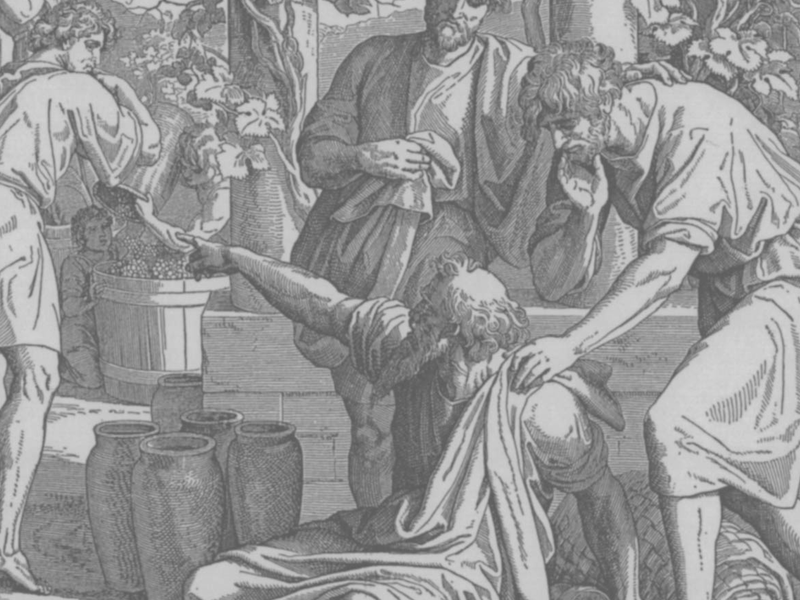
The Sin of Ham and the Curse of Canaan, Part 3 (An Exposition of Genesis 9:20-27)

The Righteousness of Shem and Japheth As noted above, the action of Shem and Japheth was purely symbolic. They did not need to cover Noah with a garment, for he was already covered by the tent. Their action was a symbolic affirmation of Noah’s authority, a symbolic rejection of Ham’s…

by James B. JordanAugust 4, 1997

Showing page 254 of 309

See all
See all

Difference

Ancient Greeks sacrificed and ate pigs and dogs. Israelites were forbidden to do so. Ancient Greeks made blood pudding from sacrifices. Israelites were not supposed to eat blood. Ancient Greeks sometimes sacrificed pregnant sows. Israelites were commanded not to take both the eggs and the hen. Greek sacrificial goats were…

April 11, 2014

Equality and Privilege

Was sacrificial meat distributed equally or hierarchically in ancient Greece? Some have resolved the question diachronically: Archaic Greece had a more democratic sacrificial distribution that democratic classical Athens. Gunnel Ekroth concludes that the two systems lived side-by-side. Choice pieces were given to dignitaries and priests, but the bulk of the…

April 11, 2014

Hold, Cold, Between

Jesus charges the Laodicean angel with being lukewarm, neither hot nor cold (Revelation 3). This is understandably and rightly taken as a symbol of their indecisiveness and lethargic piety. But there’s a whole lot more going on. Hot and cold match day and night (Genesis 8:22). “Heat of the day”…

April 11, 2014

Thoughts on 1 Samuel 17

A few scattered thoughts on 1 Samuel 17. Saul offers David his armor for battle, but David refuses (v. 39). After the battle, though, David accepts the armor of Jonathan, signifying David’s elevation to crown prince (18:1-4). David kills Goliath with a rock, trusting in Yahweh the Rock. There is…

April 11, 2014

Socially Constructed Self

By the time a child is two, he or she has developed “narrative” memory, the ability to “store” and recall events in story form. This is essential to the development of thought and self-reflection, but it is, Daniel Siegel argues, a shared, social process ( The Developing Mind , 60-1),…

April 10, 2014

Pluralist Paralysis

Millennials aren’t apathetic or lazy, argues Zachary Fine in the NYT . They are simply paralyzed, and pluralism is one of the causes. “The art critic Craig Owens once wrote that pluralism is not a ‘recognition, but a reduction of difference to absolute indifference, equivalence, interchangeability.’ Some millennials who were…

April 10, 2014

Showing page 637 of 2212

Browse by Category

In Medias Res

Your weekly digest for all things Theopolis.

Donate

Theopolis is nearly 100% donor-supported. Consider joining us on our mission.