Theopolis Logo

Writing

Explore our collection of theological essays, biblical studies, and reflections on faith and culture.

See all
e99a2191
Theopolis News

New Season & New Relationships

We have moved from death to new life, from Lenten darkness to Easter light. And while Easter Sunday may have come and gone, it's effects are continually with us. This season has brought with it several new relationships, events, and signs of growth for Theopolis. We have been networking with…

by Peter LeithartMay 9, 2016

eucharist-2
Eucharist

Social Eucharist in the Middle Ages

In The People's Work , a social history of Christian Worship, Frank Senn summarizes the developments of the medieval period with regard to the Eucharist. He begins by challenging the assumption that medieval society was held together by “the church.” He notes that the church was often divided and conflicted,…

by Peter LeithartMay 5, 2016
turing-machine
Biblical Theology

What Is Systematic Typology? Part 4: Wheels Within Wheels

The structure of the Bible resembles something which was grown rather than built, composed rather than assembled. Its employment of “structure-as-sign” at every level from micro- to macrocosmic leads to the conclusion that a hermeneutic worthy of Scripture requires not only training in history, art and music but also the…

by Mike BullMay 3, 2016
giotto-noli-me-3
Luke

Eighth Day, Eighth Verdict

For some in first-century Israel, Easter was anything but good news. It was a terrifying surprise. For the rulers and powers that put Jesus to death, the idea that He had been raised by some power beyond their control was chilling. Early in Luke’s gospel, we're told that Herod thought…

by Peter LeithartApril 28, 2016
sebastian-pena-lambarri-yv593oymkmo-unsplash
Hermeneutics

153 Large Fish

Simon Peter went up, and drew the net to land, full of large fish, a hundred and fifty-three; and although there were so many, the net was not torn. (John 21:11) This is one of those texts in the Bible that many people puzzle over. It is not a puzzle…

by James B. JordanApril 26, 2016
jesus-on-trial
Philemon

Pilate the Kingmaker

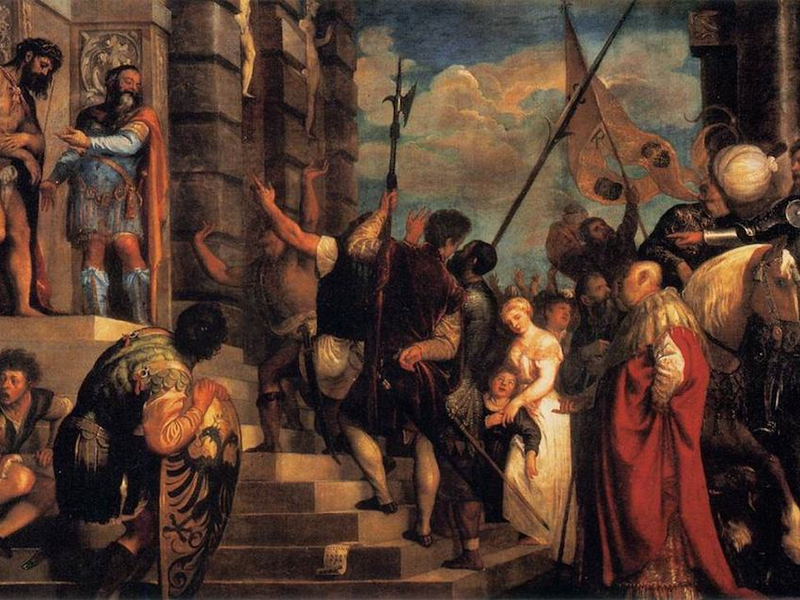
God is not mocked, Paul says. God is mocked, says Matthew. Who’s right? The two are in perfect harmony, but to see that, we need to run through the passage again. We’ll see that at every point, the mockery is being turned against the mockers. At every point, mockery is…

by Peter LeithartApril 21, 2016

Showing page 132 of 309

See all
See all

At the breast

The Torah never mentions breasts as an object of erotic fascination; they are solely nourishment for infants. In the wisdom literature, things are different. Solomon encourages young men to delight in the breasts of their wives - not of another, a strange woman (Proverbs 5) -, and in the Song…

February 14, 2013

Uncontained beauty

Solomon describes the beauty of his beloved in a neat and symmetrical poem in Song of Songs 7:1-6. Framed by “how beautiful you are” (vv. 1, 6), the poem describes ten features of her body. He starts with her feet and his gaze makes its way up. The ten features…

February 14, 2013
Literature

Books and Covers

The old adage applies in spades to the covers of Pride and Prejudice sampled in the NYTBR . Don’t judge the book by any of these covers, especially the Lady Godiva, the Twilight knock-off, and the “smokin’ bad boy Darcy” ones.

February 14, 2013

Concealed technology

Technology promises to accomplish the same things that have always been done more efficiently. Borgmann is skeptical ( Technology and the Character of Contemporary Life: A Philosophical Inquiry ) (45-46), and he summarizes George Sturt’s The Wheelwright’s Shop (Craftsman) to explain the notion of the “concealment” of technology, the fact…

February 14, 2013

Devices and Machinery

In his Technology and the Character of Contemporary Life: A Philosophical Inquiry , Albert Borgmann makes a crucial distinction between a technical device and its machinery. This is “a specific instance of the means-ends distinction” (43), the machinery being the means by which the device becomes useful to its user.…

February 14, 2013
Uncategorized

Literary Names

Claude Rawson’s review of Alastair Fowler’s Literary Names: Personal Names in English Literature focuses on names used to mock and deride. Swift, for instance, “attached enormous importance to naming and not being named (a characteristic Fowler incidentally identifies with Milton’s fallen angels). Swift scrupulously marked with an ‘X; every reference…

February 14, 2013

Showing page 795 of 2212

Browse by Category

In Medias Res

Your weekly digest for all things Theopolis.

Donate

Theopolis is nearly 100% donor-supported. Consider joining us on our mission.