Theopolis Logo

Writing

Explore our collection of theological essays, biblical studies, and reflections on faith and culture.

See all
johann-siemens-epy0gbjzzzu-unsplash
Apologetics

A Sabbath Conversation: How Old is the Earth?

As Adam and Eve walked to the center of the Garden of Eden to meet with the LORD on their first Sabbath they conversed about the origin and age of the earth. Adam: You know, honey, we spent a lot of time yesterday making preparations for our house, and we…

by Jeff MeyersOctober 3, 1997

img_1043
Biblical Horizons

Psalms for Exile: The Narrative Progression in the Fifth Book of the Psalter

Some of our forefathers believed in reading/singing the psalms in order. Today, when the psalms are even used at all, they tend to be used randomly, though sometimes tied to a church calendar or to the pastor’s sermon. The Bible does not bind us to any particular practice, but there…

by James B. JordanSeptember 4, 1997
jordan-wozniak-xp_agmeea6s-unsplash-2
Biblical Chronology

The Anthropomorphic Days of C. John Collins, Part 2

Dr. Collins begins his essay with a brief statement of the Day Age view and then a brief statement of the Six Day view, focussing on the challenge to that view posed by modern "science." He ends this discussion by writing: "Two crucial points are at stake here: first, the…

by James B. JordanSeptember 4, 1997
john-salzarulo-wtjrpjzabcq-unsplash
Biblical Horizons

Paperweights and the Puzzles of Secularism

In his The Construction of Social Reality , Berkeley philosopher John Searle puzzles over the ontology of the products of human construction. Certain things – granite, platypi, weeping willows – occur naturally; while other realities – stone walls, zoos and parks, Chase Manhattan Bank – exist only as products of…

by Peter LeithartAugust 27, 1997
ales-krivec-4mibe6zg5r0-unsplash
Biblical Chronology

The Anthropomorphic Days of C. John Collins, Part 1

In the journal Presbyterion 20 (1994):109-130, published by Covenant Theological Seminary, Dr. C. John Collins sets forth a revision of the Day Age approach in his essay, "How Old Is the Earth? Anthropomorphic Days in Genesis 1:1–2:3." Dr. Collins’s essay has been widely accepted in evangelical Presbyterian circles as an…

by James B. JordanAugust 4, 1997
screenshot-2023-09-04-at-10-37-01-am
Biblical Horizons

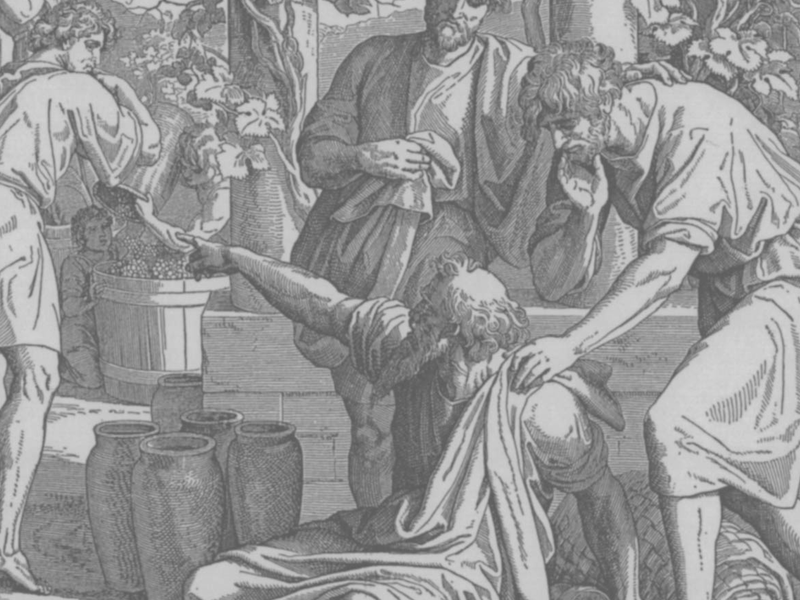
The Sin of Ham and the Curse of Canaan, Part 3 (An Exposition of Genesis 9:20-27)

The Righteousness of Shem and Japheth As noted above, the action of Shem and Japheth was purely symbolic. They did not need to cover Noah with a garment, for he was already covered by the tent. Their action was a symbolic affirmation of Noah’s authority, a symbolic rejection of Ham’s…

by James B. JordanAugust 4, 1997

Showing page 254 of 309

See all
See all
Theology

To ask is human

Hans Schaller has some profound reflections on asking in his contribution to Asking and Thanking (Concilium) , p. 3 . Disputing Seneca, he says that asking is a fundamental human form of communication, for two reasons. First, “The strength of trust, whether between God and human beings or between human…

July 6, 2012

Creation’s thanks

In his fourteenth-century Summa praedicantium, Johannes de Bromyard offers this lovely description of a creation returning thanks: “For if the flowers continuously taking in the rays of the sun ceaselessly render back bright colors and scent, it follows by a stronger reason that we who day and night constantly receive…

July 6, 2012

Where Health Care Can Happen

I offer some thoughts on the church’s response to the current debates and crises in American health care at http://www.firstthings.com/

July 6, 2012
Theology

Hospitality

Caleb Dalechamp wrote in his delightfully titled 1632 book, Christian Hospitalitie Handled Common-Place-Wise that “Hospitalitie falsely so called is the keeping of a good table, at which seldome or never any other are entertained then kynsfolk, friends and able neighbours . . . . This is no hospitalitie, though it…

July 3, 2012

Judicial poor

In the aforementioned article on giving in the early church, Neil makes this intriguing comment about the Old Testament and Jewish understanding of “the poor”: “Justice for the poor is a strong theme in rabbinic texts. Injunctions to act justly towards the poor are evident in the earliest books of…

July 3, 2012
History

Did the Early Church Help the Poor?

I n a 2010 essay on “Models of Gift Giving in the Preaching of Leo the Great” in the Journal of Early Christian Studies , Bronwen Neil answers the title question with a depressing, Not much. While the early church took over the Jewish and New Testament rhetoric on behalf…

July 3, 2012

Showing page 891 of 2212

Browse by Category

In Medias Res

Your weekly digest for all things Theopolis.

Donate

Theopolis is nearly 100% donor-supported. Consider joining us on our mission.